
Laundry Room Design Ideas: The Complete Guide to a Space That’s Actually Elegant
Most laundry rooms are designed once — during a build or a rushed renovation — and then never thought about again. That’s usually obvious the moment you walk in: mismatched storage bins, a wire shelf sagging under detergent bottles, harsh overhead light, and a floor that shows every drip. None of that is inevitable. A laundry room can be organized, durable, and genuinely elegant at the same time, and it usually takes the same handful of decisions that separate a “fine” kitchen from a beautiful one: material choice, storage logic, and a bit of restraint on color.
This guide walks through the laundry room design ideas that actually matter, in the order they pay off, with the reasoning behind each one — so you can apply the thinking to your own space instead of copying a photo that doesn’t fit your square footage.
the fastest path to an elegant laundry room is closed storage first, a durable countertop and backsplash second, and the right flooring third — in that order, since each one fixes a different reason laundry rooms end up looking cluttered or cheap. Everything below explains why, plus how to adapt it for small spaces, luxury budgets, and laundry-bathroom combos.
Why the Laundry Room Deserves Real Design, Not Just Function
Laundry rooms get treated as leftover space — whatsoever left after the kitchen, bedrooms, and bathrooms are finished. That mindset is exactly why so many feel cold and purely mechanical. An elegant laundry room doesn’t require more square footage; it requires treating the room the same way you’d treat any other room in the house — with a color plan, a material plan, and a place for everything that isn’t a folding cardboard box on the floor.
The rooms that feel best to use aren’t the ones with the most expensive machines. They’re the ones where every action — sorting, washing, drying, folding, hanging — has an obvious place to happen, and where the materials can take a splash of bleach or a dropped iron without looking ruined a year later.
How to Design a Laundry Room: Key Considerations
Before getting into individual choices, it helps to hold the whole room in your head at once. Every principle below falls under one of four considerations — the checklist a designer runs through before specifying a single cabinet.
- ✓
Durability before beauty Everything in this room gets wet, gets bumped by a laundry basket, or sits near bleach and heat. Choose finishes that can take that abuse and still look good, not just finishes that photograph well on day one.
- ✓
Storage as the organizing principleA laundry room’s biggest visual enemy is clutter left on open surfaces. Closed storage for supplies, open storage only for what’s genuinely nice to look at.
- ✓
Light that makes the work easier, not just the room prettier You need to see stains, match socks, and read care labels — this is a task room first, an elegant one second.
- ✓
A sense that it was finished, not left half-done Trim, a backsplash, a coordinated hardware finish — the small details that separate a converted closet from a real room.
Before buying anything new, walk the room and note what’s currently sitting out in the open — bottles, boxes, a stray hanger. That list is usually the real renovation plan: most laundry rooms don’t need more furniture, they need a closed home for what’s already there.
1. Choose an Elegant Palette That Won’t Show Every Splash
Color is the fastest way to make a utility room read as an elegant laundry room instead of a mechanical one, and it’s also where most laundry rooms go wrong — either too sterile (all-white, all-plastic) or too busy (a novelty print on every surface).
Anchor the room in a warm neutral base: soft white, warm greige, or a pale sage on cabinetry, with a durable satin or semi-gloss finish that wipes clean. From there, one confident accent color goes a long way — a deep navy or forest-green lower cabinet run, a black-and-white check floor, or a single wallpapered wall behind open shelving. Because the room is small, that one accent reads as a design statement rather than a distraction — this is the same logic that makes a bold powder-room wallpaper work: the smaller the room, the more a single confident choice can carry.
Test paint and cabinet finishes under your actual laundry room lighting, not the lighting in the paint aisle. Laundry rooms are frequently windowless or have a single small window, so warm-white LED bulbs (3000K) will shift how every color reads compared to daylight.
Avoid pure stark white as the only color in the room — it shows lint, hard-water spots, and detergent splashes far more than a soft warm white does, and it reads as clinical rather than elegant.
2. Layer Materials So a Utility Space Feels Considered
A laundry room that’s all plastic bins and laminate can function perfectly and still feel cheap. The fix, as in any other room, is material contrast: pair something matte with something with a bit of sheen, something soft with something hard.
A practical materials checklist, in rough order of impact:
- ✓
A durable countertop over the machines for folding — quartz or butcher block, both of which resist water and heat far better than laminate
- ✓
A patterned or textured tile backsplash behind the sink or counter — this is the single highest-impact, lowest-cost upgrade in the room
- ✓
Closed cabinetry in a furniture-grade finish rather than bare wire shelving
- ✓
A woven or rattan basket for lights/darks sorting, adding warmth against harder surfaces
- ✓
Brass, matte black, or unlacquered hardware that matches the rest of the home’s finish palette
- ✓
A durable, patterned floor that can hide the wear open shelving and bare concrete can’t
You don’t need every item at once. Start with a countertop for folding and a backsplash — those two changes alone do more for the room’s elegance per dollar than almost anything else, because they’re the two surfaces people actually look at while standing at the machines.
If you’re stretching a tight budget, our guide to DIY home decor using recycled materials covers ways to build texture and warmth without a full renovation — reclaimed wood shelving, repurposed glass jars for supplies, and fabric remnants turned into basket liners.
3. Solve Storage First (Your Highest-ROI Fix)
Of all the laundry room storage decisions in this guide, this is the one with the fastest payoff. An open room with everything visible — detergent bottles, dryer sheets, stain removers, hangers — reads as cluttered no matter how nice the paint color is. Closed storage instantly makes the room look finished, even before anything else changes.
Four storage layers, in priority order:
Detergent, bleach, and dryer sheets belong behind a door, not lined up on a shelf. This single change does more visual work than any other item on this list.
Built-in pull-out hampers, or at minimum labeled bins for lights, darks, and delicates, keep sorting from spilling onto the floor.
A stack of folded towels, a single glass jar of clothespins, one plant — open shelving only earns its place if what’s on it is worth seeing.
A retractable rod or a wall-mounted drying rack that folds flat keeps air-drying from taking over the whole room visually.
Designer Tip: If you only have room for one storage upgrade, make it closed upper cabinets. An otherwise plain laundry room with closed storage photographs and lives better than an elaborately tiled one with open shelves full of visible bottles.
4. Plan the Work Triangle: Sort, Wash, Dry, Fold
Kitchens have long been designed around a work triangle. A laundry room benefits from the same logic: the four core actions — sorting, washing, drying, and folding — should happen in a clear sequence, rather than requiring you to walk back and forth across the room every time a load moves forward.
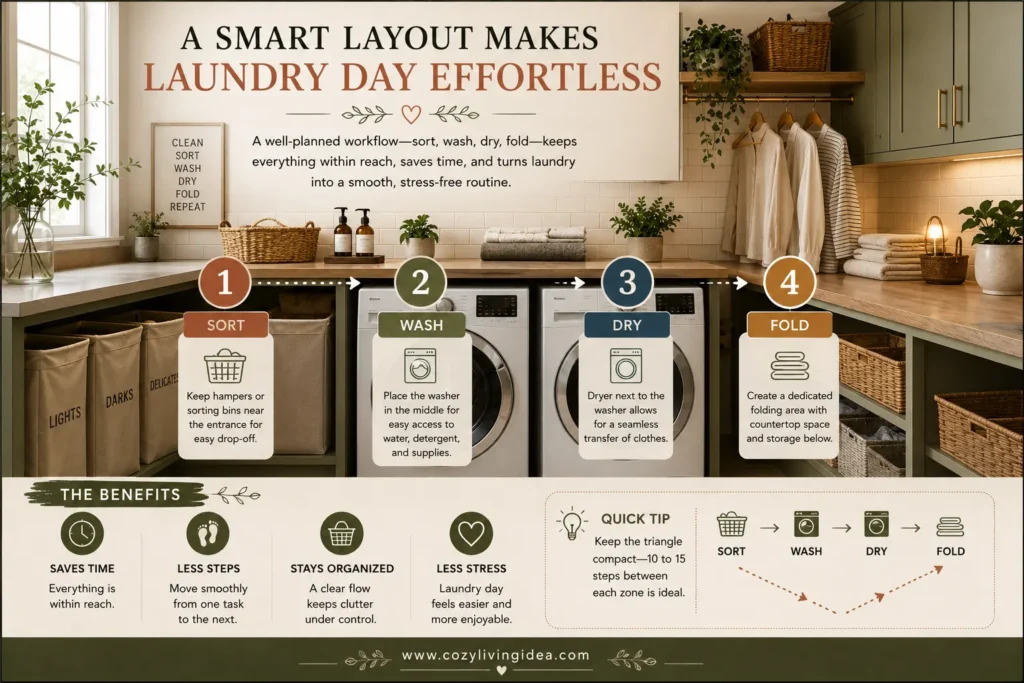
Position the hamper or sorting bins nearest the door, since that’s where laundry enters the room. The washer and dryer should sit side by side wherever possible, with a countertop bridging or sitting directly above them for immediate folding once a load is dry. If space allows, a hanging rod goes at the far end of that same counter, so items come out of the dryer, get folded or hung, and leave the room in one continuous motion rather than a zigzag.
Leave at least 42 inches of clearance in front of the machines for loading and unloading comfortably, and mount the counter at 36–39 inches — slightly taller than a standard kitchen counter — so folding doesn’t require hunching over.
5. Give the Room a Focal Point
Even a small utility room benefits from having one thing for the eye to land on, the same way a living room orients around a fireplace or a piece of art. In a laundry room, that’s almost always the backsplash or the cabinet color, since there’s rarely a window or fireplace competing for attention.
A patterned cement or ceramic tile behind the counter, run from countertop to upper cabinet, gives the room a clear visual anchor. If tile isn’t in the budget, a single bold cabinet color on the lower run — paired with a plain white or wood counter — accomplishes the same thing for a fraction of the cost. Keep everything else in the room quiet once you’ve chosen a focal point; a patterned floor and a patterned backsplash and colorful cabinets competes with itself rather than reading as elegant.
6. Get the Flooring Right
More laundry rooms lose their elegant quality to the wrong flooring than almost any other single decision, because this floor takes more water, lint, and dropped detergent than nearly any other surface in the house.
Porcelain tile is the safest long-term choice — fully water-resistant, durable, and available in patterns (like classic black-and-white checkerboard or encaustic-style prints) that read as elegant rather than purely practical. Luxury vinyl plank is the budget-friendly alternative, offering real water resistance and a wood look at a fraction of the cost and installation time. Avoid solid hardwood and most natural stone without heavy sealing — both are vulnerable to the standing water a washer leak can produce, and the repair cost outweighs the aesthetic gain.
A patterned floor is one of the few places in the house where “busy” reads as intentional rather than cluttered, precisely because a laundry room has so few competing decorative elements. It’s often the single highest-impact flooring choice you can make.
7. Luxury Laundry Room Ideas Worth the Splurge
If budget allows, a handful of upgrades move a laundry room from “nice” to genuinely luxurious. Worth prioritizing in this order:
Shaker doors, a furniture-leg detail on an end cabinet, and coordinated brass or unlacquered hardware make the room read like custom millwork rather than a big-box installation.
A deep utility basin in fireclay or stainless earns its keep for hand-washing delicates and soaking stains, and doubles as a place to wash muddy boots or rinse paint brushes.
A fold-down board built into a cabinet keeps ironing from requiring a freestanding board dragged out of a closet.
Stacked or side-by-side machines disappear behind matching cabinetry — the single most transformative luxury upgrade if your budget stretches that far, since it removes the “utility room” read almost completely.
8. Small Laundry Room Ideas That Actually Work
Small laundry rooms — closets, hallway nooks, under-stair spaces — have a real advantage: a compact footprint makes bold choices feel intentional rather than overwhelming. The goal is to commit rather than fight the size with everything scaled down.
Stack the washer and dryer instead of placing them side by side, and use the reclaimed floor space for a slim rolling cart that tucks away when not in use. Go vertical with storage — floor-to-ceiling upper cabinets draw the eye up and make the ceiling feel taller, while a slim pull-out cabinet next to the machines captures otherwise wasted space for an ironing board or drying rack.
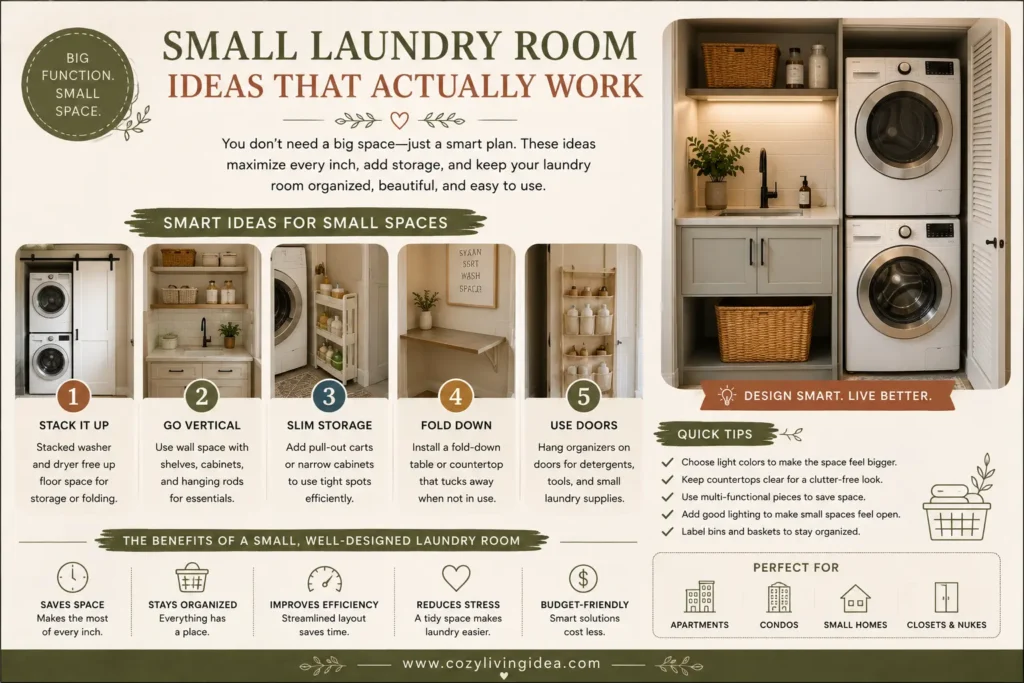
A bold wallpaper or paint color on all four walls, including the ceiling, makes a small laundry closet feel like a deliberate jewel-box moment rather than an apology for lacking space. And a fold-down counter that tucks flat against the wall when not needed keeps a truly tiny footprint from feeling cramped.
These same small-space instincts — going vertical, committing to one bold color, choosing furniture that doesn’t crowd the floor — carry over directly to other tight rooms in the house; our guide to 15 fresh ways to style an apartment bedroom covers the bedroom side of that same problem.
If your laundry space shares square footage with a compact bathroom, the section below on the laundry room bathroom combo covers layout strategies built specifically for that constraint.
9. The Laundry Room–Bathroom Combo: What Works and What Doesn’t
Combining a laundry room with a bathroom is increasingly common in smaller homes and apartments. Getting this washroom design right — one room serving two functions — can work beautifully, or feel chaotic, depending on a few key decisions.
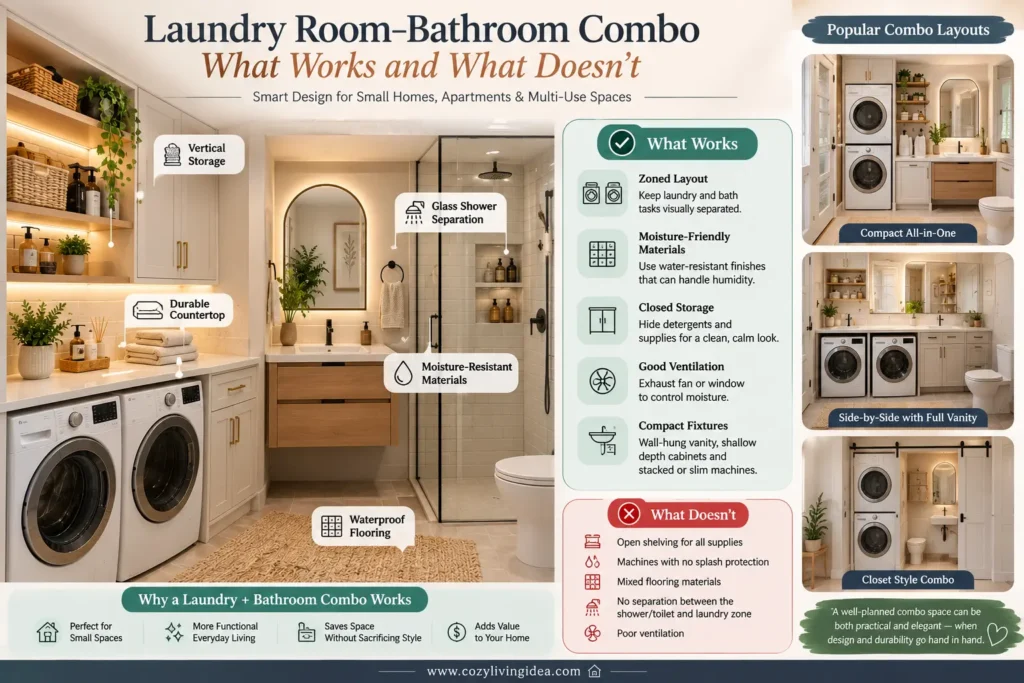
What works: Choosing one cohesive material palette for both zones, rather than treating them as two separate rooms stitched together. A single floor tile that runs from the bathroom into the laundry nook, matching cabinet finishes, and a shared color story make the combination feel planned. A stacked washer-dryer tucked into a closet with bifold or pocket doors keeps the machines visually separate from the bathroom fixtures when the doors are closed, which matters most when the space doubles as a guest bathroom.
What doesn’t work: Placing the machines directly across from the toilet or shower with no visual buffer, which makes the room feel more like a utility closet than a bathroom. Skipping ventilation planning — a washroom design that handles both moisture from bathing and heat from a dryer needs a stronger exhaust fan than either function would require alone. And relying on open shelving for laundry supplies in a space guests will also use; closed storage matters even more here, since laundry bottles sitting in view of a guest bathroom undercuts the elegance of the whole room.
If you’re planning this combination from scratch, prioritize the exhaust fan and the door treatment first — those two decisions determine whether the room reads as one cohesive space or two mismatched functions sharing a floor plan.
10. Three Laundry Room Aesthetics to Borrow From
Laundry rooms don’t have to look like an extension of the garage. A few aesthetics translate especially well to this room’s small footprint and heavy-use demands.
Classic black-and-white leans on checkerboard or encaustic-style tile floors, white shaker cabinetry, and brass hardware, in a palette that references vintage butler’s pantries. It photographs beautifully and hides scuffs surprisingly well, since the pattern itself does the visual work.
Modern minimalist pairs flat-front cabinetry in a single warm neutral with a simple quartz counter and integrated appliance panels, keeping the palette to two tones total. This style depends heavily on closed storage, since there’s nowhere for visual clutter to hide.
Cottage utility leans into open shelving, woven baskets, a farmhouse sink, and a patterned wallpaper or tile, in a palette of cream, sage, and warm wood. It’s the most forgiving of the three for a room that gets genuinely messy, since the aesthetic already expects a bit of lived-in texture.
5 Laundry Room Design Mistakes That Undo All This Work
Covered above, but worth repeating — a room with every bottle and box on display will never read as elegant, no matter how nice the tile is.
A folding counter too shallow or short to hold one full basket of laundry gets bypassed entirely in favor of piling clothes on top of the dryer.
A single flush-mount fixture creates shadows exactly where you need to see best — over the counter and sink. Add a task light or under-cabinet strip above the folding area.
Poor airflow leads to lingering damp smells and, over time, mold around the machines — a problem no amount of good styling will disguise.
A gorgeous hardwood floor or unsealed natural stone counter will not survive a washer supply-line leak. In this room, durability has to come before appearance, not after it.
Final Thoughts
None of the principles above require a full renovation to see results. If you take away one sequence to follow, make it this: solve storage first, since closed cabinets do more for the room’s appearance than any other single change; get the flooring and countertop materials right second, since those are the surfaces that take the most abuse; then layer in the backsplash, color, and finishing touches once the functional foundation is in place.
The laundry rooms that feel best to actually use aren’t usually the ones with the most expensive finishes. They’re the ones where storage, materials, and layout were solved in the right order, with a bit of restrained color and pattern layered on top. These laundry room design ideas work best tackled in that sequence rather than all at once, so give yourself permission to do the same with yours.
Once your laundry room is sorted, the same restraint-first approach — one confident color, a few good materials, storage that hides the clutter — is exactly what makes cozy living room ideas work in the rest of the house.
Save this one before your next laundry room refresh — it’s easier to follow the storage-first, materials-second, color-last order than to remember it later.
Frequently Asked Questions (FAQ)
Closed storage, a durable countertop for folding, and one confident color or pattern choice — usually a tile backsplash or a bold cabinet color — do the most work. Elegance here comes from restraint and material quality, not from adding more decor.
Porcelain tile is the most durable, fully water-resistant option and comes in patterns like checkerboard or encaustic-style prints that read as elegant. Luxury vinyl plank is a strong budget alternative with real water resistance. Solid hardwood and unsealed natural stone are best avoided, since standing water from a leak can cause lasting damage.
Stack the washer and dryer to free up floor space, go vertical with cabinetry to draw the eye up, and commit to one bold wallpaper or paint color rather than playing it safe with an all-white palette. A furniture-style cabinet front and coordinated hardware finish add a luxury feel without requiring more square footage.
Yes, if the two zones share one cohesive material palette, the machines are visually separated behind doors or cabinetry when possible, and the exhaust fan is sized for both moisture and heat. The most common mistake in a laundry room bathroom combo is placing the machines with no visual buffer from the bathroom fixtures.
At minimum: closed upper cabinets for detergent and supplies, a dedicated hamper or sorting bins, and a counter or shelf for folding. Open shelving should be reserved for a few genuinely attractive items rather than everyday supplies, since visible bottles and boxes are the fastest way to make a room look cluttered.
Yes, if space and plumbing allow it. A deep utility sink handles hand-washing, stain soaking, and rinsing muddy boots or paint brushes, tasks the washing machine can’t do on its own, and it’s one of the upgrades most associated with luxury laundry room ideas.