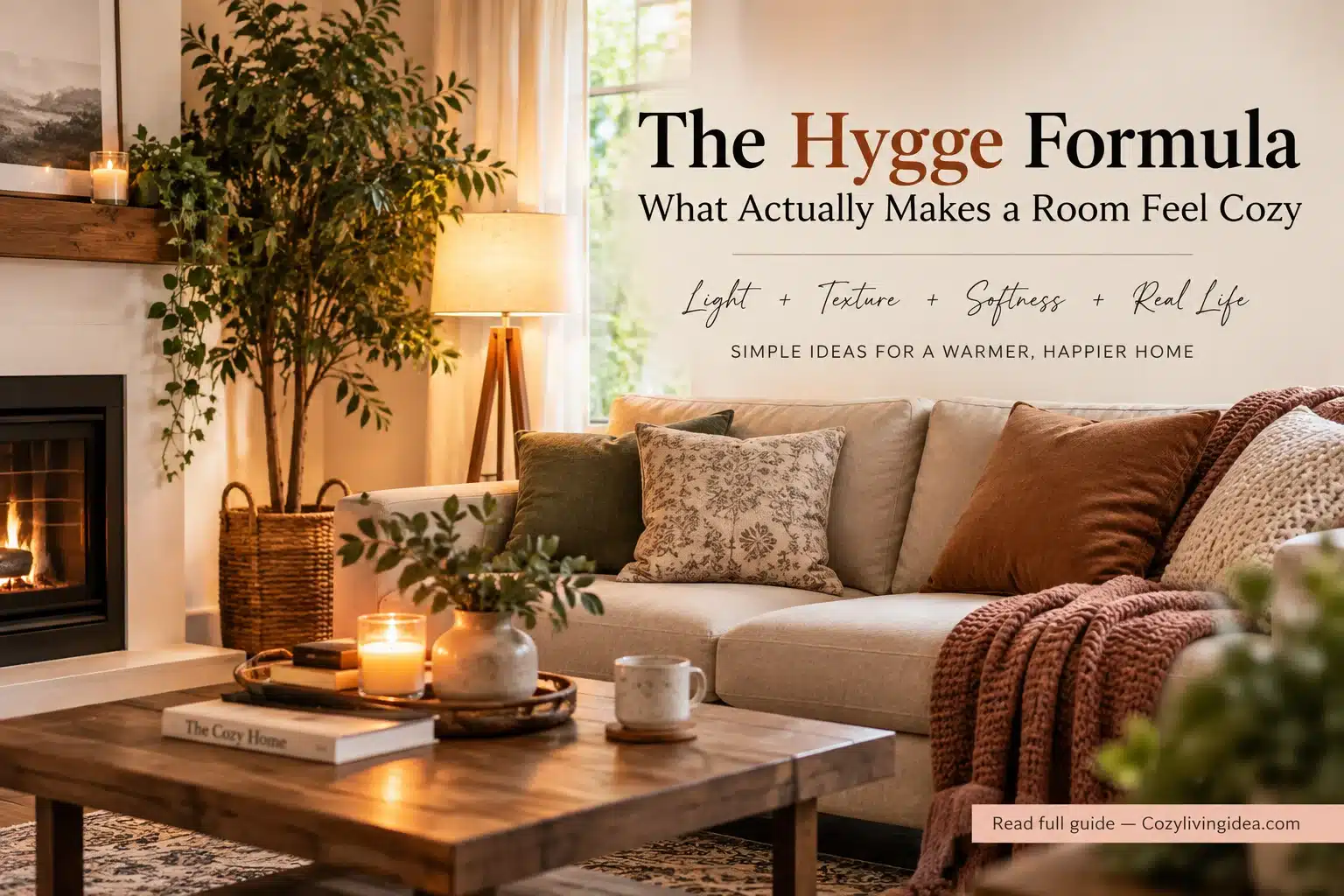
The Hygge Formula: What Actually Makes a Room Feel Cozy
Everyone can point to a room that feels cozy the second they walk in, but almost no one can explain why. It’s rarely the biggest, newest, or most expensive room in the house. More often it’s a smaller space that just feels right — warm light, a soft place to sit, and none of the stiffness of a room that’s still waiting to be lived in.
Coziness turns out to be less about any single object and more about a formula: a handful of ingredients that, combined, make a room feel like it’s holding you rather than just containing you.
Why Some Rooms Feel Warm and Others Don’t
Two rooms can have nearly identical furniture and still feel completely different. The difference usually comes down to layering rather than any one purchase — light sources at different heights, a mix of textures underfoot and at hand, and enough visual softness that the eye has somewhere gentle to land.
A room with a single overhead light, hard surfaces, and nothing at eye level reads as functional, not warm. A room with a lamp glowing at seating height, a textured throw within reach, and something soft breaking up the hard lines of furniture reads as cozy almost immediately, regardless of the furniture underneath it.
The Core Ingredients
A handful of elements show up again and again in rooms that read as genuinely cozy:
- ✓
Warm, layered lighting. Overhead light alone tends to feel clinical. A lamp or two at seating height does more for coziness than almost any other single change.
- ✓
Texture within reach. A chunky throw, a nubby pillow, a rug with some depth to it — anything that invites touch rather than just sight.
- ✓
Something soft breaking up hard lines. Furniture edges, especially in smaller rooms, can start to feel severe without a plant, a curved lamp, or rounded decor softening them.
- ✓
A sense that the room is used, not staged. A stack of books, a blanket left slightly rumpled — the small evidence that someone actually spends time there.
Of all these ingredients, greenery might be the one that does the most work for the least effort. A tall plant in the corner softens the hard geometry of a room — walls meeting at right angles, furniture with sharp edges — without adding another surface to keep clean or another decision to make about color and pattern.
It also solves a problem lighting and textiles can’t: height. A floor lamp adds warmth at eye level, and a throw pillow adds texture at seating level, but neither does much to soften the vertical space of a room the way a tall plant does.
Where Greenery Fits Into the Formula
Of all these ingredients, greenery might be the one that does the most work for the least effort. A tall plant in the corner softens the hard geometry of a room — walls meeting at right angles, furniture with sharp edges — without adding another surface to keep clean or another decision to make about color and pattern.
It also solves a problem lighting and textiles can’t: height. A floor lamp adds warmth at eye level, and a throw pillow adds texture at seating level, but neither does much to soften the vertical space of a room the way a tall plant does.
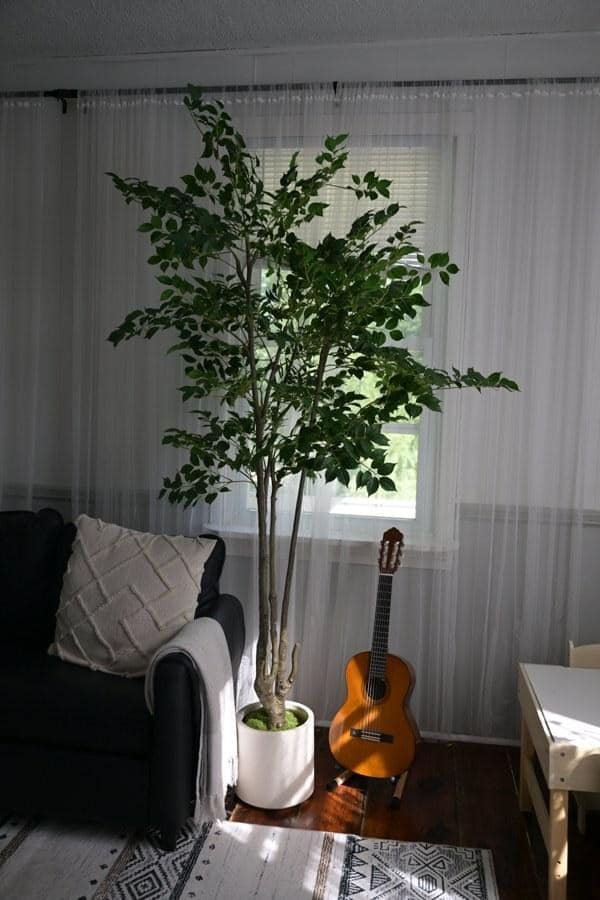
A real customer’s corner — sheer curtains, a well-loved couch, a guitar propped against the wall, and a tall tree quietly filling the space between them. Nothing about it looks staged, which is exactly the point.
Why Real Plants Complicate the Formula
Here’s the tension: live plants are one of the fastest ways to add that softness, but they’re also one of the highest-maintenance ingredients on the list. A cozy room is supposed to feel effortless, and there’s nothing effortless about a fern that needs a specific humidity level or a fiddle-leaf fig that sulks if it’s moved.
This is where a lot of people quietly split the difference — keeping one or two easy, forgiving plants for the ones they enjoy tending, and filling the harder spots (the low-light corner, the spot by the drafty window) with a well-made faux tree instead. Done well, nobody walks in and starts checking which plant is real; they just register a room that feels finished and warm.
A few home stylers going through this recently have found that a piece from a newer line like Rootless works quietly well here — the trunks have enough texture and irregularity that they don’t read as a “fake plant” so much as just a plant, which is really all a cozy room is asking for.
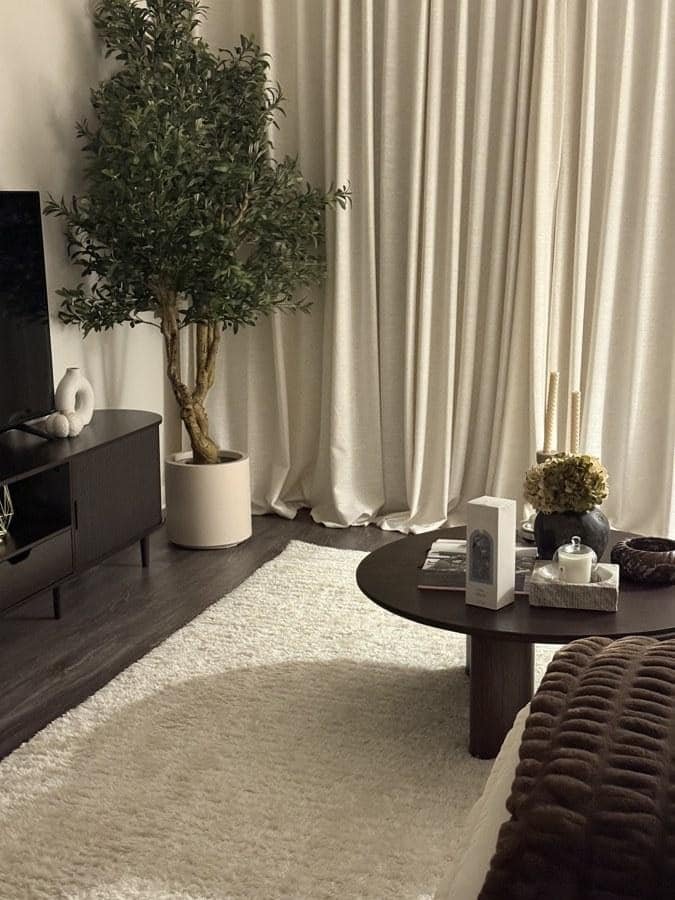
A soft rug, a low media console, a scattering of candles — and a full, textured tree anchoring the corner. This is the kind of layering that makes a room feel inhabited rather than arranged. The multi-stem look here is a small detail worth noticing — trees with more than one trunk tend to read as fuller and a little less symmetrical, which suits a room like this one.
Why This Formula Works: A Little Environmental Psychology
There’s a reason this combination of ingredients shows up in cozy rooms across completely different styles and budgets, and it isn’t just tradition. Environmental psychologists have a name for part of it: prospect-refuge theory, first proposed by geographer Jay Appleton in 1975, which holds that people feel most at ease in spaces that offer a sense of shelter — a solid wall or piece of furniture at your back — while still giving a clear view of the room in front of them.
A seat tucked against something solid, facing outward toward warm light rather than a blank wall, isn’t a coincidence. It’s the layout your nervous system is quietly looking for.
Texture and warm light do a version of the same job on a smaller scale. Soft, warm-toned light reads as evening and rest rather than daytime alertness, and touchable materials are the kind of low-level sensory input that tends to signal “safe to relax” rather than “stay alert.”
None of this requires understanding the theory behind it to benefit from it — it’s simply why the formula keeps working even for people who’ve never once thought about why a corner feels good to sit in.
Does the Formula Change With Room Size?
The four ingredients hold steady regardless of square footage, but how much of each you need does shift with the room.
- ✓
Small rooms: One well-placed lamp and one plant is often enough — in a smaller space, a single ingredient does more visual work simply because there’s less room for the eye to wander past it.
- ✓
Larger, open-plan rooms: A single lamp in the corner will look lost. Bigger spaces tend to need light and softness repeated in at least two zones — near the main seating area and near a secondary gathering point — or the room reads as cozy in one spot and stark everywhere else.
- ✓
Rooms with high ceilings: Height changes the “tallest visual gap” math. A plant that comfortably fills the gap in a standard room can look small under a much taller ceiling — in those rooms, pairing a tall plant with a piece of wall art above it usually closes the gap better than reaching for an even taller plant.
The formula isn’t more work in a bigger room, just more repetition of the same few moves.
Building the Formula in Your Own Space
None of this requires a full redecorating project. A few small, sequential additions tend to do more than one big overhaul:
- ✓
Add a lamp before adding more overhead light. Warmth comes from light sources at seating height, not from a brighter ceiling fixture.
- ✓
Bring in one piece of real texture. A textured throw or a woven basket does a lot for very little cost.
- ✓
Fill the tallest visual gap in the room. Look for the spot where the eye has nothing to land on above waist height, and put something there — a plant is usually the simplest fix.
- ✓
Leave a little evidence of use. A book left open, a blanket not quite folded — the small imperfections that separate a lived-in room from a showroom.
Common Mistakes That Undo the Formula
Even with the right ingredients on hand, a few habits quietly cancel out the effort. Buying everything at once instead of layering it in tends to produce a room that looks decorated rather than cozy.
Relying on one overhead fixture and skipping lamps entirely is the single most common miss, since no amount of texture or greenery fixes a room that’s lit like a hallway. And over-styling — fluffing every pillow, squaring every book — undoes the “used, not staged” ingredient just as fast as leaving a room bare does.
A Feeling, Not a Shopping List
It’s tempting to treat coziness as something you can buy your way into with the right lamp or the right throw, but the rooms that actually feel warm are usually the ones where a few of these ingredients were layered in gradually, in response to how the room actually gets used.
Start with the gaps that bother you most — the corner that feels empty, the light that feels too harsh — and let the room fill in from there. That’s usually a faster route to cozy than trying to replicate someone else’s living room down to the last pillow.
Conclusion
The rooms that feel effortlessly cozy aren’t accidents, and they aren’t the product of an expensive shopping list either — they’re the result of four ingredients, light, texture, softened lines, and a lived-in feel, layered in gradually, scaled to the size of the room, and left a little imperfect. Start with whichever ingredient is missing most obviously in your own space, usually the lighting, and let the rest follow at whatever pace makes sense for your room and your budget.