
Minimalist Home Decor Ideas for a Warm, Lived-In Home
Some homes make you exhale the moment you walk in. The sofa has room around it, light falls across a wooden table, and one good painting hangs where ten small ones might have been.
That’s minimalist home decor done well. It isn’t a purge or a showroom of white furniture. It’s a set of deliberate choices so the furniture, colors, and details all pull in the same direction. Good minimalist interior design feels calm because everything in the room has earned its place.
You don’t need new furniture to get there. Moving the sofa off the wall, swapping heavy curtains for linen, and clearing half a shelf can change a room more than you’d expect. The 18 ideas below show how to build a warm minimalist home that feels simple without feeling cold.
For a closer look at applying these principles to your main seating area, explore our 12 warm minimalist living room ideas, with room-specific advice on furniture, colors, lighting, and comfortable styling.
Use a soft neutral palette (cream, oatmeal, taupe) instead of stark white, plus one deeper accent color. Choose clean-lined furniture, add natural wood and layered textures, and light the room with warm 2700K lamps at different heights. Then edit what’s on display and keep a few objects that mean something to you.
What Is Minimalist Home Decor?
Minimalist home decor is an approach to decorating that prioritizes simplicity, functionality, and intentional choices. Instead of filling every corner with furniture and accessories, it focuses on a smaller selection of useful, comfortable, and meaningful pieces that work together visually.
This doesn’t mean a minimalist home has to look empty or rely entirely on white walls and furniture. Natural wood, textured fabrics, handmade ceramics, artwork, plants, and personal belongings can all have a place. The difference is that each item has a purpose, whether practical, decorative, or sentimental.
A well-designed minimalist interior balances three things: enough open space to make a room feel uncluttered, enough storage to keep everyday belongings organized, and enough warmth and personality to make the home comfortable.
Minimalist Home Decor Ideas for a Beautiful, Uncluttered Interior
You don’t need all 18 of these simple home decor ideas. Three or four done well will change how a room feels.
Give the Room a Calmer, More Cohesive Foundation
1. Create a Warm Neutral Palette Instead of Using White Everywhere

Stark white walls with gray furniture look good in photos but feel like a waiting room by evening. Warm white, cream, oatmeal, beige, taupe, and soft gray give you the same quiet backdrop with far more comfort.
Try cream walls, a beige sofa one step deeper than the walls, and light-oak furniture. To keep it from looking like one flat block, vary depth rather than hue: lightest walls, mid-tone sofa, and wood with visible grain.
Hold paint samples next to your wood furniture and check them in morning and evening light. If the undertones match (all golden or all pinkish), the room feels calm. A cream that looks right at noon can turn yellow under lamps.
2. Introduce One Deeper Color to Give the Room Contrast
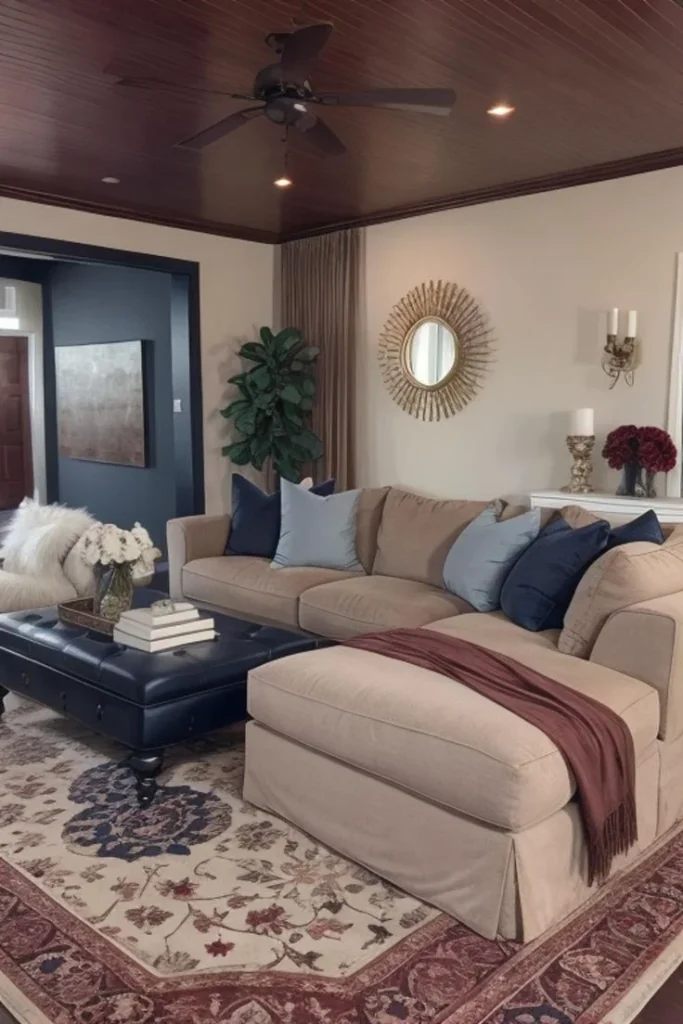
A room of only light neutrals can look washed out. One darker color gives the eye somewhere to land.
Choose charcoal, olive green, muted blue, or deep brown and put it in one main place: a single armchair, a large print, or a vase on a pale sideboard. Then echo it once in something small, like a bowl on a shelf. Scatter it across every cushion and it stops being an accent and becomes a color scheme.
3. Leave Breathing Room Around Your Furniture and Decorations

Empty space makes objects look chosen. One ceramic lamp alone on a console reads as a decision; the same lamp squeezed between a candle, a frame, and a tray is just another thing on a surface.
Leave at least one stretch of wall bare. Pull the sofa a few inches off the wall if the room allows it. As a practical starting point, aim for approximately 30–36 inches of clearance along main walking routes, but adapt the arrangement to the room dimensions, door openings, and the people using the space.
Empty space looks purposeful next to something with weight, like a big sofa. If a bare corner feels unfinished, a floor lamp or one large plant fixes it without filling it up.
4. Use Simple Window Treatments to Bring More Natural Light Inside

Heavy drapes and valances swallow light. Lightweight linen curtains, plain roller blinds, or simple Roman shades let the window do its job.
Placement matters as much as fabric. Hang the rod high, close to the ceiling, and extend it roughly 6 to 10 inches past each side of the frame. Open curtains then stack beside the glass instead of covering it, so the whole window stays clear and the room gets all its daylight.
For privacy in a bedroom, put a roller blind behind a sheer linen curtain rather than switching to thick fabric.
Choose Furniture That Makes the Space Feel Open and Comfortable
5. Choose Furniture With Clean Shapes and the Right Proportions

A plain sofa that’s too big for the room still makes it feel cramped, so scale matters as much as style.
A low-profile sofa with slim, visible legs lets you see the floor underneath, which makes the room feel larger. A slim-legged sideboard looks lighter than a cabinet that runs solid to the floor. Dining tables and chairs with simple silhouettes work the same way.
Before choosing furniture, measure the full width and depth of each piece rather than judging its size from a photograph. Mark the proposed footprint on the floor with painter’s tape and check that doors can open, walking routes remain clear, and the coffee table is comfortably reachable from the seating. A piece that fits the actual room is more important than following a fixed furniture-to-wall ratio.
6. Build Your Living Room Around One Comfortable Seating Arrangement
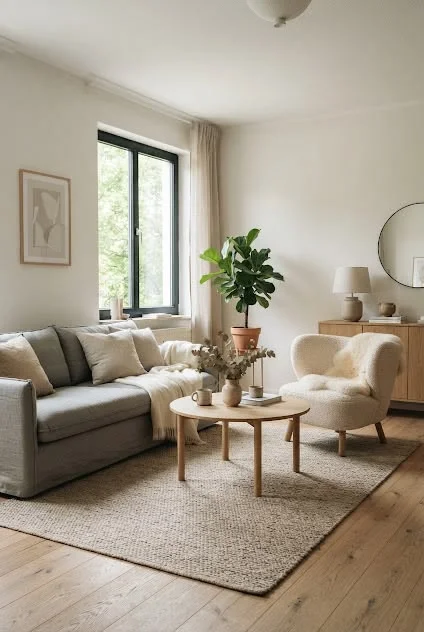
Overstuffed living rooms usually have two or three half-used seating areas competing for space. Do one properly instead.
A layout that works almost anywhere: a sofa facing a simple coffee table, one comfortable accent chair angled toward the sofa, and a side table within reach of each seat.
As a starting point, leave approximately 14–18 inches between the sofa and coffee table so people can reach the table without struggling to move through the seating area. Keep the main walking route clear as well, adjusting both distances to the furniture and available room dimensions.
Put the front legs of the sofa and chair on the same rug. It ties the group together and makes the layout look planned.
7. Make Storage Part of the Interior Design

If everyday belongings have a proper home, you don’t have to style around them.
The finish decides whether storage disappears or becomes another thing to look at. A cream built-in painted the wall color nearly vanishes, and a walnut sideboard beside a walnut dining table looks like part of one plan.
Use closed storage in busy spots like the living room and entryway, and keep open shelving for the few things you want seen. Handles should be simple or absent.
8. Use Furniture and Rugs to Define Open-Plan Spaces

You can separate zones without walls. A rug under the sofa group gives the living area a clear edge. Turning the sofa’s back toward the dining area makes a soft divider that doesn’t block light.
A pendant centered over the dining table gives that zone its own identity. Choose the hanging height according to the ceiling, fixture dimensions, and manufacturer’s installation guidance, making sure it doesn’t obstruct people’s views across the table.
What keeps it all feeling like one home is a shared palette. Use the same few colors and one or two wood tones in both zones, and the eye reads the space as connected.
Bring Warmth Through Natural Materials, Texture, and Light
9. Let Natural Wood Become a Warm Feature in the Room

Wood is the fastest way to soften a neutral room. Light oak feels fresh, walnut feels richer, and ash sits between them with a pale, straight grain.
Put it where you’ll see and touch it: coffee table, dining table, bedside cabinet, or hallway console. One or two substantial pieces do more than many small wooden accessories.
Stick to one main wood tone and one supporting tone. An oak dining table with a walnut bedside cabinet in another room is fine. Oak, walnut, cherry, and pine all in one room looks accidental. Choose pieces where the grain shows, because that variation is what reads as warm.
10. Layer Different Textures Within the Same Color Palette
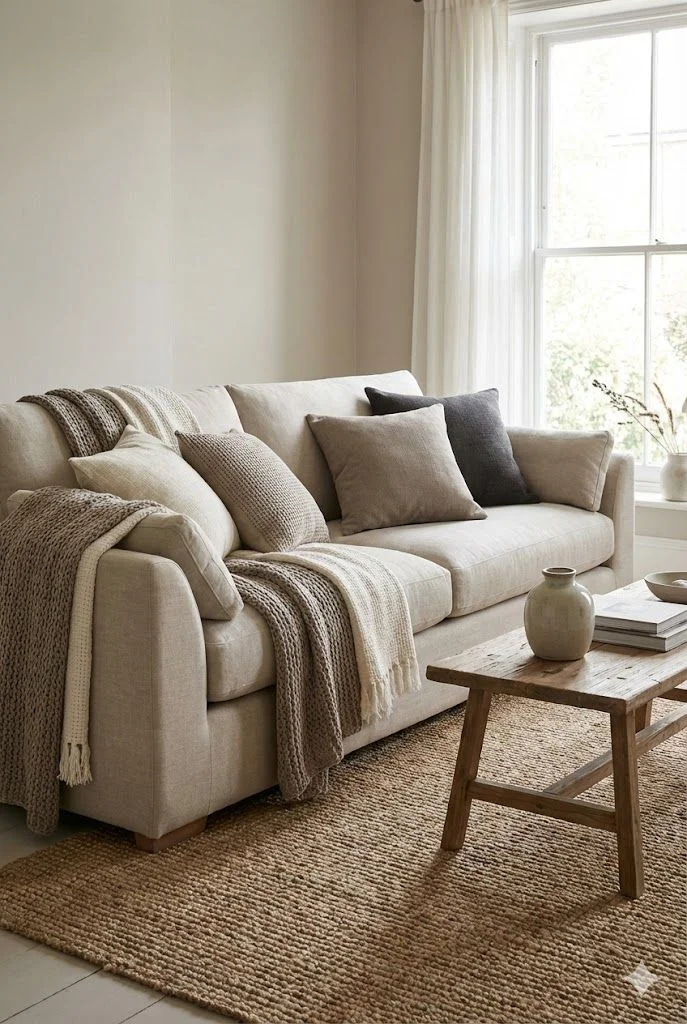
When the colors are quiet, texture gives the room depth. Think in materials within one shade family.
A working recipe: an oatmeal sofa, a chunky wool throw over one arm, linen cushions in two slightly different creams, a jute rug underneath, and linen curtains. No bold color anywhere, but your eye keeps catching different surfaces.
Try combining two or three noticeably different textures in the same seating area. A room can feel flat when its surfaces are too similar, so consider adding a woven, knitted, natural, or softly textured material before introducing another decorative color.
11. Use More Than One Type of Lighting to Create a Relaxed Atmosphere
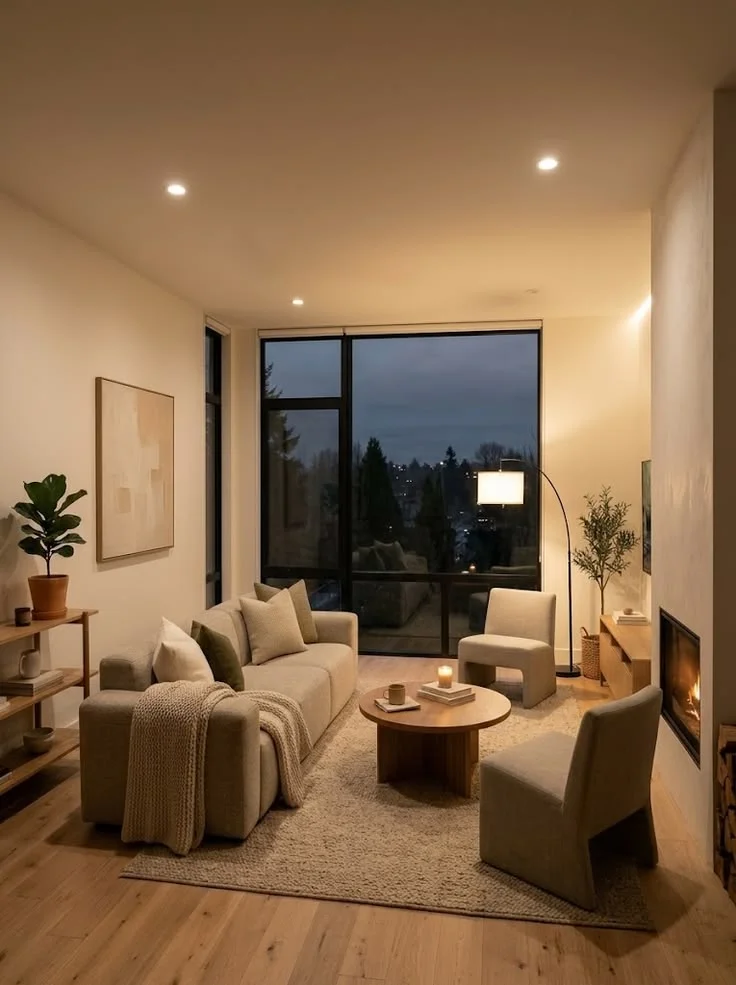
A single ceiling light makes even a lovely room feel like an office. Light from different heights is what makes it feel like home in the evening.
Combine at least three sources: the ceiling fixture (on a dimmer if possible), a table lamp on a console or side table, and a floor lamp by the sofa or armchair. Add a reading light by the bed or favorite chair.
Check the bulbs too. Warm white around 2700K is a good starting point for relaxed ambient lighting in living rooms and bedrooms. However, choose task lighting according to what the area is used for rather than forcing every light in the home to have the same specification. Keep lighting in each room visually coordinated, and consider dimmable bulbs where you want more control over the atmosphere.
If your ceiling light has no dimmer, a plug-in dimmer on a floor lamp is a cheap, no-wiring way to control the evening mood.
12. Soften Straight Lines With Curved Furniture and Organic Shapes

Minimalist rooms are full of straight edges: rectangular sofas, square shelves, flat walls. A few curves break that up.
Pick one or two: a round coffee table, a curved-back armchair, an arched mirror, a hand-thrown vase. A round coffee table also helps in tight rooms because there are no corners to bump into.
Keep the curves rare enough to stay noticeable. One curved chair, one round table, and an organic vase already give the room plenty of movement.
13. Bring a Little Greenery Into Your Home Without Overdoing It

One healthy plant looks like a decision. Six plants in six corners look like a collection. Start with one statement plant in the corner that needs it most, or two or three on a shelf or windowsill.
Choose by light, not looks. A snake plant or ZZ plant copes with dim rooms, while an olive tree or fiddle-leaf fig needs a bright window. If daylight is poor, a tall branch in a plain vase gives you the same green or sculptural shape with no upkeep.
Use matte ceramic, clay, or stone pots so the plant stays the focus.
14. Add Character With Handmade Ceramics and Natural Stone

Handmade pieces have small irregularities, like an uneven rim or glaze pooling in one spot, and that’s what gives a quiet room personality. Mass-produced decor tends to look identical from home to home.
You only need one or two. A single large handmade vase on a sideboard has more presence than a row of five matching ones. A stone bowl on the coffee table or a ceramic dish by the door for keys is decorative and useful.
Let colors lean toward your palette: sage green, chalky white, or a deep charcoal glaze all sit well with oak and cream.
Finish the Interior With a Few Meaningful Details
15. Let One Beautiful Artwork Become the Room’s Focal Point

One large piece does the work of a gallery wall without the clutter. Choose a big abstract print, a landscape photograph, a loose line drawing, or a textured canvas.
It’s also the easiest way to add color without adding objects. A muted-blue abstract above an oatmeal sofa, or a charcoal line drawing above a pale console, brings contrast and personality in one move.
Hang it with the center about 57 to 60 inches from the floor, the usual designer guide for eye level. Over a sofa, keep it low enough that the art and furniture read as a pair.
If you prefer a collection of smaller frames rather than one large statement piece, explore these corner wall gallery ideas for practical arrangements that make use of adjoining walls.
16. Style Open Shelves Without Filling Every Available Space
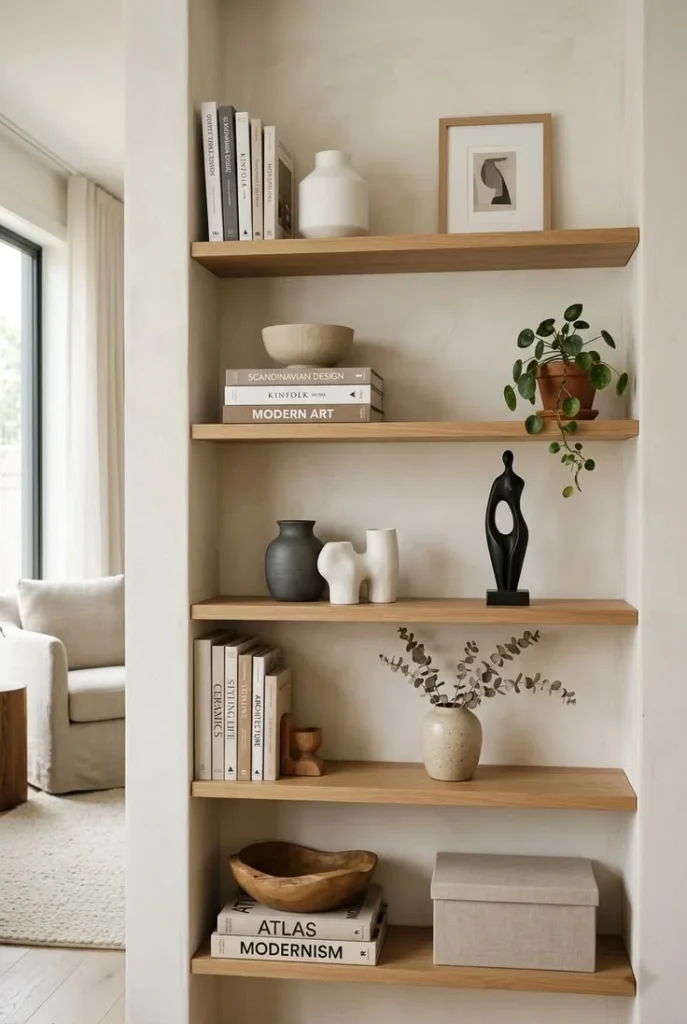
Open shelves look calm or chaotic depending on how much you load onto them. A good rule of thumb is to leave about a third of each shelf clear.
Mix a few categories: books stacked flat, a couple upright, one ceramic piece, one framed photograph. Vary the heights so the eye moves along the shelf, and leave one shelf partly empty so the display looks edited.
Each object needs enough room around it that you can see its shape.
17. Give Your Coffee Table a Simple but Interesting Arrangement

A coffee table should still hold a mug. Three things is usually enough: a book (or two stacked), a small ceramic bowl, and a low vase with a few stems or a branch.
Keep everything low so people can see each other across the table, and mix shapes: round bowl, rectangular book, short vertical vase. A plain wooden tray pulls the group together and lifts off in one go when you need the space.
Keep remotes and coasters in a drawer or basket nearby.
18. Display Personal Objects That Make the Home Feel Like Yours
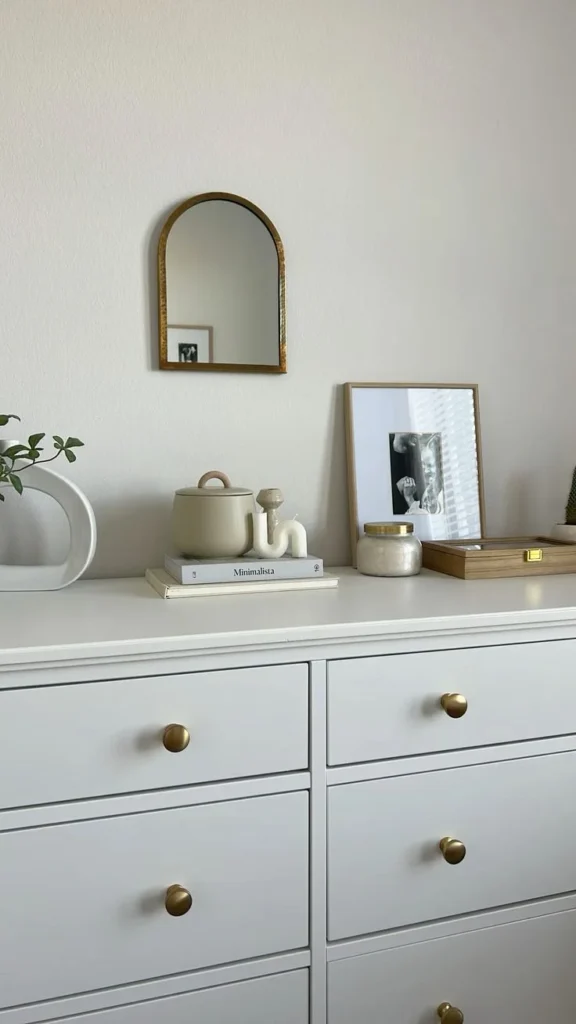
This is where minimalist home styling stops looking like a catalog. A home with nothing personal in it feels like a rental, however well arranged.
Choose a few things with a story: a framed photograph, a travel souvenir, a handmade piece from a friend, a family keepsake. Give each its own spot instead of crowding them together, such as a photo with a generous mat on the console or a hand-painted bowl on the bookshelf.
If you own a lot of sentimental items, rotate them. Show three or four, store the rest, and swap in a few months. They stay meaningful because you see them freshly.
See How Minimalist Home Decor Comes Together in Different Rooms
These examples show how several ideas combine into a finished room.
A Living Room That Feels Comfortable Rather Than Empty
Picture a warm neutral sofa on a jute rug, a light-oak coffee table in front, a floor lamp with a linen shade at one end, and one large abstract print on the wall. Add one olive-green cushion and a throw. The table holds only a book and a stone bowl.
It works because of placement. The sofa is angled into the room instead of pushed flat to the wall, the lamp gives warm light at seat height, and the art gives the eye a resting place. That’s minimalist living room decor that feels welcoming because every piece is comfortable and nothing competes.
A Bedroom Designed for Rest and Simplicity
For minimalist bedroom decor, start with the bed. An oatmeal upholstered frame with linen sheets, a cotton duvet, and one wool or waffle-weave blanket at the foot gives you texture without any other decoration.
Add slim bedside tables with ceramic lamps on warm bulbs, ideally dimmable. Put storage on one side of the room, such as a low dresser or built-in wardrobe in the wall color so it fades away.
Skip the pile of decorative pillows. Two sleeping pillows and one lumbar cushion are enough.
A Kitchen With Clear Counters and Functional Details
Minimalist kitchen decor is mostly about counters. Keep out only what you use daily: the kettle or coffee machine, one jar of utensils, and a chopping board you like looking at.
A wooden board leaning against the backsplash adds warmth. Matching glass or ceramic jars for flour, sugar, and pasta tidy up mismatched packaging. Choose simple bar pulls, and let one small plant or bowl of fruit be the only decoration.
Everything else goes behind a door, so cooking gets easier too.
An Entryway That Feels Organized From the Moment You Walk In
A slim console or floating shelf holds a catchall tray for keys, with a round mirror above it to bounce light around. Underneath, a low bench or closed shoe cabinet keeps shoes out of sight, and two or three wall hooks take coats and bags.
That covers the daily mess without anything on the floor. Add a plain doormat and a single plant or branch, and a small entrance feels calm and larger than it is.
How to Make Minimalist Home Decor Feel Warm Instead of Cold
If your minimalist room still feels stark, one of these four things is usually missing. The warm approach is getting plenty of attention: Homes & Gardens reports that designers are leaning toward lived-in minimalism built on soft, nature-inspired tones.
Too many cool whites and grays. Cool shades read as clinical, especially in rooms with little sun. Swap in warm whites, cream, mushroom, or soft taupe and the same room feels more welcoming.
No tactile contrast. If every surface is smooth, the room feels cold to the eye. Pair a smooth wooden table with a wool throw, a glazed lamp base with a linen shade, and a rough jute rug.
No personal details. Photographs, art you love, and objects with a story are what make a home look lived in.
Comfort came second. Choose a sofa you want to sink into, lighting you can read by, and furniture that works daily. A chair that looks good but hurts to sit in ends up as a coat rack.
Example: Take a beige living room with a white wall, a sofa, and a glass coffee table. Add a jute rug under the sofa, replace the glass table with an oak one, put a lamp with a 2700K bulb in the corner, and hang one large piece of art you love. Nothing else changes, but the room now has texture, wood, soft light, and something personal.
Minimalist Home Decor Ideas for Small Spaces
Minimalist decor for small spaces is about keeping floors, walls, and surfaces as open as possible while everything you need still has a home.
- ✓
Choose furniture with visible legs and a light profile. Seeing the floor under the sofa, sideboard, and bed makes the room read as larger.
- ✓
Move things onto the wall. Wall-mounted shelves and sconces free floor and side-table space. A floating shelf can replace a bookcase, and a plug-in wall light can replace a table lamp.
- ✓
Buy pieces that do two jobs. Nesting tables tuck away, and a storage bench gives you a seat and a place for blankets or shoes.
- ✓
Use one palette across connected spaces. When the living room, hallway, and kitchen share three or four colors, the eye doesn’t stop at each doorway.
- ✓
Skip the collection of small decor. A dozen tiny objects read as noise. One large object does more in a small room than ten little ones.
Example: refreshing a small living room without replacing the sofa. Say you have a 72-inch gray sofa, a dark TV stand, and a crowded bookcase.
Replace heavy curtains with linen ones hung near the ceiling so the window looks taller.
Swap the bulky coffee table for a small round oak one, about 24 to 30 inches across for a sofa this size.
Clear the bookcase to about a third full and stack the books you love.
Add one natural-fiber rug in a warm shade to anchor the seating area.
Hang one large artwork above the sofa and put a warm lamp in the corner.
7 Minimalist Home Decorating Mistakes to Avoid
Minimalist decorating can look simple in photographs, but a few common decisions can make an actual home feel uncomfortable, unfinished, or difficult to maintain.
1. Using Only Stark White and Cool Gray
A limited palette doesn’t have to mean using only white and gray. Combine warmer neutrals, natural wood, and a carefully chosen deeper accent to create more visual depth.
2. Removing Too Many Personal Belongings
A home can become visually empty when every photograph, book, keepsake, and decorative object is removed. Keep the items that carry personal meaning and give them enough space to stand out.
3. Buying Furniture Before Measuring
A beautifully designed sofa or storage cabinet can still overwhelm a room if its dimensions are wrong. Measure the available footprint, doorways, and walking routes before purchasing.
4. Ignoring Everyday Storage
Minimalist rooms still need somewhere for cables, paperwork, electronics, toys, and daily essentials. Include practical closed storage instead of expecting every surface to remain permanently clear.
5. Depending on One Overhead Light
A single ceiling fixture often creates flat lighting. Combine ambient lighting with practical table, floor, or task lamps to make different parts of the room more comfortable to use.
6. Filling Every Empty Surface
A bare section of wall or an empty part of a shelf doesn’t necessarily need decoration. Add something only when it improves the function, balance, or personality of the room.
7. Choosing Appearance Over Comfort
A minimalist room should still support everyday activities. Check seating comfort, storage accessibility, lighting, and furniture usability before prioritizing appearance alone.
Minimalist Home Decor on a Budget: Small Changes That Make a Big Difference
Minimalist home decor on a budget is mostly about decisions, not shopping.
Refresh the Room Without Buying New Furniture
Pull the sofa off the wall, angle the armchair toward it, and see how the room feels. Remove anything without a purpose, like the extra side table or the chair nobody sits in. Edit surfaces down and clear a walking path. It costs nothing and often beats any purchase.
Spend a Little on the Details That Matter
If you do buy something, choose what people see and touch: plain cushion covers in two shades of cream, linen-look curtains, one well-designed table lamp, a textured rug, or matching storage baskets.
Pick one or two. A single good lamp changes the evening mood of a whole room, while six cheap accessories mostly add clutter.
Invest in One Piece That Changes the Entire Room
With more to spend, put it into one anchor: a well-proportioned coffee table, a good armchair, a statement light, or a simple storage cabinet. The rest of the room can stay modest because that piece sets the tone. Wait for the right one, because a piece that fits is worth more than three that nearly do.
Avoid Buying Decorations Just to Fill Empty Space
A bare shelf or wall isn’t a problem to solve. Before buying, ask whether it serves a purpose and whether it adds something meaningful. If both answers are no, leave the space alone.
Final Thoughts on Minimalist Home Decor
Minimalist home decor works when the home feels comfortable, functions for the way you live, and is arranged with care. It isn’t a test of how little you can own.
You don’t need to redo every room or part with things you love. Start with one area: improve the furniture arrangement, bring in a natural material, or choose a few pieces that mean something to you.
What makes minimalism worth the effort is simple: with less in the way, there’s more room for the things that matter.