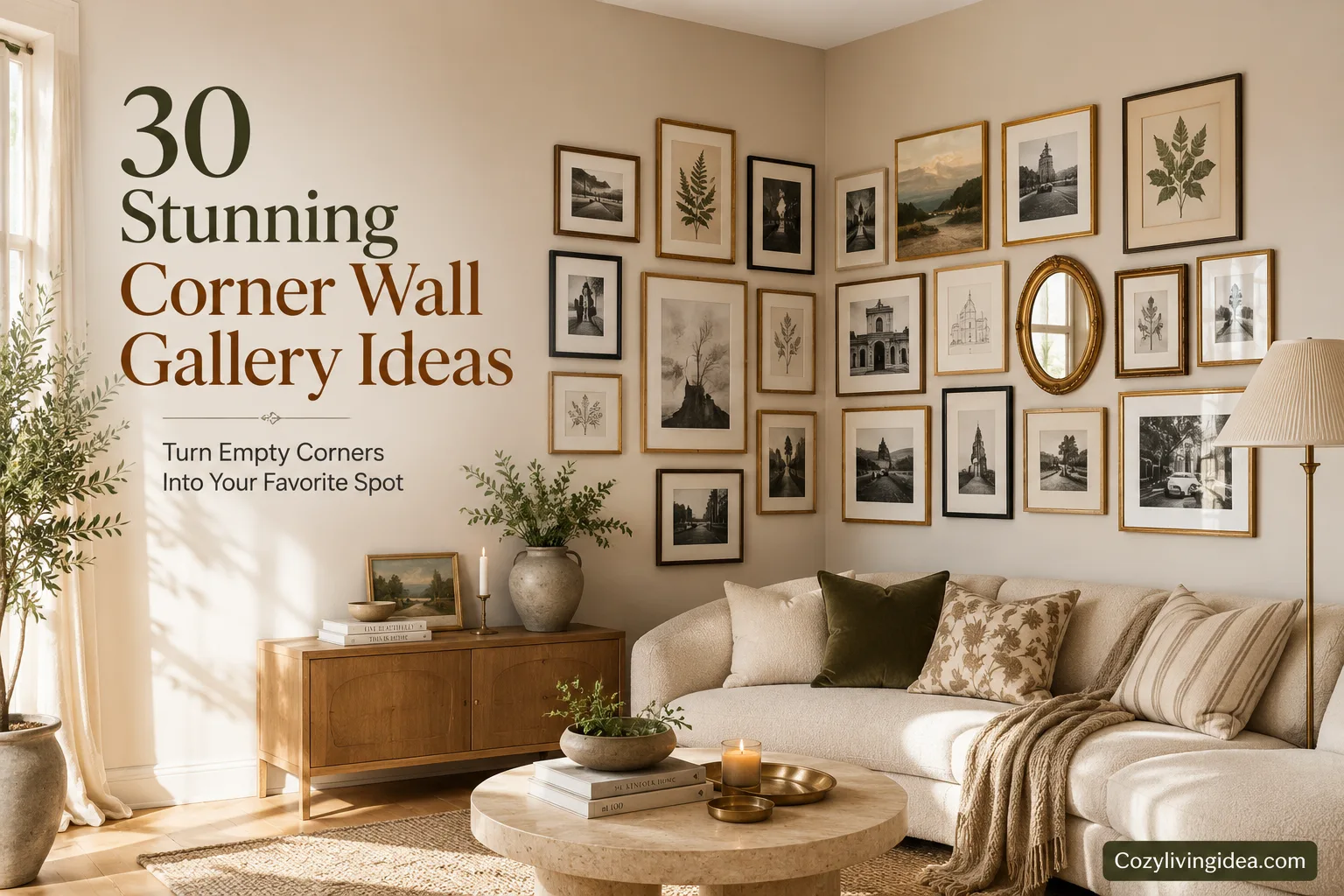
Corner Wall Gallery Ideas: 30 Ways to Style Any Corner
Every home has one: the corner nobody quite knows what to do with. Too narrow for furniture, too awkward for a single framed print, so it just collects a lamp and a dead plant. That corner is actually one of the best spots in the house for a gallery wall, because it gets you 2 sightlines instead of 1. Good corner wall gallery ideas treat that seam between the walls as a feature, not an obstacle — the frames turn the corner with the room instead of stopping at it.
This guide walks through the layout rules specific to corners, then breaks down corner wall gallery ideas by style — vintage-inspired, eclectic, simple, and photo-driven — plus a full weekend plan so you’re not guessing where to put the first nail.
The best corner wall gallery ideas treat both walls as one continuous composition rather than two separate ones. Keep spacing between frames consistent at 2–3 inches, center the whole arrangement at 57–60 inches from the floor, and leave 3–6 inches of breathing room right at the corner seam so the two sides read as a matched pair instead of two collisions.
What Makes a Corner Different From a Flat Wall
A flat-wall gallery only has to solve for one thing: balance across a single plane. A corner has to solve for two planes meeting at an angle, which is exactly why so much generic gallery wall advice falls apart the moment you try to apply it here. Before picking a style, it helps to understand the handful of rules that are specific to corner wall gallery ideas.
The corner gap rule. Don’t push a frame right up against the point where the two walls meet — it looks pinched, and it’s usually where the drywall is least even. Leave 3 to 6 inches of open space on either side of the seam. That gap becomes the visual hinge that tells your eye the two walls are working together, not competing.
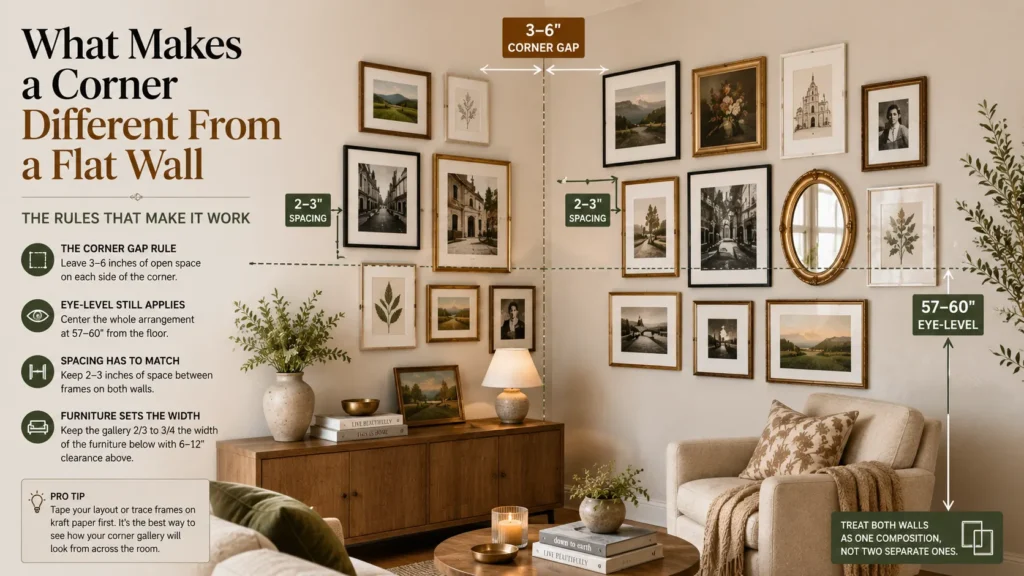
Eye-level still applies. Interior designers and museums both anchor art around a 57 to 60-inch center line, measured from the floor to the middle of the whole arrangement — not the middle of each individual frame. It’s the same eye-level math Apartment Therapy walks through for a single piece, just applied to the whole footprint. In a corner, treat both walls as one arrangement and find that center line across the full footprint, not on each wall separately.
Spacing has to match on both sides. Whatever gap you choose between frames — most corner wall gallery ideas land between 2 and 3 inches for a tight, cohesive feel — use that exact same gap on both walls. A grid that’s snug on one side and loose on the other is the single fastest way to make a corner gallery wall look like an accident.
Furniture sets the width. If your corner sits above a console, reading chair, or the end of a sectional, keep the total width of the arrangement to about two-thirds to three-quarters of the furniture’s width, and leave 6 to 12 inches of clearance above it. Anything wider looks like it’s floating past its anchor — if you’re still working out furniture placement in the room itself, our small apartment living room layout guide has room-by-room measurements to check before you commit to a corner.
Before a single frame goes on the wall, tape the whole layout out in painter’s tape or trace the frames onto kraft paper and stick that up instead. It’s the only way to actually see how a corner photo gallery wall will read from across the room before you commit to nail holes.
5 Layout Formats That Actually Work in a Corner
Once the rules are set, the format is what actually gives a corner wall gallery its personality. These 5 show up again and again in the best corner wall gallery ideas, and each one solves a slightly different kind of corner.
The Wrap-Around Grid. A tight, evenly spaced grid that turns the corner and continues at the exact same rhythm on the second wall. This is the format to reach for when your two walls are close to the same width — it reads as one uninterrupted picture gallery wall rather than two separate groupings, which is what makes it feel so deliberate.
The Vertical Column Stack. One narrow column of frames climbing straight up each wall, meeting at the corner. Works especially well in tight hallway corners or beside a doorway, since it draws the eye up instead of out and doesn’t need much horizontal room to feel complete.
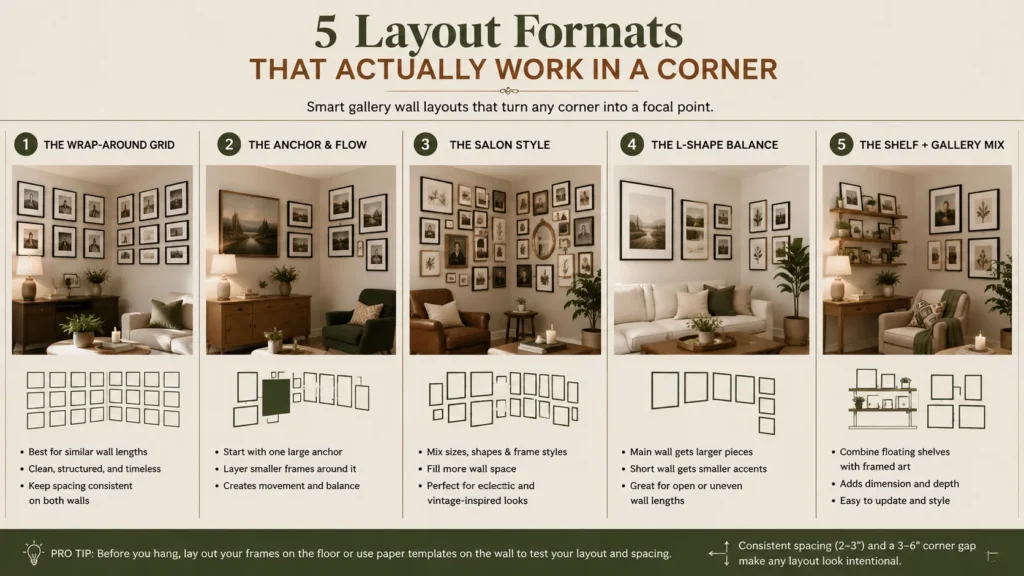
The L-Shape Anchor. A single larger, bold piece sits right at the bend, with smaller frames branching off on both sides. The oversized anchor gives the eye somewhere to land first, which keeps an otherwise busy arrangement from feeling scattered — a trick worth borrowing any time you’re combining a lot of small pieces.
The Asymmetrical Cluster. Mismatched frame sizes arranged with intentional, uneven gaps rather than a grid. It takes more planning up front (this is where the paper-cutout trick really earns its keep), but it’s the most forgiving format for a genuinely eclectic mix of frames, mirrors, and objects.
The Ledge Shelf Layer. Floating picture ledges installed to turn the corner, with prints leaned and slightly overlapped instead of hung flush. Because nothing is nailed in a fixed spot, this is the easiest format to rearrange on a whim, and it doubles as a spot to layer in small objects like a vase or candle for texture.
Pick your format before you pick your frames. A wrap-around grid wants matching or near-matching sizes; an asymmetrical cluster wants variety. Choosing the layout first keeps you from buying frames that fight the format.
Vintage-Inspired Gallery Wall Ideas for a Corner
Vintage-inspired gallery wall ideas work especially well in a corner because aged, mismatched pieces already read as collected-over-time — which softens the more architectural, deliberate lines a corner naturally creates.
Ornate gold and gilt frames, thrifted and mixed. Real vintage frames rarely match perfectly, and that’s the point. Anchor the arrangement with one larger ornate frame at the bend, then work outward with smaller gilt pieces in varying finishes. The irregularity is what sells the vintage gallery wall ideas look — a uniform grid of gold frames just reads as new frames painted gold.
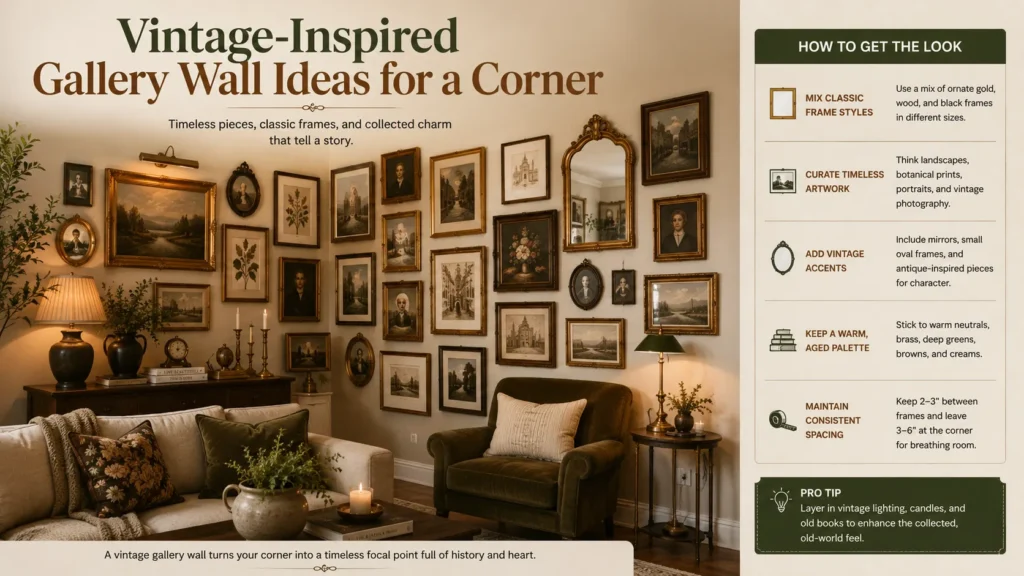
Sepia and black-and-white family photography. A muted, monochrome palette keeps a busy corner from feeling visually loud, and it’s the fastest way to make a picture gallery wall feel like it belongs to an older home even in a newer build.
Botanical and antique map prints. Look for estate sale finds or inexpensive reproduction prints of botanical illustrations, old maps, or vintage travel posters. These fill a corner with real visual detail without needing large-scale artwork, which matters if your budget doesn’t stretch to statement pieces.
Mismatched mirrors mixed with frames. A small vintage mirror or two, worked into the layout alongside framed prints, adds depth and catches light differently on each wall — genuinely useful in a corner, which often gets less direct light than the center of a room.
Because nothing here is permanently mounted, a vintage-leaning corner is also easy to dress for the season — swap in a few smaller antique-style prints around fall or October, borrowing from our aesthetic Halloween decor ideas, and leave the anchor pieces untouched.
Eclectic Gallery Wall Ideas for a Corner
Eclectic gallery wall ideas lean into contrast on purpose — different eras, textures, and subjects sitting next to each other. In a corner, that contrast has to be balanced by one unifying thread or the whole thing tips into clutter.
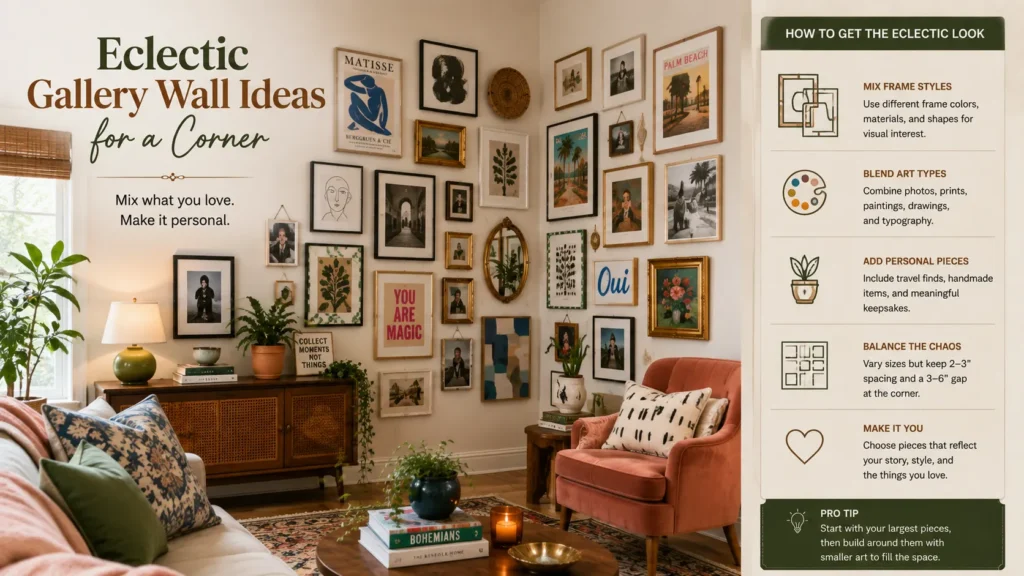
One consistent color story, wildly different frames. Let every piece share a color palette — warm terracottas, or cool blues — while frame styles, sizes, and subjects go anywhere they want. The shared palette is what keeps an eclectic gallery wall idea from looking random. A warm, terracotta-leaning palette is also an easy way to carry the mood from our fall living room decor ideas into a corner that stays up past the season.
Art mixed with functional objects. A small woven basket, a hat, or a textile hung alongside framed prints adds real dimension, especially on the wall that gets less traffic. This works particularly well in the L-Shape Anchor format, where the object can sit near the bend without disrupting the frame rhythm.
Mixed media on purpose. Combine a framed print, a canvas, an unframed paper print pinned with clips, and a small shelf object in the same arrangement. The variety in texture is what makes an eclectic corner feel curated instead of matchy.
A single bold, oversized statement piece anchoring smaller eclectic pieces. Same logic as the L-Shape Anchor format above — one large piece gives the eye a resting point so the smaller mismatched frames around it read as intentional rather than chaotic.
If an eclectic gallery wall idea is starting to feel busy, remove one piece rather than adding more negative space between the rest. Editing down almost always fixes a cluttered corner faster than spreading things out does.
Simple and Fun Gallery Wall Ideas
Not every corner needs a dozen frames. Simple gallery wall ideas and fun gallery wall ideas both start from the same place — restraint — they just differ in what fills that restrained layout.
The 3-frame minimal corner. A single large frame on 1 wall, 2 smaller matching frames on the other, all in the same finish. This is the fastest, lowest-commitment version of a simple gallery wall, and it still respects the corner-gap and eye-level rules from earlier.
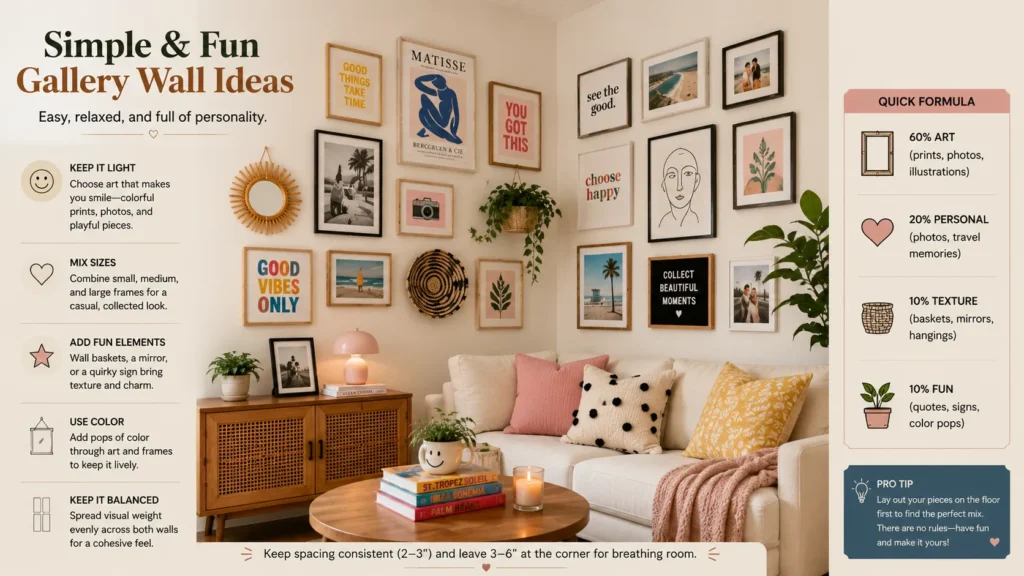
1 color, 1 frame style, done. Every frame identical, every print black-and-white or single-tone. A simple gallery wall built this way looks intentional even with as few as 4 pieces, which makes it a good starting point if you’re not ready to commit to a full wraparound layout.
Bright, saturated prints in matching thin frames. For a fun gallery wall, skip the neutral palette and lean into color — travel posters, abstract shapes, or your kid’s favorite illustrations, all in the same slim frame so the color does the work instead of the frame style.
A rotating “current favorites” corner. Use a picture ledge (from the Ledge Shelf format) styled with just 3 or 4 pieces that change with the season. It keeps a fun gallery wall idea low-pressure since nothing is permanently mounted.
Picture Wall Ideas for a Living Room Corner
The living room is where corner wall gallery ideas get the most use, mostly because it’s the room with the most awkward leftover corners — beside a window, behind a reading chair, or flanking a media console. If you’re building the whole room around a warmer feel, pair whichever layout you pick here with our cozy living room tips for the furniture and lighting choices that make a corner gallery feel like part of the room instead of an add-on.
Behind a reading chair. A tall, narrow arrangement using the Vertical Column format fills the space above a chair without competing with a nearby window. Keep the bottom frame 6 to 8 inches above the top of the chair back so it reads as connected rather than floating.
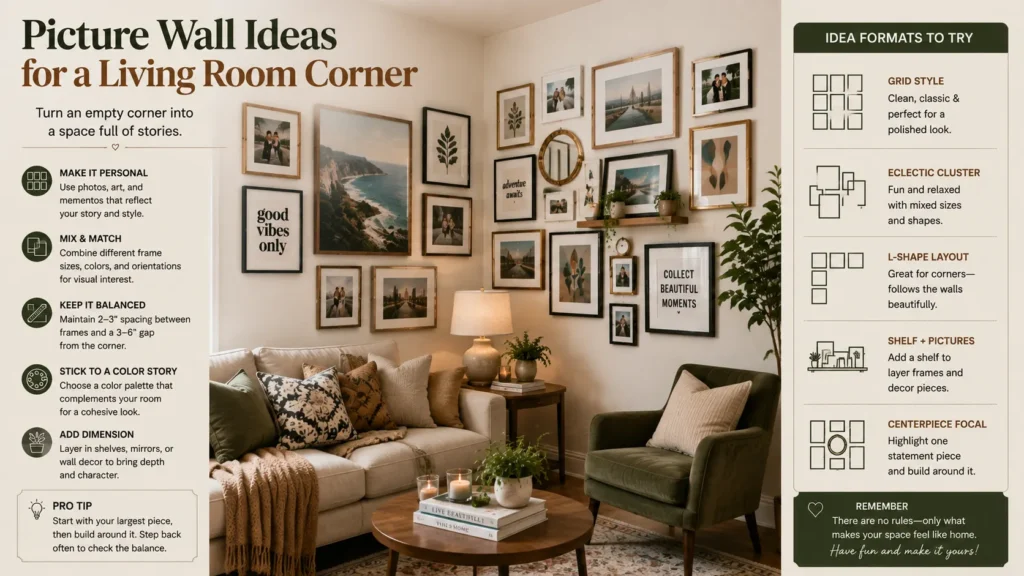
Flanking a TV or console. An L-shaped picture gallery wall on either side of a media unit adds warmth to a wall that would otherwise be dominated by a screen. Keep frames smaller and simpler here — the goal is to soften the TV wall, not compete with it.
Above a sectional’s short end. Sectionals almost always leave one short, awkward wall segment at the end. A wrap-around grid that turns the corner above that segment makes the leftover space look planned instead of unused.
Beside a bay or picture window. Natural light changes how framed pieces look throughout the day, so this is a good spot for picture wall decor with some texture or dimension — a mix of matte and glossy frames — rather than flat prints that can look washed out at certain hours.
Using Mixtiles, Smallwoods, and Other Ready-Made Sets
If measuring, leveling, and hole-patching sounds like more commitment than you want, ready-made systems solve most of the corner-specific headaches for you.
Mixtiles-style adhesive tiles. Mixtiles photo wall ideas are popular for corners specifically because the tiles are repositionable — you can shift a piece an inch to fix spacing without a new hole, which matters a lot when you’re trying to keep both walls of a corner matched. Upload your own photos, choose a consistent frame style, and stick them up in the same 2–3 inch rhythm covered earlier.
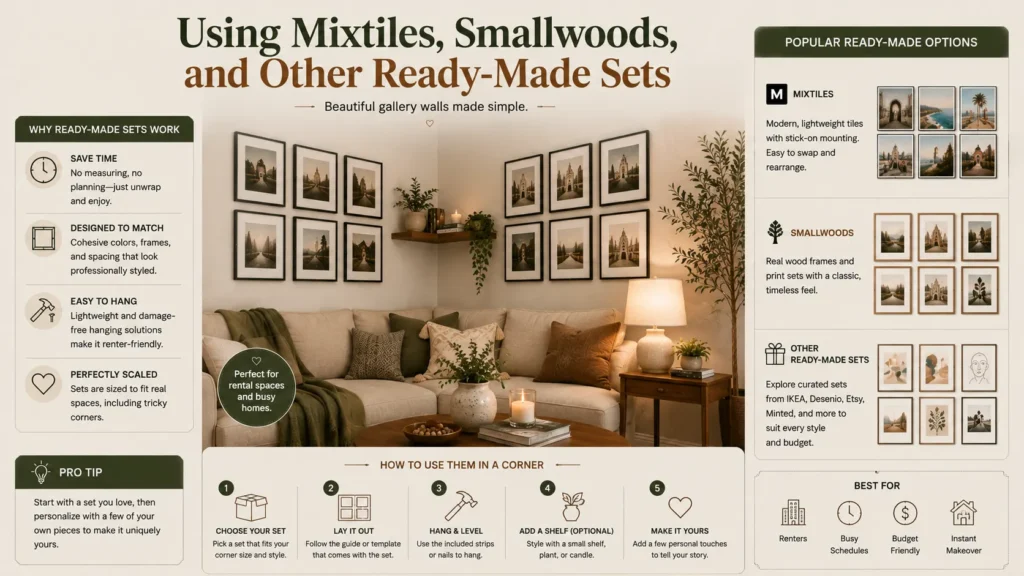
Curated canvas sets. A Smallwoods gallery wall set — pre-matched canvas prints sold as a coordinated group — takes the guesswork out of choosing sizes and finishes that work together, which is genuinely useful for a wraparound corner where mismatched proportions are the most common mistake.
Print-on-demand collections. Several online print shops sell “gallery wall kits” bundled by theme or palette, sized to fit standard layout templates. These work well for the Wrap-Around Grid format specifically, since the sizing is already coordinated.
Mixing a ready-made set with a few personal pieces. You don’t have to choose one or the other — a curated set (Mixtiles or Smallwoods style) gives you the structure, and 1 or 2 thrifted or personal frames worked into the mix keeps the corner from feeling too catalog-perfect.
Command Picture Hanging Strips are rated for frames up to 24 by 36 inches with the large size (4 pairs hold about 16 pounds), which covers most gallery wall frames without a single nail — useful to know if you’re renting and want to test a layout before committing to anything permanent.
Budget-Friendly Corner Gallery Wall Tips
- ✓
Thrift the frames, not the art. Mismatched secondhand frames in the same finish (spray paint helps here) cost a fraction of buying a matching set new, and they’re the backbone of most vintage-inspired gallery wall ideas anyway.
- ✓
Fill gaps with dollar-store finds. A few small frames or decorative objects tucked into the layout stretch a tight budget further — our dollar store decor tips cover how to style them so they blend in instead of standing out as the cheap piece.
- ✓
Print your own. Home-printed photos in inexpensive frames fill a corner for less than a single piece of store-bought art, and they double as the most personal picture gallery wall ideas you can build.
- ✓
Start with fewer, larger pieces. A corner filled with 3 or 4 bigger prints can look more finished than 10 tiny ones, and it’s cheaper once you count frames.
- ✓
Buy frames in 1 trip, 1 finish. A Even an eclectic gallery wall idea benefits from frames purchased together — it’s easier to hit a cohesive look in one pass than to keep adding pieces over months and hoping they match.
Common Mistakes (and Fixes)
The most common issue with corner wall gallery ideas is starting one wall, finishing it, then starting the second wall from scratch. Plan the whole footprint — both walls, one composition — before hanging a single frame.
Pushing frames right up to the seam looks cramped and highlights uneven drywall. Leave that 3–6 inch gap from the height rules above.
Hanging too high to “fill the wall” is the single most common fix requested by anyone who’s had a gallery wall professionally reviewed. Keep the visual center at 57–60 inches regardless of ceiling height.
Even a few extra inches of drift between frames reads as messy from across the room. Measure once, use a spacer (a stack of coins or a cut piece of cardboard works fine) for every gap.
A corner with 10 same-size frames and nothing larger to rest the eye on tends to feel busy rather than curated. Add 1 larger piece, even if everything else stays small.
Build Your Corner Wall Gallery in a Weekend
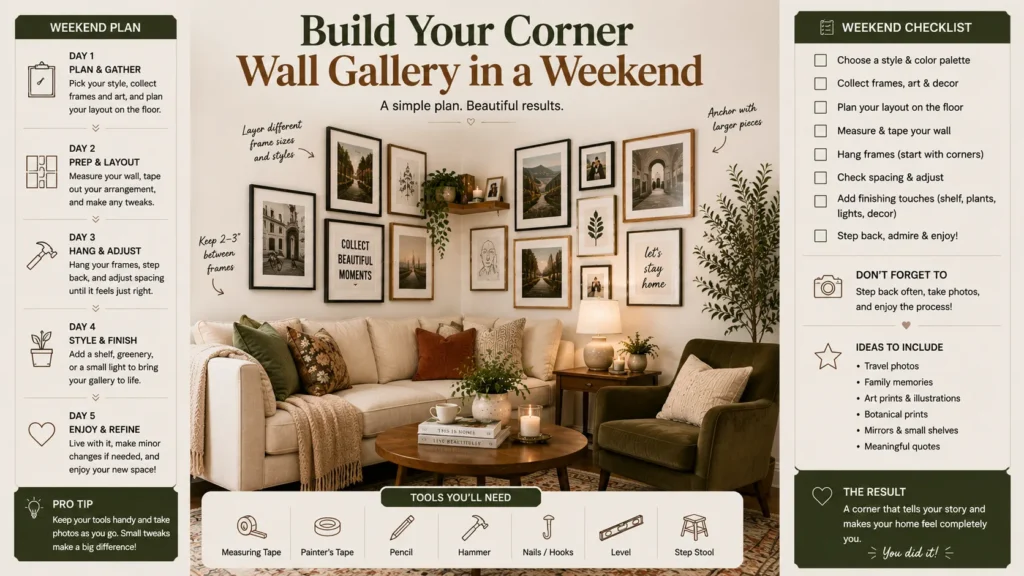
Friday evening — plan. Choose your format from the 5 above, measure both walls, and settle on your 57–60 inch eye-level line and 2–3 inch spacing. Cut kraft paper to the size of each frame and tape the whole layout to the wall.
Saturday morning — gather. Thrift or shop for frames in one trip if you’re going the vintage-inspired or eclectic route, or place your order if you’re using a Mixtiles or Smallwoods-style set. Pick up Command strips sized for your largest frame if you’re renting.
Saturday afternoon — hang the anchor. Start with your largest or most central piece — right at, but not touching, the corner gap — and work outward from there on both walls at once, so the spacing stays matched.
Sunday — finish and adjust. Step back from across the room, not just up close, and check the height and spacing rules hold up from a normal viewing distance. This is the moment to swap anything that looks off before you commit further.
Final Thoughts
A corner only looks awkward because most decorating advice is written for flat walls. Once you treat both sides as one composition — same eye-level line, same spacing, a deliberate gap at the seam — almost any style works: thrifted vintage frames, a color-tied eclectic mix, a 3-frame minimal grouping, or a ready-made Mixtiles or Smallwoods set. Pick the format that fits your walls first, then let the style follow. That’s really the whole difference between a corner that feels unfinished and one that becomes the best-looking wall in the room.
Frequently Asked Questions (FAQ)
Leave 3 to 6 inches of open space at the actual seam where the two walls meet. This gap is what makes the two sides of a corner wall gallery read as one connected composition instead of two arrangements that happen to be near each other.
It depends on the corner. A Wrap-Around Grid suits 2 similarly sized walls, a Vertical Column works in narrow hallway corners, and an Asymmetrical Cluster is the most forgiving choice for a mix of frame sizes and styles.
Center the entire arrangement — both walls treated as one — at 57 to 60 inches from the floor, the same eye-level standard used for a single flat-wall gallery.
Yes. Adhesive picture-hanging strips rated for your frame size (large strips typically hold up to 24-by-36-inch frames) or a Mixtiles-style repositionable system both work well and are ideal for rentals.
There’s no fixed number — a simple gallery wall can work with as few as 3 or 4 pieces, while a full wraparound grid might use 15 or more. What matters more than the count is consistent spacing and 1 anchor piece to rest the eye on.