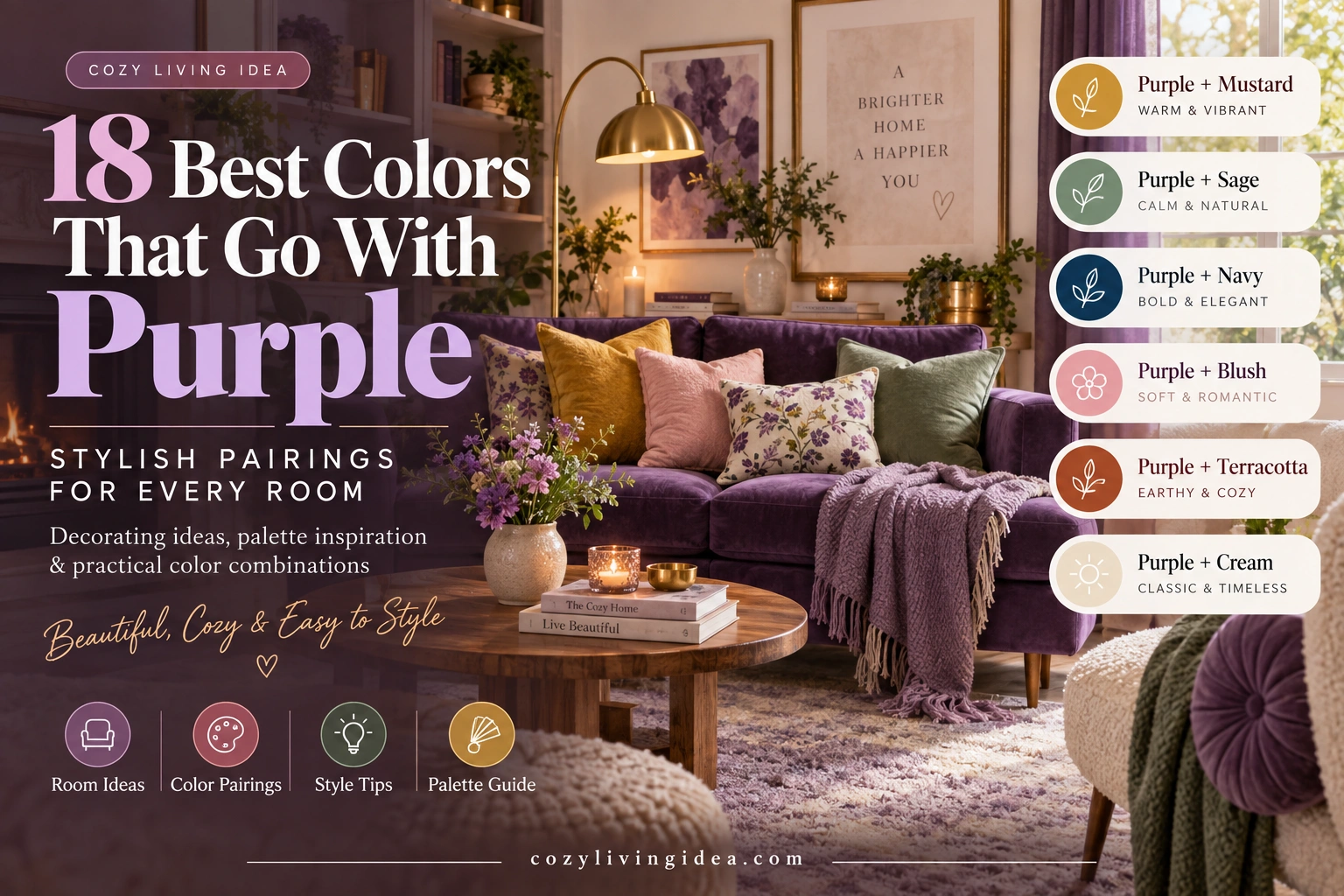
Colors That Go With Purple: 18 Combinations That Work
Purple gets treated like a mood rather than a color, and that’s the problem. Say “purple” and most people picture one thing — usually something closer to grape juice than an actual paint chip — when the real range runs from a barely-there lavender to a near-black eggplant, with lilac, mauve, amethyst, and royal violet in between.
Each of those behaves completely differently next to the same partner color, which is exactly why so many “purple doesn’t work in my house” conclusions are really just a mismatch between the wrong shade and the wrong pairing.
This guide is here to fix that. Instead of one generic list, you’ll find good colors that go with purple broken down by exact shade, by room, and by how much contrast you actually want — plus the color-wheel logic behind why yellow, blue, and green all show up so often as purple’s partner colors. If you’d rather scan first, the quick-reference table below is a fast way in before you get to the details.
Purple works with neutrals such as white, gray and beige; yellow-family accents such as mustard for stronger contrast; greens such as sage or emerald; blues such as navy and powder blue; and warmer accents such as terracotta or blush. Start with the exact purple you’re using, then decide whether you want the partner color to harmonize with it or deliberately create contrast.
How to Identify Your Purple’s Undertone
Purple can lean more blue, red, gray or brown depending on the exact shade. Lavender and some violets often read cooler, while plum, wine and aubergine can lean warmer or redder.
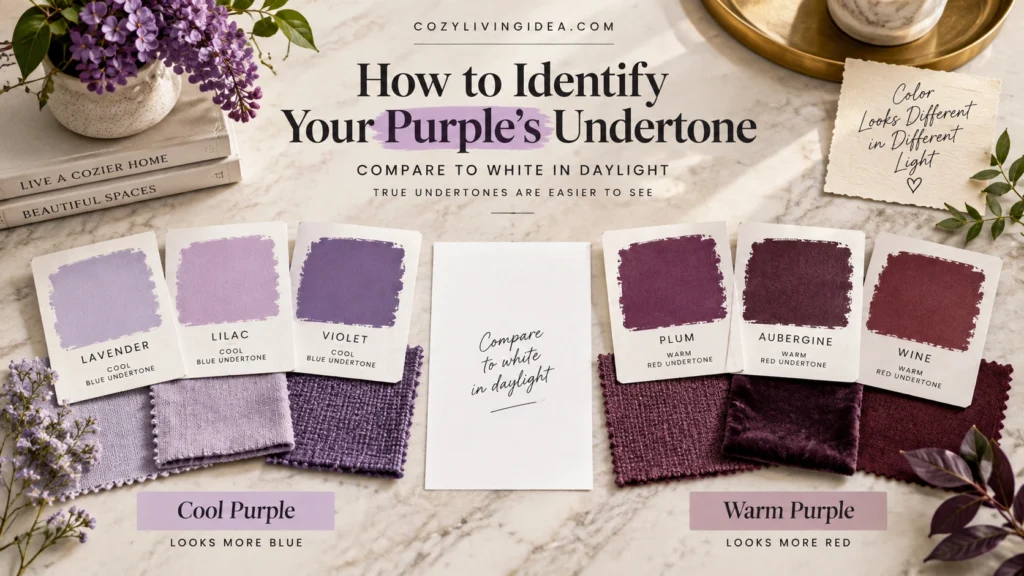
Compare the purple with a neutral reference and, more importantly, with the finishes already in the room—flooring, wood, upholstery, countertops or existing wall colors. Similar undertones usually create a more blended palette, while contrasting undertones can create more energy.
Don’t assume cool purple must only be paired with cool colors or warm purple only with warm colors. That can be a useful starting point, but it isn’t a rule. Lighting and surrounding materials can change how the combination reads.
What Colors Go With Purple?
| Color | Effect With Purple | Works Especially Well With |
|---|---|---|
| White | Clean and bright | Lavender, lilac, violet |
| Gray | Calm and modern | Almost any purple |
| Charcoal | Grounded, easier to live with | Plum, amethyst |
| Black | Dramatic, moody | Deep plum, eggplant |
| Beige | Warm and natural | Mauve, plum |
| Mustard Yellow | Bold, near-complementary | Royal purple, amethyst |
| Gold | Warm and glamorous | Almost any purple |
| Butter Yellow | Soft and cheerful | Lavender, lilac |
| Emerald Green | Jewel-toned and rich | Royal purple, violet |
| Sage Green | Calm and organic | Lavender, mauve |
| Olive Green | Earthy and grounded | Plum, aubergine |
| Teal | Cool and contemporary | Violet, amethyst |
| Navy | Deep and elegant | Plum, eggplant |
| Powder Blue | Soft and romantic | Lavender, lilac |
| Blush Pink | Gentle and tonal | Lavender, mauve |
| Hot Pink | Bold and playful | Violet, amethyst |
| Coral | Warm and energetic | Softer purples like mauve |
| Terracotta | Earthy contrast | Plum, aubergine |
Once you’ve spotted a pairing that fits your space, the sections below break down exactly how to use it — including which specific purple shade it works best with and where to bring it into a room.
18 Best Colors That Go With Purple – Stylish Pairings for Every Room
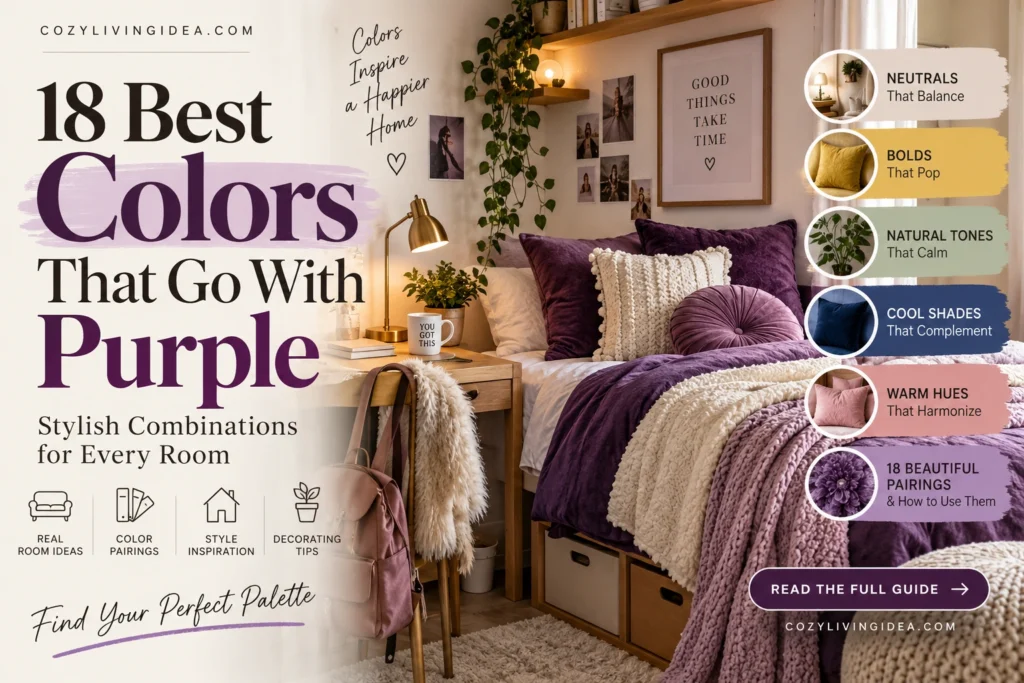
If you’re after combination colors that go with purple that feel curated rather than random — colors that go with purple and yellow, colors that go with purple and green, colors that go with purple and blue, or colors that go with purple and pink — they’re all below, broken down one at a time.
Purple and White
White does for purple what it does for almost every bold color: it clears the palette and lets the purple read clearly instead of competing with anything else in the room. Against a pale lavender it feels airy and fresh; against a deep violet or amethyst it turns crisp and almost gallery-like.
Best pairings: Lavender + crisp white · Violet + white trim · Amethyst + white walls Works well for: Bedrooms, bathrooms, small spaces
Purple and Gray
Gray is the quiet workhorse on this whole list. It’s neutral enough to sit next to almost any purple you own, which makes it the safest possible base if you’re still deciding exactly which shade you’ll commit to.
Best with: Nearly all purples, from pale lilac to deep plum Works well for: Rentals, walls you can’t repaint, furniture-first decorating
Purple and Charcoal
Charcoal grounds purple without the starkness of true black, which makes it easier to live with day to day. It’s a natural match for the deeper end of the purple spectrum — plum, amethyst, aubergine — where you want the room to feel rich rather than pastel.
Best with: Plum, amethyst, deep violet
Purple and Black
This is the highest-contrast neutral pairing here, and it works best in small, deliberate doses — black hardware, a black-framed mirror, a single black accent chair — rather than covering equal space with purple. Because both colors read as deep and saturated, too much of each together can swallow the light in a room.
Best with: Deep plum, eggplant, aubergine
Purple and Beige
Beige brings warmth that gray doesn’t, which makes it a strong match for the warmer, more red-leaning purples like mauve and plum. Bring it in through linen curtains, a woven rug, or a beige sofa against a purple accent wall.
Best with: Mauve, plum, warm violet
Purple and Mustard Yellow
On a traditional color wheel, yellow and violet form a complementary pair, which is why yellow-family accents can create strong contrast with many purples. Mustard tones that relationship down because the yellow is deeper and more muted, making it easier to use with amethyst, violet and royal-purple shades.
Best pairings: Royal purple + mustard · Amethyst + mustard accents Works well for: Living rooms, accent walls, statement furniture
On a traditional color wheel, yellow and violet form a complementary pair, which is why yellow-family accents can create such strong contrast with many purples. Adobe likewise identifies yellow and violet as a classic complementary-color pairing, meaning they sit opposite each other on the color wheel and create strong visual contrast.
Purple and Gold
As an accent rather than a full color block, gold brings some of yellow’s warmth into a purple palette without behaving like a full yellow color block.. Brass hardware, picture frames, or a lamp base all do the job, and it works across nearly every purple shade.
Best with: Almost any purple, from lavender to eggplant
Purple and Butter Yellow
This is the pastel version of the same complementary pairing — closer in saturation to lavender or lilac, so it reads as gentle and spring-like rather than bold. It’s an easy way to bring in complementary colors that go with purple without committing to a full mustard wall.
Best with: Lavender, lilac, pale violet
Purple and Emerald Green
Emerald is the boldest of the green family here, and one of the clearest examples of colors that go with purple and green working at full saturation. Two jewel tones together read as rich and a little dramatic, so it’s a strong choice for a single accent piece — a velvet chair, a lamp — rather than a full wall.
Best with: Royal purple, violet, amethyst
Purple and Sage Green
Sage is the calmer, more muted version of the green family, and it’s the pairing most people mean when they picture colors that go with purple and green in a real, lived-in room rather than a showroom. Both colors show up together constantly in nature — lavender fields, wisteria against foliage — which is part of why the combination feels instantly familiar rather than forced.
Best with: Lavender, lilac, mauve
Purple and Olive Green
Olive pushes the same nature-inspired pairing into earthier, more grounded territory. It works especially well with the deeper, warmer purples — plum, aubergine — since both colors share a similar depth.
Best with: Plum, aubergine, deep mauve
Purple and Teal
Teal is a near-neighbor of purple on the wheel, which gives colors that go with purple and blue a cooler, more contemporary edge than navy does on its own. The two together read as rich without tipping into moody.
Best with: Violet, amethyst, royal purple
Purple and Navy
Navy is the anchor of the whole blue family here. It grounds purple the way a dark neutral would, and it’s especially effective with the deeper end of the purple spectrum where you want the room to feel elegant rather than playful.
Best pairings: Plum + navy · Eggplant + navy trim Works well for: Living rooms, home offices, formal spaces
If blue will play a larger role in the room, our Colors That Go With Blue guide compares additional pairings across navy, dusty blue, cobalt, teal and other shades.
Purple and Powder Blue
This creates one of the softest, most romantic pairings on the list — both colors are already desaturated, so nothing fights for attention. It’s the pairing to reach for in a bedroom where you want calm over drama.
Best with: Lavender, lilac, pale violet
Purple and Blush Pink
Because pink sits right next to purple on the color wheel, this is an analogous pairing rather than a complementary one — which is exactly why colors that go with purple and pink tend to feel soft and blended instead of high-contrast. Blush is the gentlest version, and it works best with equally soft, cool purples like lavender.
Best with: Lavender, lilac, pale mauve
If pink is becoming more than a small accent, see our Colors That Go With Pink guide for shade-specific combinations and undertone guidance.
Purple and Hot Pink
This is the bolder, more saturated cousin of the same analogous relationship. Two high-energy colors from neighboring parts of the wheel read as playful and a little maximalist rather than calm, so it works best as an accent rather than the dominant palette.
Best with: Violet, amethyst, royal purple
Purple and Coral
Most people don’t think to try this one, but it genuinely works, especially with the softer end of the purple spectrum. Coral warms up a cool purple the way terracotta warms up a cool pink, and it keeps the combination from reading as too somber.
Best with: Mauve, lilac, soft lavender
Purple and Terracotta
Terracotta’s warm, clay-like tone grounds a purple palette the same way navy or charcoal would, just with more inherent warmth. It’s an especially good match for the deeper, red-leaning purples like plum or aubergine.
Best with: Plum, aubergine, deep mauve
Purple Pairings That Need More Care
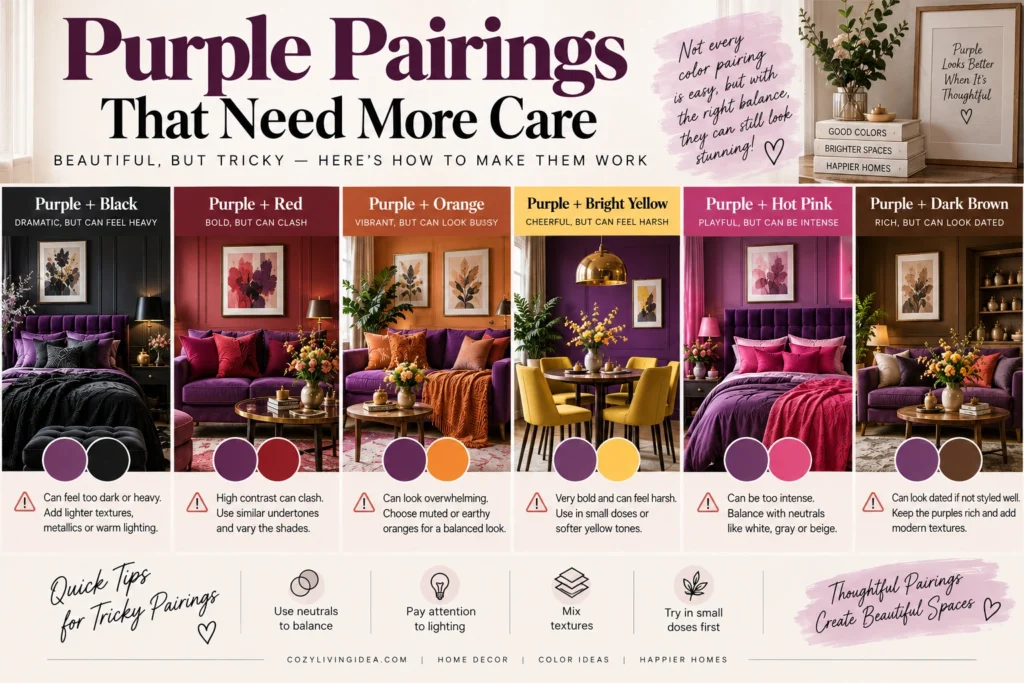
Very few colors are automatically off-limits with purple. Problems usually come from saturation, value, undertone or proportion rather than the color name itself.
Bright red + saturated purple: This can create an intense, high-energy palette. If it feels overwhelming, mute one color or introduce a neutral to separate them.
Neon green + strong purple: Both colors carry a lot of visual energy. Use one as the dominant color and keep the other to a smaller accent if you want the room to feel more controlled.
Warm tan + cool lavender: This can work, but compare the exact undertones beside the flooring, wood and textiles. A different tan or a slightly warmer lavender may connect the palette better.
Cool white + warm plum: The contrast can be crisp or stark depending on the exact white. Compare cool white, warm white and cream samples beside the plum before choosing.
The useful question isn’t “Does this color clash with purple?” but “Do these exact shades work together in this room?”
Metallics and Natural Materials That Pair Well With Purple
Paint and fabric aren’t the only way to build a purple palette — metals and natural materials do real work too.
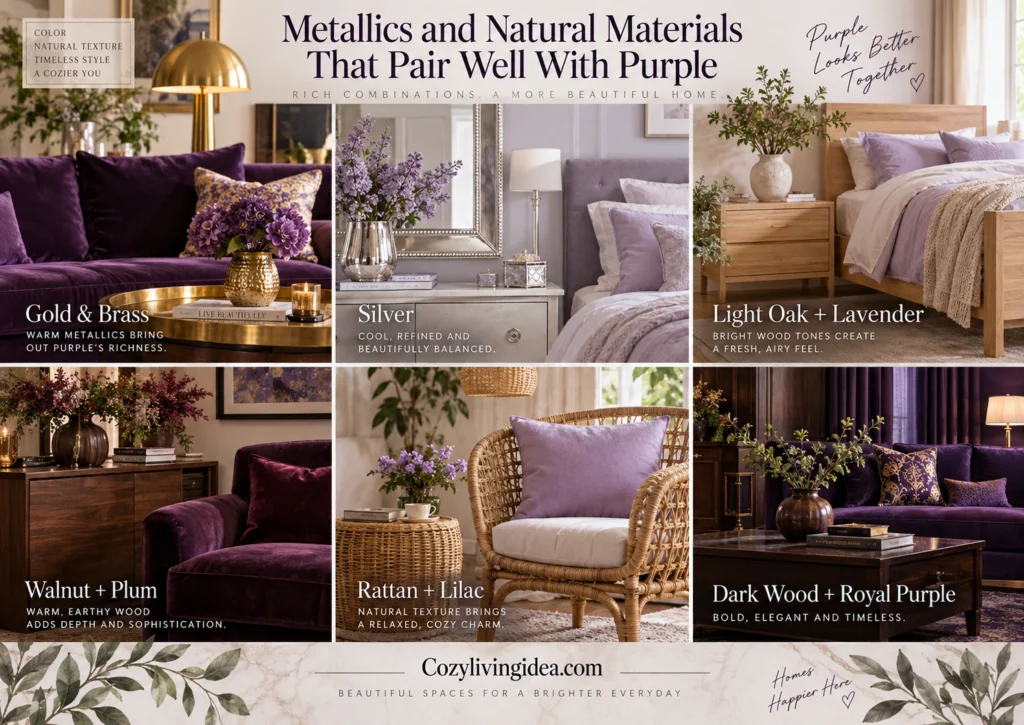
Gold is the classic match, working across nearly every shade from pastel lilac to deep aubergine, especially through lighting, hardware, and frames. Silver is the cooler, more contemporary alternative, and it suits the paler end of the spectrum — lavender, lilac — better than gold does. For wood tones: light oak keeps lavender feeling fresh and airy, walnut grounds plum, rattan leans boho with lilac, and dark wood adds drama to royal purple.
Best Colors for Different Shades of Purple
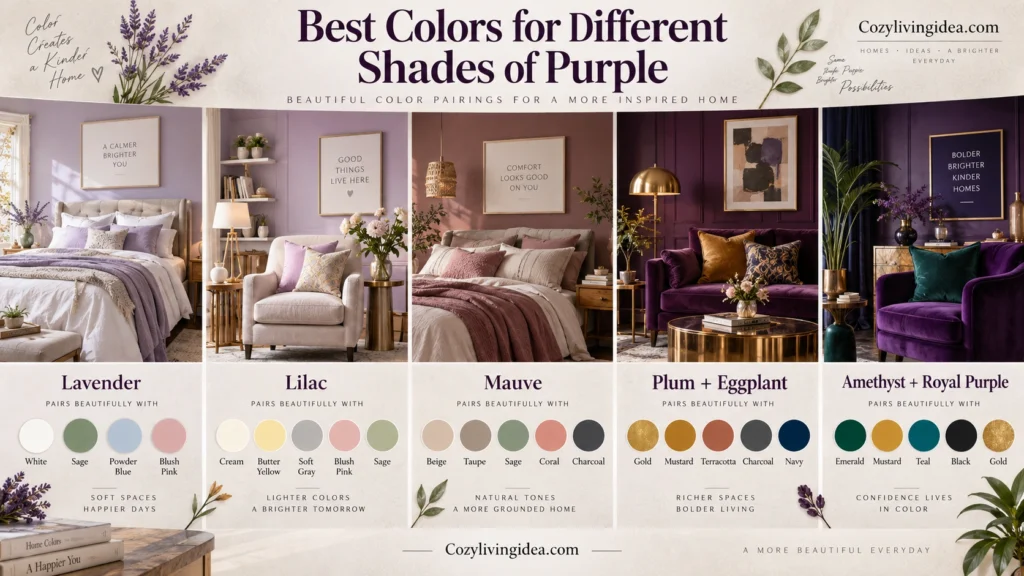
Not every purple asks for the same partner. If you already know exactly which shade you’re working with, this shortcuts the search.
Colors That Go With Lavender
White, sage, gray, powder blue, blush pink, gold
Colors That Go With Lilac
Cream, butter yellow, soft gray, blush pink, sage
Colors That Go With Mauve
Beige, taupe, sage, coral, charcoal
Colors That Go With Plum or Eggplant
Gold, mustard, terracotta, charcoal, navy
Colors That Go With Amethyst or Royal Purple
Emerald, mustard, teal, black, gold
Use 60-30-10 as a Starting Point
If you’re unsure how to distribute three colors, the 60-30-10 idea can be a useful starting point: one color carries most of the visual weight, another supports it, and a third appears in smaller accents.
The useful part is the hierarchy, not following exact percentages. A neutral room might use purple as the secondary color, while a bolder room might make purple the dominant wall or furniture color. Adjust the proportions to the room, existing finishes and amount of contrast you want.
Best Purple Color Combinations by Room
| Room | Softer Direction | Stronger Direction |
|---|---|---|
| Bedroom | Lavender + cream + sage | Plum + charcoal + warm wood |
| Living room | Mauve + beige + olive | Amethyst + mustard + gold |
| Kitchen | Soft purple + white + wood | Plum + black + brass |
| Bathroom | Lavender + white + silver | Purple + charcoal + warm metal |
| Small space/rental | Lilac + white + gray | Purple accents + navy or sage |
Treat these as starting combinations rather than room rules. A bedroom can be dark and dramatic, and a living room can be pale and quiet—the room’s light, existing finishes and the atmosphere you want matter more than the room label itself.
How to Test a Purple Color Combination Before Committing
Start with the materials that are staying in the room: flooring, countertops, large furniture, cabinetry, wood tones or existing wall colors. Place the purple and its proposed partner beside those finishes rather than judging the colors in isolation.
If paint is involved, test actual samples or large movable swatches. Check them in morning daylight, later in the day and after your normal lamps are switched on. Move the sample to more than one wall if the room receives different amounts of light.
Then test the partner color through something reversible—a pillow cover, fabric sample, throw, artwork or accessory—before buying several coordinating pieces.
If the combination still looks balanced next to the fixed finishes and under the room’s normal lighting, then move to the larger commitment.
Common Mistakes When Decorating With Purple
01. Undertone mismatch may be one reason
A cool lavender behaves very differently next to a given color than a warm plum does, even if the two purples look related in isolation. When a “good” pairing looks slightly off in person, undertone mismatch is almost always why.
02. Going full-strength with two bold colors
This shows up most with purple-and-yellow and purple-and-hot-pink pairings. Two high-energy colors at equal strength rarely feel calm, even if each one individually works. Let one lead and the other support.
03. Testing swatches under artificial light only
Paint chips and fabric swatches read differently under LED bulbs, warm incandescent light, and daylight. A pairing that looks perfect in a store aisle can shift noticeably once it’s actually on your wall.
04. Treating every purple as the same color
A decision that works for pale lilac won’t necessarily work for deep eggplant. Always test your pairing against the exact shade you’re using, not “purple” in the abstract.
05. Forgetting neutrals need undertones too
Not all gray is the same gray. A warm-toned gray can clash with a cool lavender the same way a wrong color would, so treat your “neutral” the same way you’d treat any other color in the pairing.
Final Thoughts on Colors That Go With Purple
There’s no single best color for purple — it depends on the exact shade you’re working with, its undertone, how much contrast you want, and the mood you’re going for.
What matters more than memorizing all eighteen pairings above is understanding the logic underneath them: yellow creates maximum contrast as purple’s complement, blue and pink create harmony as its neighbors on the wheel, and green brings a nature-inspired balance that shows up in lavender fields and forest floors alike.
If you’re choosing the palette as part of a full-room or whole-home direction, our Home Inspiration Ideas guide shows how to carry colors and materials consistently from room to room.