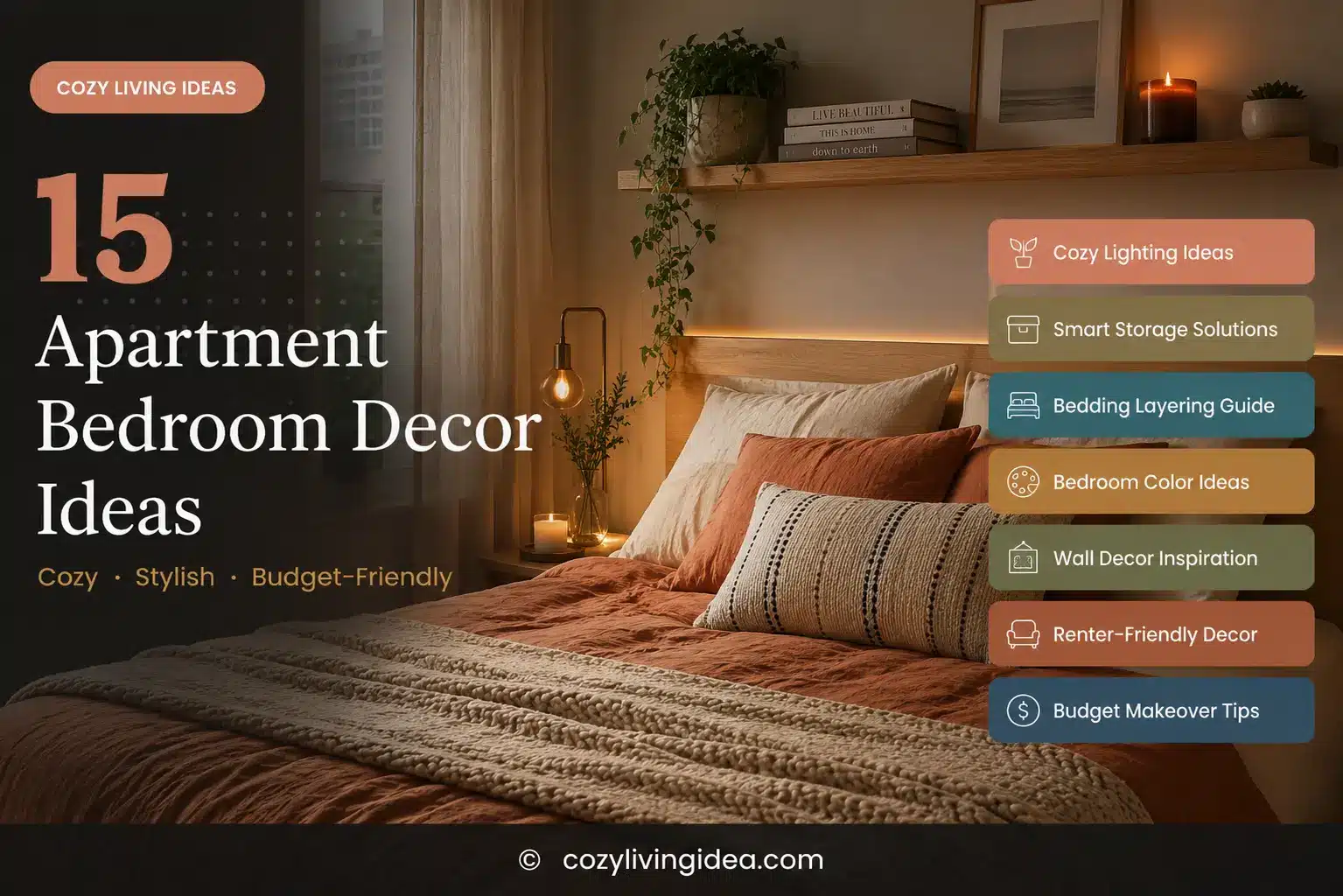
Apartment Bedroom Decor Ideas: 15 Fresh Ways to Style It
Your bedroom shouldn’t look like you’re still deciding whether to stay.
If you’re renting, working with a small footprint, or just haven’t gotten around to it yet, most bedroom advice online isn’t built for your situation. It assumes you can paint anything, mount anything, and buy a $2,000 bed frame to start.
This guide isn’t that. Every idea here works in a real apartment — no drilling into a wall you don’t own, no furniture that doesn’t fit through the door, no advice you’ve already read six times this year.
What you’ll get:
- ✓
15 ideas, each with a specific technique — not just “add a rug,” but how to size and layer one
- ✓
Real budgets and time estimates for every idea
- ✓
Designer-level tricks for making a small room look considered, not crammed
- ✓
A clear sense of your decorating style before you buy anything
Let’s start with why this room deserves more attention than it usually gets.
Why Apartment Bedroom Decor Matters
It’s easy to let this room slide. It’s the one space nobody else sees, so it becomes the one space that gets ignored.
That’s a mistake, for three reasons:
- ✓
Sleep quality – A cluttered, dim, visually busy room keeps your nervous system slightly more alert than it should be at bedtime. Softer textures and warmer light genuinely help you wind down.
- ✓
Function – Apartment bedrooms usually double as a closet overflow zone, a home office, and a laundry pile all at once. A room with an actual storage plan removes a surprising amount of daily friction.
- ✓
Ownership – This is the one room where nobody else’s taste gets a vote. A bedroom that reflects even a little of your personality changes how the whole apartment feels to come home to.
Find Your Apartment Bedroom Decor Style
| Style | Defines itself by | Best for |
|---|---|---|
| Modern | Clean lines, restrained palette, one bold piece doing the visual work | Renters who want sharp and uncluttered |
| Minimalist | Fewer pieces, more open floor, near-monochrome | Small rooms where visual quiet = bigger feeling |
| Scandinavian | Light woods, soft grays, cozy knit textiles | Anyone chasing “clean” and “cozy” together |
| Boho | Earthy color, macramé, rattan, layered pattern | Maximum personality, minimal permanent change |
| Japandi | Low furniture, natural materials, muted earth tones | Minimalist lovers who find it too cold alone |
| Coastal | Soft blue, sandy neutral, linen, light wood | Rooms with strong natural lighting |
| Industrial | Black metal, leather, moody tone, exposed texture | Apartments with existing brick or duct details |
| Farmhouse | Warm white, reclaimed wood, “collected over time” pieces | Renters who like a lived-in, vintage feel |
| Luxury | Rich color or deep neutral, velvet, symmetry | Anyone chasing a boutique-hotel feeling |
| Contemporary | Whatever’s current, filtered through clean lines | People who like to update often without a full redo |
Pick one style as your base and borrow one element from a second. A Scandinavian room with one boho textile layered in (a jute rug, a woven basket) almost always looks more collected than a room that follows one style rigidly.
15 Apartment Bedroom Decor Ideas (With Real Techniques)
I listed around 15 easy Bedroom decor guides and each idea below includes the actual method — not just the concept — plus a quick-reference summary so you can decide what’s worth your weekend.
1. Layer bedding with the five-piece stacking method
Most “layered bedding” advice stops at “add a throw.” That’s why so many beds look decorated but not styled — there’s texture, but no structure underneath it. Professional stylists build a bed in layers for the same reason a good outfit is built in layers: each piece has a job, and the order matters more than the pieces themselves.
Here’s the order that actually works:
Fitted sheet, flat sheet
Duvet or comforter, folded back about a third from the top — this exposes the flat sheet underneath and gives the bed a hotel-style fold line instead of one flat expanse of color
Two sleeping pillows, standing upright against the headboard, not lying flat
One or two smaller lumbar or accent pillows, angled slightly forward against the sleeping pillows
A folded throw draped — not folded flat — across one-third of the bed’s foot, so it falls with some natural movement
Quick take: $50–200 · a couple of hours · works in any size room
Where to source it: You likely already own most of this. The two things worth buying new are a textured throw (something with visible weave, like a waffle knit or chunky cable knit) and one or two lumbar pillows in a contrasting texture — those two items alone will do more than a full new bedding set.
Designer tip: Mix at least three textures (smooth cotton, chunky knit, linen) instead of buying a matching bedding set. Uniform texture is what makes bedding look store-bought instead of styled.
If your space is tight: Skip the lumbar pillows and go with just two sleeping pillows plus the throw — in a twin or full bed, extra pillows can overwhelm the proportions of the whole bed.
2. Plan a gallery wall with the paper-template method
The gallery wall is one of the most requested apartment decor ideas, and also one of the most botched — usually because people start hammering before they’ve actually seen the layout at scale. Paper solves that, because it lets you test, adjust, and live with a layout before a single hole exists.
Trace each frame onto kraft paper or newspaper and cut it out
Tape the paper templates to the wall in your planned layout, leaving 2–3 inches between each piece
Live with it for a day and adjust before committing — walk past it at different times of day to see how it reads in changing light
Mark nail or hook placement through the paper, then remove it and hang
Quick take: $30–150 · a weekend project · best in small-to-mid rooms
Layout options that work well in apartments: A grid (equal frame sizes, evenly spaced) reads modern and calm. A salon-style cluster (mixed sizes, organic spacing) reads collected and personal, and tends to forgive imperfect spacing better than a grid does — a good option if this is your first gallery wall.
Designer tip: Center the whole grouping at eye level when seated on the bed, not standing — that’s the detail most gallery walls get wrong, because most people plan them while standing in the room.
Mistake to avoid: Using frames that are all the exact same size and finish. Two or three finishes (black, wood, a thin brass) mixed together read as curated; one finish repeated ten times reads like a stock photo.
3. Build a leaning headboard from reclaimed wood
Skip the upholstered headboard everyone already has. A leaning panel built from reclaimed wood — stair tread offcuts, a salvaged door panel, or weathered fence board — adds texture and a sense of history that a new upholstered piece can’t fake, and because it leans instead of mounts, it moves with you at the end of your lease.
Source reclaimed boards from a salvage yard, reclaimed lumber supplier, or even a demolition sale — look for boards with consistent thickness even if the surface texture varies
Sand lightly, keeping some texture and grain variation rather than sanding it smooth — the imperfections are the point
Join boards with a simple back brace (a hardware store cross-brace kit works fine, or two horizontal furring strips screwed across the back)
Lean the finished panel against the wall behind your mattress, slightly larger than the bed itself, and let the weight of the mattress hold the base in place
Quick take: $60–250 · a weekend build · any size room
No tools, no problem: If building isn’t for you, a secondhand door, an old wooden shutter, or even a large framed piece of reclaimed barn wood from a salvage shop can lean the same way with zero assembly.
Designer tip: Go a few inches wider than your mattress. An oversized leaning headboard reads as a finished design choice; one sized to match the bed exactly reads as an afterthought.
Safety note: For a leaning piece taller than about four feet, anchor the base lightly with furniture straps or a non-slip pad so it can’t be pulled forward — this keeps it renter-friendly while still being secure.
This is really just one application of a bigger idea — building character into a room using materials that already have some history. If reclaimed wood appeals to you here, our 15 budget-friendly ideas for decorating with recycled materials covers plenty of other ways to bring that same feel into the rest of the apartment.
4. Style a floating shelf as an open-shelving vignette
A single floating shelf can function like a full piece of open shelving if you style it in groupings instead of a straight row of evenly spaced objects — which is the difference between a shelf that looks like storage and one that looks like styling.
- ✓
Anchor one end with a stack of 3–4 books, spine-out or spine-in depending on whether you want the color of the spines to show
- ✓
Add one woven basket next to the books for visual weight and hidden small-item storage
- ✓
Finish the other end with a trailing plant so greenery breaks up the shelf’s straight horizontal line
Quick take: $20–100 · renter-friendly with adhesive strips · best for small apartments
Placement: Mount shelves at roughly 12–16 inches above furniture (a dresser, a desk) rather than isolated on an empty wall — this visually ties the shelf to the furniture below it instead of leaving it floating without context.
Designer tip: Style in odd numbers — three groupings, not four — and leave visible gaps between them. A packed shelf reads as clutter no matter how nice each object is.
If you have room for two shelves: Stagger them at slightly different heights and widths rather than stacking them evenly — it reads more like a considered arrangement and less like a display case.
5. Add a plug-in sconce instead of a table lamp
Freeing up your nightstand surface does more for the room than people expect, because a table lamp is often the single largest object on a small nightstand — remove it, and suddenly there’s room to actually style the surface instead of just clearing it. Plug-in sconces need no wiring and no electrician, which makes this one of the easiest upgrades on this entire list.
- ✓
Choose a sconce with a visible cord (some are designed with a fabric-wrapped cord as a feature, not a flaw) or one with a cord channel you can run along the wall discreetly
- ✓
Mount using an adhesive hook or a small picture hook rated for the sconce’s weight
- ✓
Route the cord down to the nearest outlet, using cord clips to keep it flat against the wall rather than hanging loose
Quick take: $30–120 · an easy afternoon · any size room
Designer tip: Keep the bulb warm and slightly dim. A sconce should support the room’s mood, not replace your main light source.
Style match: A swing-arm sconce works especially well here because it lets you angle the light directly over a book without needing a separate reading lamp — genuinely useful in a small room where every surface needs to multitask.
6. Layer two rugs instead of one
A single rug is fine. Two, layered, look intentional — the same principle as layering bedding, applied to the floor. Start with a large jute or sisal base rug that anchors the whole room, then add a smaller patterned or textured rug angled slightly under the foot of the bed.
Quick take: $100–350 for both · an afternoon · any size room, most impactful in bigger rooms
How to size it: The base rug should extend past the bed on at least two sides. The top rug should be noticeably smaller — roughly half the width of the base rug — so it reads as a deliberate accent rather than a second full-size rug competing for attention.
Designer tip: Size the base rug to extend past the bed on at least two sides — feet should land on rug, not cold flooring, when you get up.
Budget version: If two full rugs isn’t in the budget, a jute base rug alone still solves the “cold, unfinished” problem most small bedrooms have, and you can add the layered accent rug later.
7. Angle a leaning floor mirror to catch natural light
Skip the wall-mounted mirror. A leaning floor mirror, angled about 15–20 degrees toward your main window, bounces natural lighting across the room without any installation — and because it leans rather than hangs, you can experiment with placement before committing to a spot.
Quick take: $40–200 · 10 minutes to place · best for small or dim rooms
Finding the right spot: Stand at your bedroom doorway and look toward each wall. The wall that receives the most direct window light during the day is usually your best mirror placement — it’ll bounce that light back across the room rather than absorbing it into a dim corner.
Designer tip: Check what the mirror reflects before you settle on a spot. A mirror bouncing light across a cluttered corner works against you, not for you.
Size matters here: A mirror shorter than about 48 inches tends to read as a grooming mirror rather than a room feature. For the “make the room feel bigger” effect, look for one at least chest height or taller.
8. Hang a macramé plant corner
Instead of floor-space planters, use a macramé plant hanger in an empty corner — it adds greenery, texture, and a boho layer without using any floor footprint at all, which makes it one of the few decor ideas on this list that adds visual interest without taking up a single inch of usable space.
Install a ceiling hook or a wall-mounted plant bracket rated for at least 10–15 lbs
Choose a trailing variety (pothos, string of pearls, or a spider plant) that will grow to fill the hanger’s drop length over time
Hang at a height where the plant’s lowest leaves sit roughly at shoulder height or above — low enough to notice, high enough to walk under
Quick take: $20–70 · an easy hour · ideal for small apartments with no plant floor space
Designer tip: Group two hangers at slightly different heights rather than one alone. A single hanging plant can look sparse; two feel styled.
Renter note: A tension rod mounted corner-to-corner near the ceiling, with the macramé hanger looped over it, avoids ceiling hardware entirely if a hook isn’t an option in your lease.
9. Color-drench a nook instead of a full accent wall
A full accent wall is common — almost every decorating article recommends one. A color-drenched nook is fresher and lower-commitment: instead of one entire wall, you saturate a smaller, contained area — the wall behind a reading chair, or the inset behind a headboard — using removable, renter-safe alternatives like a fabric panel or a large-format peel-and-stick section.
Quick take: $50–200 · a weekend · any size room
How to choose the nook: Look for a wall section that’s naturally framed by something else — a headboard, a chair, a piece of furniture on either side. The existing furniture acts as a visual border, so the color reads as a considered zone rather than an unfinished attempt at a full wall.
Designer tip: Pick the wall you see first walking into the room, not automatically the one behind the bed. First sightlines carry more visual weight than people expect.
Color guidance: Because you’re only committing to a small area, this is the place to be bolder than you would with a full wall — a deep terracotta, forest green, or navy nook reads as intentional in a way the same color might feel overwhelming across an entire wall.
10. Channel warm LED lighting behind the headboard
Run an LED strip along the top back edge of your headboard so light washes down the wall instead of shining toward your eyes — this is the difference between LED lighting that looks like a dorm room and LED lighting that looks like a design choice.
- ✓
Choose warm white, 2700K–3000K — never cool white, which reads clinical rather than cozy
- ✓
Adhere the strip along the top back edge, facing the wall, not facing outward into the room
- ✓
Add a plug-in dimmer remote so you can adjust brightness by mood or time of day
Quick take: $15–50 · under an hour · any size room
Designer tip: The strip itself should stay hidden — only the glow should be visible.
Beyond the headboard: The same technique works behind a floating shelf or along the underside of a desk, using the surface itself to hide the strip while the light spills out below or behind it.
11. Build a labeled under-bed basket system
Under most beds sits the single largest block of unused square footage in the room — often more usable space than an entire closet shelf. Woven baskets, sized to clear your bed frame, keep that storage from looking like storage, which matters if your bed frame sits low enough that the baskets are ever visible from the doorway.
Measure your actual bed clearance before buying anything — many under-bed containers are taller than standard bed frame clearance allows
Choose woven baskets in a size that fits your clearance with an inch to spare for sliding in and out easily
Label each basket by season or category (winter linens, off-season clothing, extra pillows) so you’re not digging through all of them at once
Quick take: $20–100 · under an hour · best for small apartments and studios
Designer tip: Reserve this space for seasonal or rarely used items — not the clothes you reach for weekly.
If your baskets are visible: Match them to your rug or bedding tone so they read as an intentional part of the room’s palette rather than storage that happened to end up in view.
12. Turn a dead corner into a reading nook
A slim accent chair, a small side table, and a floor lamp — plus a macramé hanger or small shelf above it — turn an unused corner into a second function for the room, which matters most in a studio or one-bedroom where you don’t have a separate space to retreat to.
Quick take: $80–300 · a weekend · any room with an underused corner
Building it out: Start with the chair, since it dictates how much room you actually have left. A slim accent chair or a papasan-style chair (which visually reads as lighter due to its open frame) both work well in tight corners. Add the side table only if there’s genuinely room to walk past it without brushing it.
Designer tip: Scale the furniture to the corner, not to a living room. Oversized pieces block walking paths and shrink the room instead of expanding its use.
No room for a chair: A floor cushion and a small round tray for a drink and a book create the same “second function” effect in corners too tight for actual furniture.
13. Mount curtains high with the ceiling-line trick
Hang the rod as close to the ceiling as you can, well above the actual window frame, and let linen curtains fall to just skim the floor. This single adjustment changes the perceived proportions of the entire room — it’s one of the only decor moves on this list that actually alters how large the space reads, rather than just how it’s decorated.
Quick take: $30–150 · under an hour · most noticeable in smaller rooms
Measuring it correctly: Mount the rod 4–6 inches below the ceiling line (or as close as your wall allows), and choose curtain panels long enough to reach the floor once hung at that height — this usually means buying panels longer than the ones sized for your actual window.
Designer tip: Curtains that stop short of the floor are the single most common reason this trick fails to land — they should just barely brush it.
Fabric choice: Linen or a linen-blend holds a relaxed drape better than a stiffer cotton, which matters here because the fabric’s fall is doing a lot of the visual work.
14. Hang a textile piece instead of framed art
Skip another framed print. A woven wall hanging, a vintage textile, or a small tapestry adds texture that flat art can’t, and it needs only a single nail or adhesive hook — no frame, no glass, no risk of a cracked corner in a move.
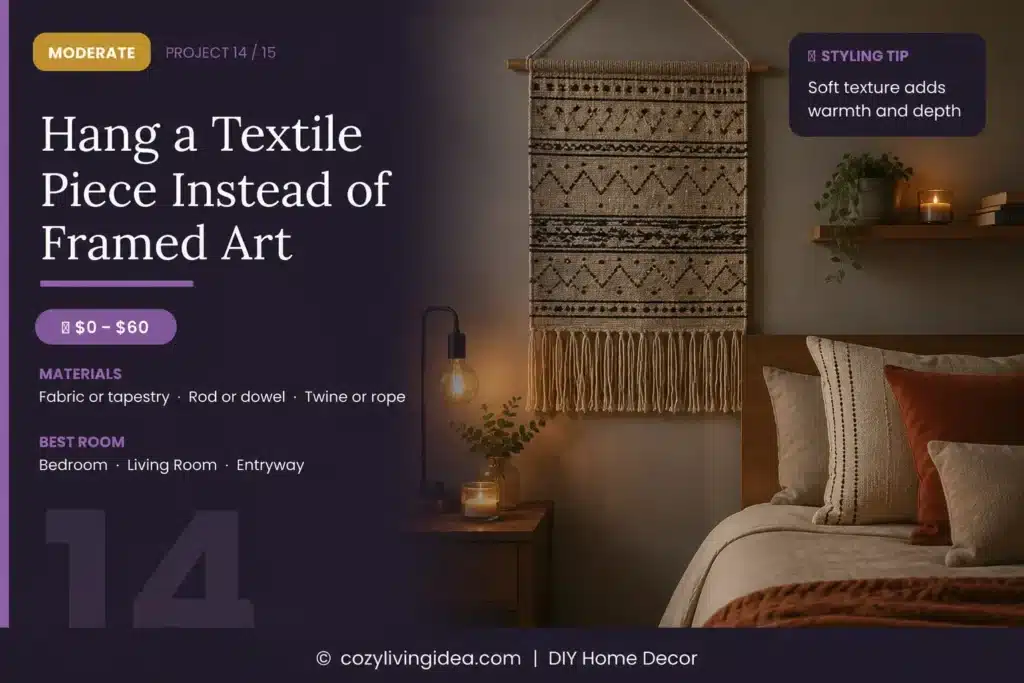
Quick take: $30–150 · 20 minutes · any size room
Where to find one: Vintage and estate sales often have textiles for far less than new woven wall art, and a piece with some wear or fading tends to look more intentional here than something brand new and stiff.
Designer tip: Size it to cover roughly two-thirds of the width of the furniture below it — the same scale rule that applies to framed art.
Hanging it right: A simple wooden dowel through a fabric sleeve at the top, with a length of cord or leather strap looped over a single hook, gives it the relaxed, gallery-style hang that makes textile art read as curated rather than makeshift.
15. Style nightstands with the rule-of-three tray method
Group your nightstand items on a small tray, using terracotta or ceramic vessels for texture: one lamp, one small object (a candle or terracotta vase), one short stack of books. The tray itself matters more than it seems — it visually contains the grouping, so the items read as a single styled vignette instead of separate objects that happen to share a surface.
Quick take: $20–80 · 15 minutes per side · any size room
Building the grouping: Start with the lamp, since it’s the tallest element and anchors the whole tray. Add the terracotta vessel next to it, then finish with the book stack on the opposite side so the tray has visual balance without being perfectly symmetrical.
Designer tip: Match lamp height and style across both nightstands. Symmetry here reads as far more finished than a mismatched pair.
One-nightstand rooms: If you only have space for a single nightstand, keep the same three-item rule but add a small dish for rings or glasses — in a one-sided room, that little bit of function matters more than it would with a matching pair.
Apartment Bedroom Color Ideas That Read as Cozy
Terracotta, warm blush, and amber create an enveloping feeling — best in colder climates or rooms without much direct sun.
Soft blue, sage, and dusty lavender feel calming and restful — best in rooms that already get plenty of bright light.
Warm white, greige, and oatmeal give you a flexible base and let furniture carry the personality — useful if you rent and plan to change accents later.
Clay, olive, and sand bring warmth without the intensity of a full accent wall, and pair naturally with reclaimed wood and rattan.
Shades of a single color feel calm and cohesive — especially useful in small rooms, where too much contrast can feel busy.
A dark accent against light bedding, or black fixtures against white walls, keeps an all-neutral room from going flat.
Cooler tones lower perceived energy and support winding down; warmer tones raise coziness but can feel more stimulating in excess.
cooler tones lower perceived energy and support winding down; warmer tones raise coziness but can feel more stimulating in excess. Most balanced bedrooms lean cool or neutral with one warm accent layered in.
Small Apartment Bedroom Storage Solutions
- ✓
Vertical storage: tall, narrow shelving or a ladder bookcase uses wall height instead of floor space
- ✓
Hidden storage: under-bed bins, a storage ottoman, or a frame with built-in drawers
- ✓
Multi-purpose furniture: a bench that opens for storage, a nightstand with drawers, a fold-flat desk
- ✓
Closet upgrades: a second hanging rod, slim velvet hangers, an over-the-door organizer
- ✓
Wall storage: floating shelves, hooks, or a small pegboard to clear surfaces
A clear horizontal surface — nightstand, dresser top, windowsill — reads as a calmer room even if the closet behind it is a mess.
Budget Bedroom Makeover Priorities
If you’re working with a tight budget, prioritize in this order:
Swap every bulb in the room for warm-toned (2700K–3000K) light
Add two or three new pillow covers instead of new pillows
Rearrange existing furniture so the bed isn’t the first thing seen from the doorway
Frame a few affordable prints instead of buying large-scale art
Add one or two indoor plants to an empty corner or nightstand
Layer a throw and rug over what you already own
Declutter every visible surface — free, and the single biggest visual shift
Renter-Friendly Bedroom Decor Rules
- ✓
Removable wallpaper or a fabric panel instead of paint
- ✓
Plug-in sconces instead of hardwired fixtures
- ✓
Weight-rated adhesive hooks and strips instead of nails
- ✓
A leaning headboard or freestanding divider instead of anything wall-mounted
- ✓
A floor lamp instead of a ceiling fixture
- ✓
Photograph your walls before hanging anything, so you know what to restore
- ✓
Check your specific lease before any change — policies vary more than people expect
Designer Secrets for an Expensive-Looking Apartment Bedroom
- ✓
Layer at least three textures (knit, linen, rattan) — one texture alone looks flat
- ✓
Layer your lighting — a lamp, a sconce, and an accent light beat one overhead source every time
- ✓
Use symmetry — matching nightstands and lamps read as intentional, not accumulated
- ✓
Mix materials — wood, wool, linen, and metal together add richness
- ✓
Get scale right — furniture and art sized to the room, not too small or too large
- ✓
Add contrast — a dark frame on a light wall gives the eye somewhere to land
- ✓
Leave negative space — expensive-looking rooms have some empty space too
- ✓
Support one focal point — usually the bed — and let everything else complement it
Common Apartment Bedroom Decorating Mistakes
| Mistake | Why it hurts | The fix |
|---|---|---|
| Furniture pushed flush to every wall | Leaves an awkward dead zone in the middle | Pull the bed slightly forward if space allows |
| Skipping a rug in a small room | Reads cold and unfinished | Size it to extend past the bed on two sides |
| Buying furniture before measuring | Common cause of a cramped feeling | Measure the room and doorway first |
| Overhead lighting only | Flat, harsh, no ambiance | Add one lamp or warm secondary source |
| Over-decorating every surface | Reads as clutter, not personality | Choose fewer, more meaningful pieces |
| Art sized too small for the wall | Looks like an afterthought | Size to two-thirds the width of furniture below |
| Everything matching exactly | Feels sterile | Add one contrasting texture or color |
Final Thoughts
None of this requires a renovation or a landlord’s permission. It requires a few deliberate choices — a texture you actually like touching, a light that’s warm instead of clinical, a corner that’s finally doing something for you.
Start with one idea from this list. Live with it for a week. Let the next one follow naturally.
Frequently Asked Questions
Use a leaning mirror to bounce natural light, size your rug to extend past the bed, keep the palette light and cohesive, and avoid furniture that’s too large for the room.
Warm neutrals, terracotta, warm blush, and deep earth tones — especially layered with warm lighting.
Removable wallpaper, fabric panels, oversized textiles, and lighting changes can shift a room’s feel without touching a single wall.
Layer three sources: ambient (overhead or floor lamp), task (a reading lamp), and accent (LED strips or a sconce).
A budget refresh runs $150–400. A fuller makeover with new furniture pieces runs $800–2,000+, depending on scope.
Large enough to extend past the bed on at least two sides — typically 8×10 for a queen, 5×7–6×9 for a twin or full.
Vertical shelving, under-bed baskets, a storage bench, and wall-mounted hooks recover space without needing floor footprint.
Stick to removable and freestanding changes — textiles, a leaning headboard, plug-in lighting, plants — and photograph the space beforehand.