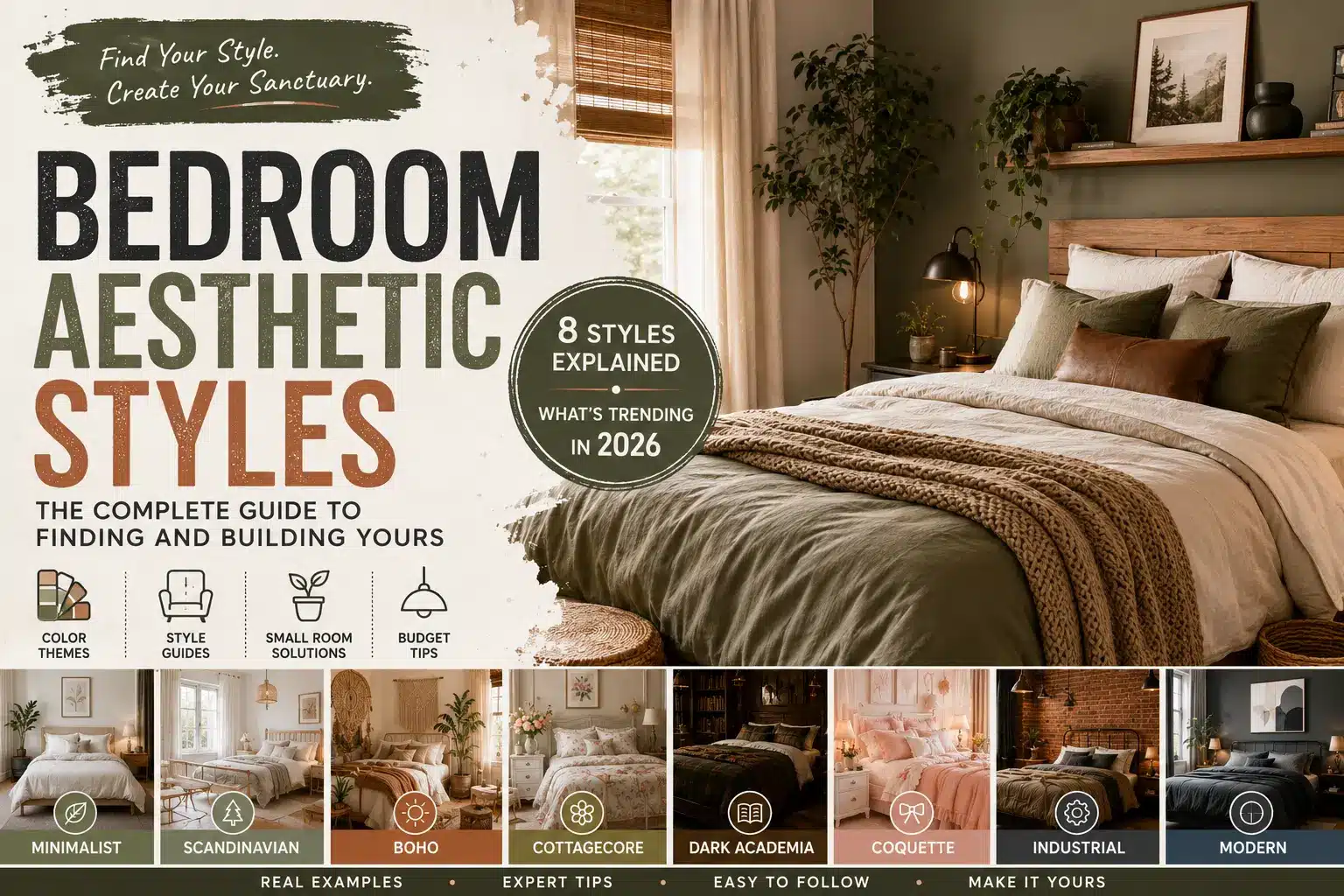
Bedroom Aesthetic Styles: The Complete Guide to Finding and Building Yours
Look up bedroom aesthetic styles and two kinds of content show up.
The first is a wall of photos — twenty, forty, sixty-plus — each captioned with a sentence that says almost nothing. The second is a “which bedroom style are you” quiz. Ten questions, then a single word: cottage core, minimalist, boho. Nothing about what to actually do with it.
Neither one solves the real problem. You don’t want a label — you want to know what a style is made of, whether it’ll work in the room you have, and how to build it without turning your bedroom into a Pinterest board that only looks good from one angle.
That’s what this guide does instead. Skip the quiz — Section 2 gets you to a style in about a minute. From there:
- ✓
A comparison table for all eight of the most-searched styles
- ✓
A repeatable formula for what makes any aesthetic bedroom actually look pulled together
- ✓
A full section on adapting any of it to a small room, since almost nothing else covers that properly
If your dream room inspiration board is a mess of dozens of styles that don’t agree with each other, this is the guide that turns it into one room. Once the bedroom itself is sorted, carrying that same palette into the rest of the house is a natural next step.
A bedroom aesthetic is built from four repeatable layers — color, texture, furniture silhouette, and lighting — not a single style label. Pick the aesthetic that matches your gut reaction in Section 2, then build it using the formula in Section 4. Everything else in this guide fills in the specifics.
Why Most Bedroom Aesthetic Styles Guides Leave You More Confused
Here’s the thing nobody says out loud: a photo of someone else’s finished bedroom doesn’t tell you how they got there. It shows the result, not the decisions.
That’s fine for inspiration. It’s useless for actually shopping. You end up with forty saved pins pulling in four different directions, no sense of which pieces matter most, and a color palette that only exists in your head because no single photo laid it out clearly.
A workable guide to bedroom aesthetic styles has to do the opposite of a photo dump. It has to name the ingredients, not just show the finished dish. That means:
- ✓
A real palette, not “moody tones” or “soft neutrals”
- ✓
Specific materials and furniture shapes, not just a vibe
- ✓
A build order, so money goes toward the pieces that matter first
That’s the structure the rest of this guide follows — and the reason it works better than another scroll of room inspo ideas with no organizing principle behind them.
Find Your Bedroom Aesthetic Style: A 60-Second Gut-Check
Skip the ten-question quiz. Answer this one instead: when you picture your ideal bedroom, what’s the first word that comes to mind?
- ✓
Calm, quiet, uncluttered → Minimalist or Scandinavian
- ✓
Warm, layered, collected → Boho or Cottagecore
- ✓
Moody, scholarly, a little dramatic → Dark Academia
- ✓
Soft, romantic, a bit girlish → Coquette or Soft Girl soft
- ✓
Sleek, current, a little edgy → Modern or Industrial
- ✓
All of the above, and I don’t want to choose → Read Section 8 on mixing styles before buying anything
That one-word instinct is more reliable than a quiz. It’s your actual first reaction, not an answer engineered to fit four multiple-choice options.
Hold onto that word. It’s the filter for every purchase from here on — the fastest way to keep a growing pile of room ideas aesthetic boards pointed at one room instead of five, and the difference between a folder of screenshots and actual dream room inspiration you can build from.
8 Bedroom Aesthetic Styles Compared at a Glance
Here’s what nearly every roundup skips: a side-by-side comparison. Scrolling through dozens of individual photos makes it hard to see how one style’s palette actually differs from another’s. A table fixes that in five seconds.
| Style | Color Palette | Signature Materials | Best For |
|---|---|---|---|
| Minimalist | White, oatmeal, taupe, charcoal | Clean-lined wood, matte finishes, no visible pattern | Anyone who wants an aesthetic bedroom that photographs as calm, not empty |
| Scandinavian | White, pale wood, soft gray | Light woods, wool, linen, tone-on-tone texture | A version of minimalism that still feels warm underfoot |
| Boho | Terracotta, rust, cream, sage | Rattan, macrame, mixed patterned textiles, plants | A collected, personal room built up over time, not bought in one trip |
| Cottagecore | Sage, cream, dusty florals | Ruffled linens, dried flowers, vintage wood furniture | A nostalgic, countryside feeling regardless of where you actually live |
| Dark Academia | Deep browns, forest green, burgundy | Leather, dark wood, brass, layered textiles | A moody, scholarly room that leans dramatic rather than airy |
| Coquette / Soft Girl | Blush, cream, soft pink | Ruffles, bows, satin, delicate florals | A romantic, feminine room with a lighter touch than full glam |
| Modern | White, black, gray, one bold accent | Metal, glass, sharp lines, minimal ornamentation | A sleek, hotel-like room that leans current rather than trendy |
| Industrial | Charcoal, black, exposed brick tones | Metal piping, raw wood, leather, Edison bulbs | An edgier room built around texture and material contrast rather than color |
Screenshot this before shopping anything. It’s the fastest way to catch a beautiful piece that doesn’t belong to your style at all — one of the most common reasons a room aesthetic ends up looking like four different rooms stacked on top of each other.
It’s also the quickest way to sort a scattered collection of room ideas aesthetic boards into one clear direction, and to check whether a piece of room inspo aesthetic content belongs to the style being built, or just looked nice scrolling past it.
The Formula Behind Every Great Aesthetic Bedroom
Every one of the eight styles above is built the same four ways. The style changes the specifics; the structure never does.
Pick the palette from Section 3 before buying a single item. Every other decision gets measured against it.
This is what separates a styled room from a matched one — mixed materials (wood against linen against metal) read as intentional in a way that one flat finish never does.
Rounded and soft for cottagecore or coquette, sharp and clean for modern or minimalist, chunky and natural for boho. The shape of the furniture does more for a style than any single accessory.
A warm lamp instead of an overhead fixture changes a room’s entire mood more than almost any decorative purchase — and it’s the one layer every style on this list shares.
Skip a layer, and even a beautifully chosen aesthetic ends up looking unfinished. Follow all four in order, and any of the eight styles above turns from a mood board into a real set of aesthetic bedroom ideas — one that can be built, piece by piece, starting today.
8 Bedroom Aesthetic Styles & Color Themes, Explained
Each of these eight builds out a different set of aesthetic bedroom ideas, but the same four-layer formula from Section 4 sits underneath every single one. The style changes; the color theme is what makes it instantly recognizable.
1. Minimalist
Minimalist strips a room down to what actually earns its place — one substantial piece of furniture, negative space treated as a design choice rather than an accident, and nothing on a surface without a reason to be there. The goal is calm, not empty.
Color theme: warm neutrals only — white, oatmeal, soft taupe, a touch of charcoal for contrast. No pattern, no competing accent color. The palette itself is the texture.
2. Scandinavian
Scandinavian takes minimalism and adds warmth back in through material, not color. Where straight minimalism can feel a little cold, this style solves it with pale wood, wool throws, and linen bedding layered on top of the same restrained base.
Color theme: white and pale wood tones, with soft gray as the only real departure from Minimalist’s palette. Think tone-on-tone rather than contrast — every shade in the room should sit within one or two steps of the next.
3. Boho
Boho is built on collected pieces rather than a matching set — rattan furniture, a macrame wall hanging, mixed patterned textiles, and plants in varying sizes. It’s the most forgiving style on this list for mixing old and new, since the whole point is that it looks gathered over time, not bought in one trip.
Color theme: terracotta, rust, and sage anchored by a cream base. Two or three accent tones can repeat across the room without clashing, as long as they all sit in the same warm, earthy family.
4. Cottagecore
Cottagecore leans into softness and nostalgia — ruffled linens, dried lavender, vintage or vintage-style furniture. It’s less about a specific era and more about a feeling: a quiet countryside morning, wherever you actually live.
Color theme: muted sage and cream, with the occasional dusty floral print as the only pattern allowed in. Nothing saturated or bright — every color in this palette should look like it’s been slightly sun-faded.
5. Dark Academia
Dark Academia trades pastel softness for deep, moody tones paired with leather, dark wood, and brass accents. It reads as scholarly and a little dramatic, closer to an old library than a typical bedroom.
Color theme: forest green, burgundy, and warm brown, grounded by black or espresso furniture. This is the one color theme on this list built to be dark on purpose — resist the urge to lighten it with white walls or pale bedding, or the mood disappears.
6. Coquette (Soft Girl)
Coquette is romantic and delicate — ruffled or bow-detailed bedding, satin textures, soft floral accents. It shares a palette with cottagecore but leans more polished and less rustic.
Color theme: blush pink and cream, occasionally lifted with a single deeper rose or red accent. Keep the palette almost entirely pastel; one saturated color is a highlight, three starts to look like a different aesthetic entirely.
7. Modern
Modern is defined by clean lines and restraint — metal, glass, and almost no ornamentation. Done well, it reads like a boutique hotel room.
Color theme: white, black, and gray, built around exactly one bold accent color. That single accent — a deep blue, an emerald, a rust — is doing all the personality work in an otherwise neutral room, so it’s worth choosing deliberately rather than defaulting to whatever throw pillow was on sale. The same one-accent restraint works just as well outside the bedroom; contemporary kitchen design leans on this exact principle in a much higher-traffic room.
8. Industrial
Industrial builds around raw texture instead of color — exposed materials, metal fixtures, leather, and warm Edison-style lighting against an otherwise dark, stripped-back palette. It’s the edgiest style on this list, and the one that leans hardest on lighting to keep it from feeling cold.
Color theme: charcoal, black, and exposed brick or concrete tones, with warm amber lighting as the only source of real warmth in the room. Skip pastels entirely here — even one soft accent color undercuts the whole look.
Whichever one matches the gut-check from Section 2, treat it as a starting point rather than a rulebook — the best bedroom inspo aesthetic boards borrow a detail or two from a neighboring style without losing the core color theme that ties the room together.
What’s Actually Trending in 2026
The eight styles above are the durable ones — the searches that hold steady year over year. But two things are worth knowing if the goal is a room that also feels current in 2026, not just timeless.
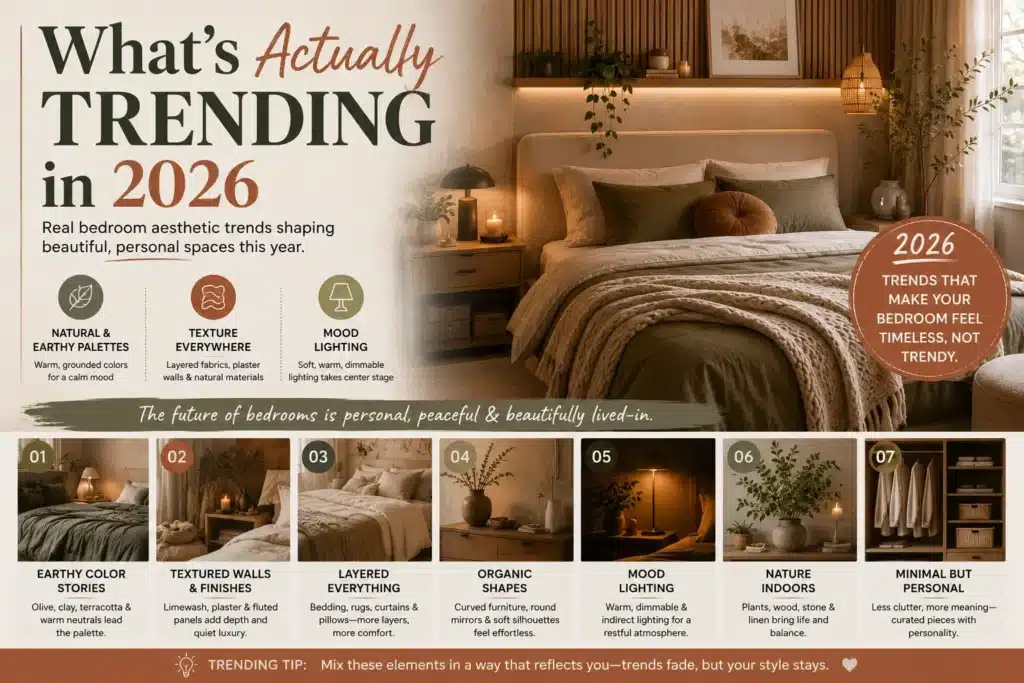
The color shifting under all eight styles. Pantone’s Cloud Dancer — a soft, putty-warm white — is quietly replacing the starker whites that used to anchor Minimalist and Scandinavian rooms, and a soft icy blue is showing up as its most common pairing. Neither one requires repainting: swapping the bedding to that palette does most of the work, since the bed is the single largest visual surface in the room.
The micro-aesthetics rising fast, but not built to last. Pinterest’s own trend data points to things like alien-core (holographic accents, bubble chairs) and circus-inspired interiors (bold stripes, sculptural silhouettes) as fast-rising searches this year.
They’re worth knowing about, but they behave more like a fashion trend than a bedroom aesthetic — best treated as a single accent layered onto one of the eight core styles above, not a full room built from scratch. A striped throw pillow or one holographic frame on an otherwise Minimalist or Modern base gets the current-feeling reference without betting the whole room on a trend that may not hold past this year.
Cozy Bedroom Aesthetic: Why It’s the Most Searched Style of All
Search interest for cozy bedroom aesthetic consistently outpaces every single named style above — including specific ones like boho or dark academia — and that’s because cozy isn’t really a style. It’s a quality every style on this list can have, or fail to have, depending on execution.
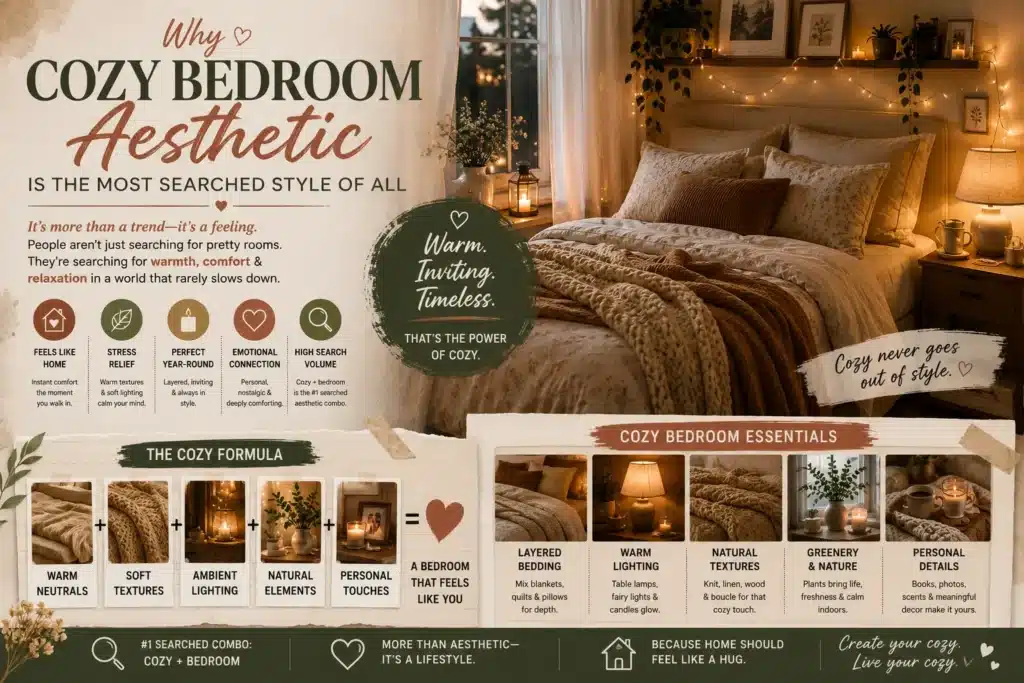
A minimalist room can be cozy with the right lamp and a chunky knit throw. A modern room can be cozy with layered lighting and one soft textile against all the hard surfaces.
What makes a room cozy has less to do with which aesthetic it belongs to. It comes down to three things: warm lighting instead of a cold overhead fixture, at least one soft textured layer within arm’s reach of the bed, and a palette that leans warm rather than stark, whatever the specific colors are.
That’s why “cozy” shows up as a modifier on almost every style search — cozy minimalist, cozy boho, cozy cottagecore. It’s not competing with the eight styles in Section 5. It’s a filter you can run any of them through.
Usually it’s the fastest fix when a cozy bedroom aesthetic was the actual goal all along, not a specific named style.
Room Inspo Ideas for Small Rooms: Adapting Any Style to a Tiny Space
This is the section almost every aesthetic roundup skips entirely, even though it’s one of the most searched angles on the whole topic.
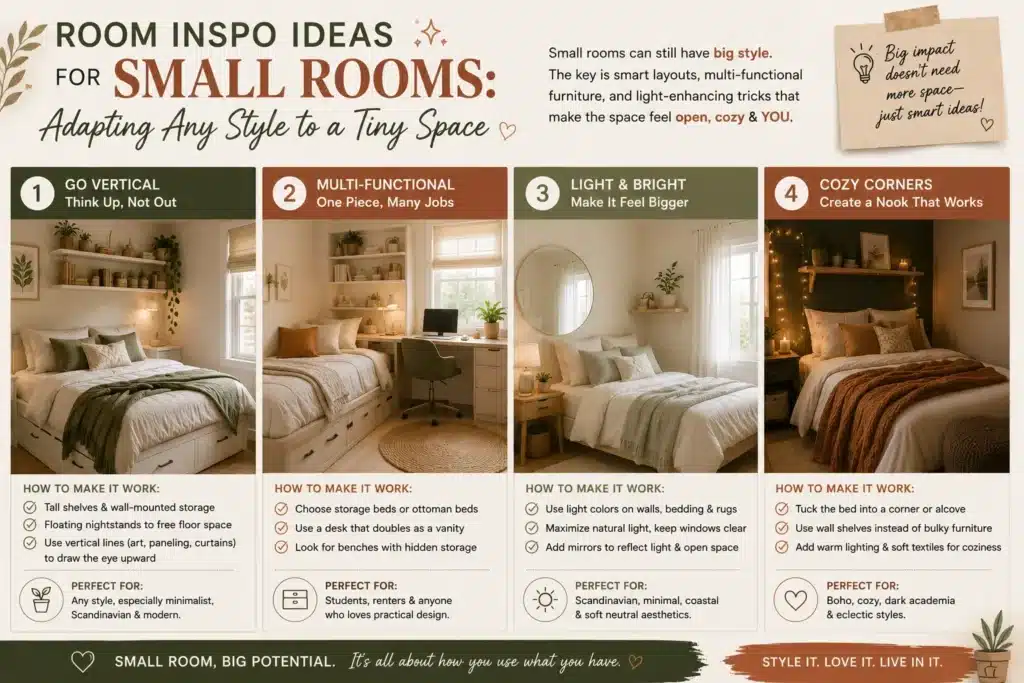
Room inspo ideas for small rooms don’t mean picking a different, “smaller” style. Every aesthetic from Section 5 can work in a tight space — it just means adjusting how each layer from Section 4 gets applied.
Color matters more in a small room, not less. Lighter, warmer tones from any style’s palette reflect available light and keep walls from visually closing in — a dark academia room can still work in a small space, just leaning toward its lighter browns rather than its deepest ones.
Furniture needs to multitask. A bed with built-in drawers, a nightstand that doubles as a shelf, wall-mounted lighting instead of a floor lamp that eats up walking space — every style has a compact version of its signature pieces, it just takes more intention to find them.
Vertical space does the decorating that floor space can’t. A gallery wall, hanging shelves, or a tall macrame piece brings in a style’s personality without taking up a single inch of square footage. This is where boho and cottagecore in particular translate beautifully to a small room, since both styles lean on wall-mounted texture already.
One statement layer, not five. A small room absorbs far fewer decorative choices before it starts to feel cluttered rather than styled. Pick the single most defining piece of whichever aesthetic was chosen in Section 2 — the macrame hanging, the brass lamp, the ruffled duvet. Let that one piece carry the style, rather than spreading five smaller pieces across a room that doesn’t have space to hold them all.
Good room inspo ideas for small rooms aren’t a separate aesthetic. They’re the same eight styles from this guide, built with fewer, more deliberate pieces — sometimes just one strong room idea executed well instead of ten half-finished ones. Dorm rooms push that constraint to the extreme, which is exactly what dorm bedding ideas digs into: fitting any of these eight styles onto a Twin XL bed in a shared space.
Can You Mix Two Bedroom Aesthetics?
Yes — and most real bedrooms, the kind people actually live in rather than photograph for a portfolio, are some kind of mix already. The trick is mixing on purpose instead of by accident.
The safest way to combine two styles is to borrow the palette from one and the furniture silhouette from another, rather than mixing both at once.
A dark academia palette with cottagecore’s softer, rounded furniture shapes reads as intentional. A dark academia palette and dark academia furniture and a completely different lighting style on top reads as three separate rooms competing for the same four walls.
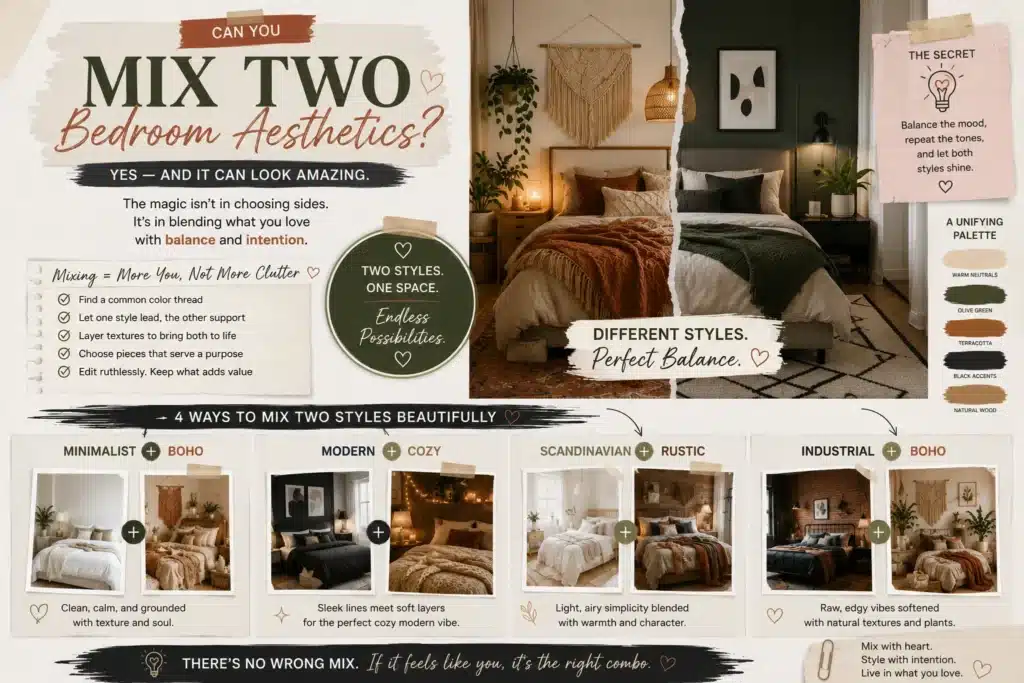
A second reliable approach: pick a dominant style at roughly 70 percent of the room, then let a second style show up only in accessories. A boho macrame piece in an otherwise minimalist room. One coquette-style ruffled pillow on an otherwise modern bed.
The dominant style holds the room together. The second one adds personality without diluting it.
What doesn’t work is treating every piece of bedroom inspo aesthetic content as equally weighted. If five pins are minimalist and one is maximalist glam, that one outlier isn’t a style decision — it’s noise.
Mixing styles well means choosing the ratio on purpose, not letting whatever caught your eye that week decide it for you.
Aesthetic Room Decor on a Budget: Building the Look Without a Redesign
None of the eight styles in Section 5 require new furniture or a paint job to start showing up in a room. Budget-friendly aesthetic room decor works the same four-layer formula from Section 4, just starting from the top of the list and stopping wherever the budget runs out.
- ✓
Textiles first – A duvet cover, a throw, and two or three pillows in the right palette do more to shift a room’s style than any other single purchase, and they’re fully reversible if the style changes later.
- ✓
Lighting second – A warm bulb swap and one plug-in lamp cost very little and affect the mood of the whole room more than most decorative purchases combined.
- ✓
One statement piece third – A macrame hanging, a brass mirror, a vintage-style frame — whatever single item most defines the chosen aesthetic, bought once it fits the palette rather than on impulse. Boho and cottagecore statement pieces in particular don’t have to be bought at all — DIY home decor using recycled materials has budget-friendly ways to make one instead.
- ✓
Furniture last, if at all – Existing furniture can usually be reframed with the right textiles and lighting around it; a full furniture swap is the most expensive way to shift a style and rarely the first thing that’s needed.
Building in that order keeps a limited budget going toward the changes that are felt every day, not just the ones that photograph best on move-in day.
It’s also the fastest way to make aesthetic room decor feel worth the money instead of like a pile of purchases that never quite added up to a finished room. When the budget is especially tight, Dollar Tree craft ideas shows how to stretch that last category further without the finished pieces looking cheap.
Mistakes That Make an Aesthetic Bedroom Look Try-Hard
A handful of avoidable mistakes come up again and again, even with a genuinely good style choice behind them — the kind of small missteps that turn a promising set of aesthetic bedroom ideas into a room that feels staged rather than lived-in.
Buying every item from one style’s “starter kit” at once. A room furnished entirely from a single aesthetic’s signature pieces, purchased in one trip, often reads as staged rather than lived-in. The most convincing aesthetic bedrooms were built a few pieces at a time.
Skipping the color layer and jumping straight to accessories. A macrame hanging or a moody lamp means very little sitting on top of a palette that was never actually chosen. Section 4’s order exists for a reason — color first, always.
Copying a photo exactly instead of adapting the formula. A photographed room was built for its specific space, light, and furniture. Borrowing the palette and materials from Section 3 works in any room; copying the exact layout rarely does.
Ignoring scale in a small room. As covered in Section 7, a small space absorbs far fewer statement pieces before it tips into clutter. One defining piece per style beats five competing for the same wall.
Treating “cozy” and “style” as the same decision. As covered in Section 6, warmth is a filter that applies across every aesthetic, not a ninth style competing with the other eight. Trying to force a specific “cozy aesthetic” often means missing the actual style underneath it.
Final Thoughts
Good bedroom aesthetic styles aren’t found in a ten-question quiz or a forty-photo scroll. They come from naming a real palette, a real texture story, and a real furniture silhouette, then building all three in the same order every time: color, texture, furniture, lighting.
That’s true whether the room is a spacious primary bedroom or the smallest room in the house.
Start with the gut-check in Section 2. Cross-reference it against the comparison table in Section 3. Build from there one layer at a time.
Do that, and what started as a scattered folder of room inspo aesthetic screenshots turns into an actual room — one that still looks like the room you meant to build a year from now, not just on the day it was finished.
That’s the real difference between a pile of loose room ideas aesthetic boards and genuine dream room inspiration worth acting on — the kind of bedroom inspo aesthetic that holds up long after the trend it borrowed from has moved on.
Frequently Asked Questions (FAQ)
Picture your ideal bedroom and note the first word that comes to mind — calm, warm, moody, romantic, sleek, or edgy. That instinct maps directly to one of the eight styles in Section 3 faster than a multi-question quiz ever will.
Cozy isn’t a standalone style — it’s a quality (warm lighting, soft texture, a non-stark palette) that any of the eight aesthetics in this guide can have. See Section 6 for the full explanation.
Yes. Every style in this guide works in a small room — it just means choosing one defining statement piece instead of five, and leaning on vertical wall space instead of floor space. Section 7 covers the full approach.
Yes, as long as it’s intentional. The safest approach is picking one dominant style at roughly 70 percent of the room and letting a second style show up only in accessories, rather than mixing furniture, palette, and lighting from different styles all at once.
Start with textiles — a duvet cover, a throw, and two or three pillows in the right palette — then move to lighting. Both are inexpensive, fully reversible, and covered in more detail in Section 9’s budget breakdown.