Budget Home Decor Ideas: The Complete Guide to Decorating Without Overspending
Search budget home decor ideas and you’ll get the same list, over and over. Fifty-plus photos. Thrift a mirror. Add plants. Hang some art. None of it is wrong, exactly. It’s just not enough to run a real budget on.
Here’s what’s missing from almost every one of those lists: a number. Not one of them tells you what $50 actually buys versus $250, which purchases are worth stretching for and which ones you should never pay full price on, or how to avoid the single most common outcome of decorating cheap — a room that looks cheap.
This guide fixes all three. There’s a real splurge-vs-save rule, a dollar-by-dollar breakdown of what different budgets actually accomplish, and eighteen specific ideas sorted by room instead of dumped into one long scroll. If your budget decorating ideas board is full of pretty pins and zero plan, this is the guide that turns it into an actual room — and if the goal stretches beyond one room, picking an overall direction for the whole house is worth doing before any of it gets shopped for.
the fastest way to make a limited budget go further is to spend on the two or three things you touch or see every day — a sofa, a rug, your lighting — and save everywhere else. Everything below builds out exactly where that line sits, room by room.
Why Most Budget Home Decor Ideas Lists Leave You Broke Anyway
Here’s the trap: a fifty-item list of cheap things to buy doesn’t add up to a decorated room. It adds up to fifty small purchases with no order, no priority, and no sense of which ones matter most.
Buy the cheap throw pillows first and the good sofa never happens. Buy five decorative accents before the lighting gets fixed, and the room still looks flat under a bare overhead bulb no matter how many pillows are on the couch.
A workable plan for budget-friendly decor needs a spending order, not just a shopping list. Two things drive that order:
- ✓
Some purchases get touched daily. Others barely get touched at all. The first category deserves more of the budget. The second almost never does.
- ✓
Cheap and cheap-looking are two different problems. A five-dollar frame can look expensive with the right mat and placement. A fifty-dollar throw pillow can still look cheap if the fabric is wrong for the room. Price and appearance don’t move together the way most lists assume.
That’s the structure the rest of this guide follows — the difference between a pile of budget-friendly decor purchases and an actual plan to decorate on a budget with something to show for it.
The Splurge-vs-Save Rule Nobody Applies to Budget Decorating Ideas
Interior designers have talked about splurge-vs-save for years. Almost nobody folds it into an actual budget home decor ideas list — which is exactly why so many budget rooms end up spending evenly across everything and ending up mediocre everywhere instead of great in the places that matter.
The rule is simple: splurge on what you touch, save on what you look at.
Splurge categories:
- ✓
Seating you actually sit in — a sofa, a bed, a favorite chair. These get used every single day and show wear fastest when they’re cheap.
- ✓
Rugs, specifically sized correctly for the room. An undersized cheap rug reads as cheap far more than an oversized quality one costs to fix.
- ✓
Lighting you switch on daily — a bedside lamp, an overhead fixture in the main living space. Cheap lighting usually means cheap-looking light, and that affects everything else in the room.
Save categories:
- ✓
Trend-driven accessories — throw pillows, seasonal decor, small vases. These get swapped out anyway, so spending big on them is money that won’t last past the trend.
- ✓
Accent furniture you don’t sit in or use daily, like a side table or an accent chair used only occasionally.
- ✓
Art and frames, especially in the early stages — this is one of the easiest categories to DIY or thrift well, covered more in Section 6.
Running every future purchase through this filter is the single highest-leverage habit in this entire guide. It’s the difference between decorating on a budget that reads as intentional and one that reads as a pile of cheap purchases that happened to end up in the same room.
Decorating on a Budget by Dollar Amount: What $50, $100, and $250 Actually Buys
Most budget guides talk in vague terms — “affordable,” “inexpensive” — without ever naming a number. Here’s what different inexpensive home decor ideas realistically accomplish at each tier, based on the splurge-vs-save rule from Section 2.
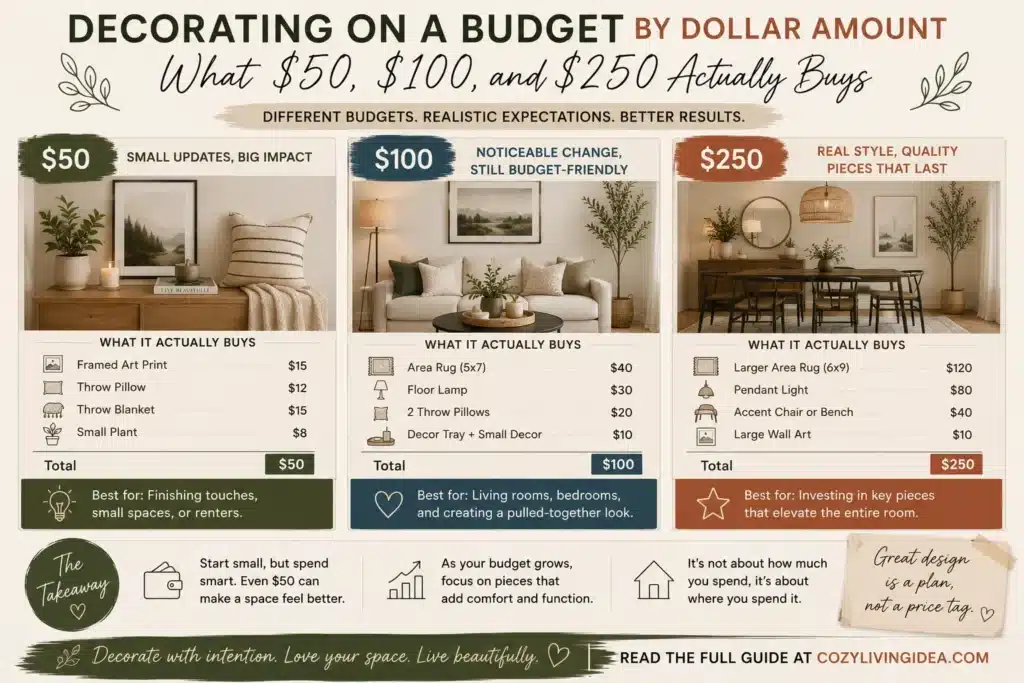
With $50: One category, done well. A can of paint and supplies for an accent wall. A set of new throw pillow covers. A few thrifted frames and a printable art set. This is the tier for testing a color or style direction before committing to a full round of budget-friendly decor.
With $100: One full save-category upgrade, or two smaller ones. A budget-friendly area rug for a small room. A lamp plus a bulb swap for the whole room’s lighting mood. A curtain rod and a set of budget curtains, which changes a window’s whole presence for relatively little.
With $250: The first real splurge-category purchase becomes possible — a quality secondhand accent chair, a well-made rug for a mid-sized room, or a genuinely good lamp plus a full round of save-category accessories to go with it. This is usually the tier where a room starts to look finished rather than just improved.
Beyond $250: Money starts going toward the true splurge items from Section 2 — a sofa, a real bed frame, professional-grade lighting. Everything built at the $50 and $100 tiers doesn’t get wasted here; it becomes the accent layer around the bigger piece instead of getting replaced.
Working through these tiers in order — rather than spending $250 all at once on whatever looks nicest — is what keeps a home decor on a budget project from stalling out halfway through a room.
What’s actually trending right now in 2026?
Pinterest’s 2026 forecast points to warm creams and oat tones replacing the stark whites that dominated budget rooms for years — good news for anyone on a budget, since a warm off-white paint or bedding swap costs the same as a stark white one. Terrazzo-inspired patterns are also having a moment, showing up on cheap peel-and-stick tile and trays rather than actual stone.
And the single biggest budget-decor trend by volume isn’t a color at all — it’s the thrift flip, a format built entirely around taking a secondhand piece and reworking it, with the transformation itself being the point. All three fit directly into the splurge-vs-save rule from Section 2: none of them require new furniture, just a different finish on what’s already being bought.
The 4-Layer Order: How to Decorate on a Budget Without It Looking Cheap
Every well-decorated budget room, expensive or not, gets built in the same order. Skipping ahead to the fun layer before the boring one is the most common reason a room still looks unfinished after real money has gone into it.
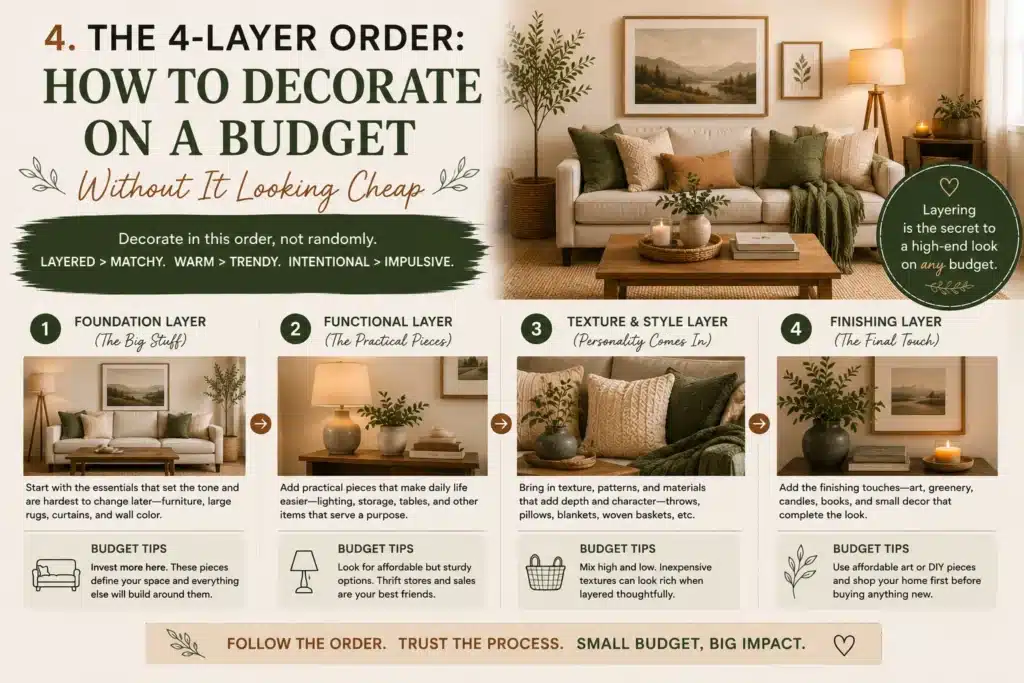
A wall color, a peel-and-stick option for renters, or simply a consistent palette across existing furniture. This is the cheapest layer to get right and the most expensive to fix later if it’s wrong — naming a specific style direction before shopping makes this step far less guesswork.
The sofa, the bed, the rug — whatever the room’s splurge categories are from Section 2. These get chosen before anything decorative, since every other purchase is measured against them.
A warm bulb swap and at least one lamp beyond the overhead fixture. This single layer affects a room’s mood more than almost any decorative purchase that comes after it.
Pillows, art, plants, small decor. This is where most cheap home decor ideas roundups start and stop — which is exactly why so many budget rooms feel unfinished even after a lot of shopping.
Building bottom to top instead of top to bottom is the real difference between a room that reads as affordable home decor done well and one that reads as a collection of cheap purchases with nothing holding them together.
18 Budget Home Decor Ideas by Room
Here’s where the four-layer order from Section 4 turns into specific, build-able ideas — sorted by room instead of dumped into one long scroll. Each one gets a full explanation, not just a name, since the “why” is usually what makes an idea actually work instead of falling flat.
1. Budget-friendly Living Room Decor Ideas
Rearrange before buying anything. Pulling furniture a few inches off the wall or angling a chair toward a window often solves what felt like a shopping problem. Most living rooms default to a layout that pushes everything against the walls, which leaves a dead zone in the middle and makes the room feel like a waiting area instead of a place to sit. Floating the sofa even slightly, or turning a chair to face a window instead of the TV, usually fixes the “something feels off” problem for free.
One quality rug, sized correctly. An undersized budget rug reads as an afterthought; a correctly sized one anchors the whole room. The sizing rule that actually matters: at minimum, the front legs of every major piece of furniture should sit on the rug. A rug that only fits under the coffee table, with the sofa and chairs floating around the edges, is the single most common rug mistake in budget living rooms — and it’s a layout problem money can’t fix without buying a bigger rug in the first place.
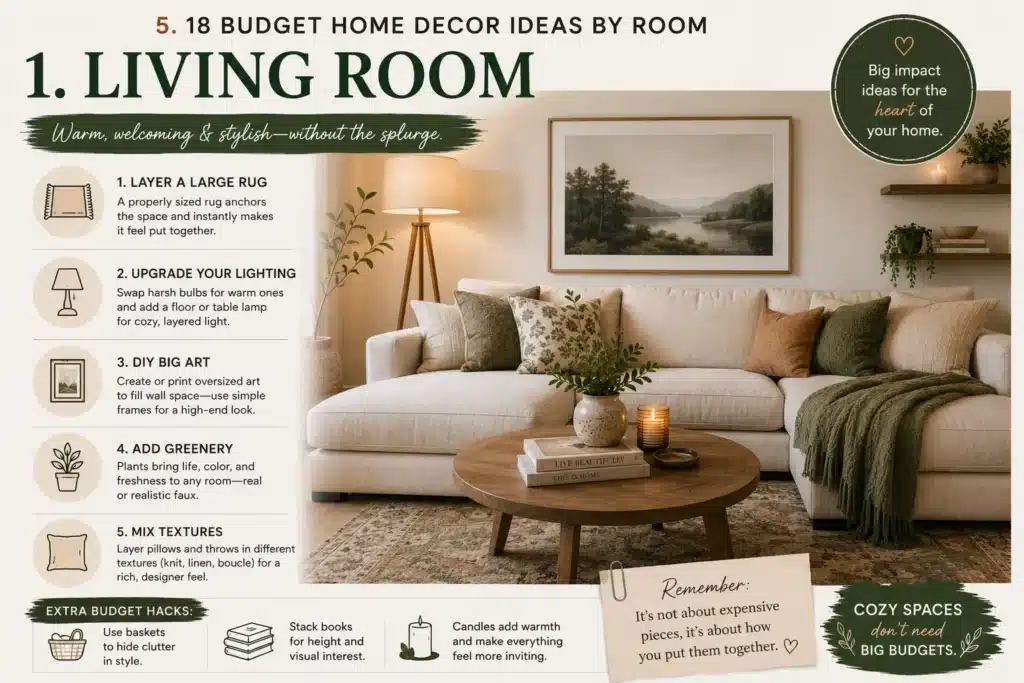
Swap lampshades instead of lamps. A new shade changes the light’s warmth and the fixture’s whole look for a fraction of a full lamp’s cost. A dated brass lamp with a fresh linen or fabric shade looks like an entirely different, more expensive piece, and shades are one of the few home decor items where the cheap version and the expensive version look nearly identical once installed.
Layer two throw blanket textures on the sofa for depth without buying new furniture. One knit, one smooth — draped rather than folded — reads as intentional in a way that a single matching throw pillow-and-blanket set never quite does. Texture is doing the work that a second piece of furniture would otherwise have to do.
Style the coffee table in threes — a tray, a stack of books, one small object — instead of leaving it either bare or cluttered. Three items with varying height (low tray, medium book stack, one taller object) creates a small visual landscape instead of a flat arrangement. This is the fastest single styling trick in this whole list to execute, and it costs nothing if the items are already in the house.
2. Affordable Bedroom Makeover Ideas
Fold the duvet down instead of pulling it all the way up, so the bed reads as fuller and more intentional. A duvet pulled flush to the headboard flattens visually; folding it back a third of the way down exposes the top sheet or a contrasting pillow layer underneath, which is the exact styling trick hotel and catalog beds use to look intentionally made rather than just made.
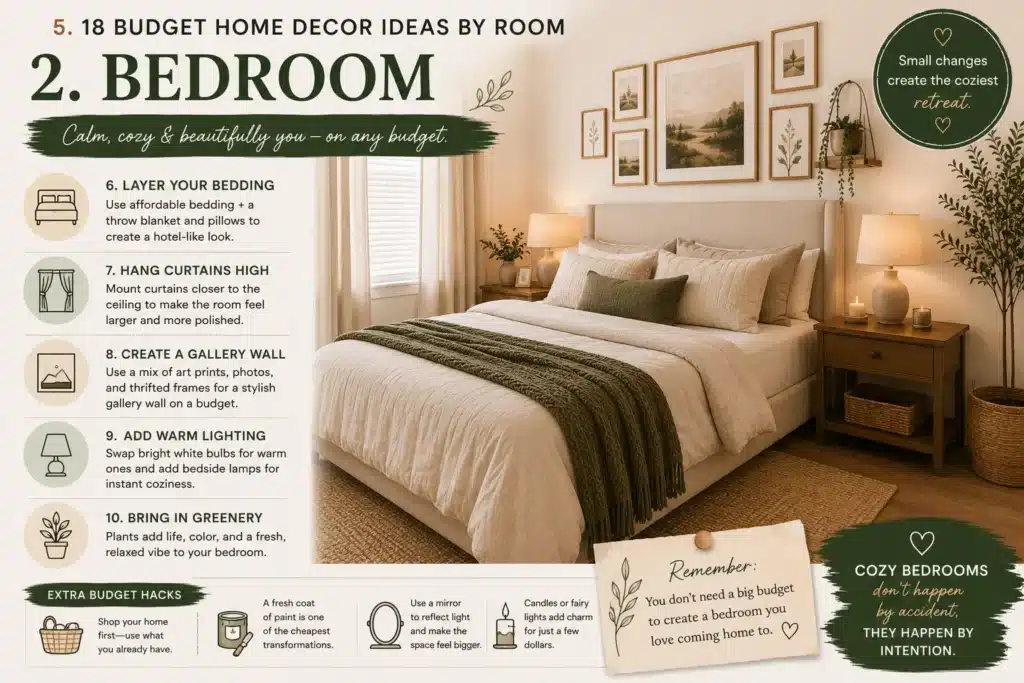
Add a headboard alternative — a large piece of fabric, a leaning mirror, or an oversized art print behind the bed — for the visual impact of a real headboard at a fraction of the price. A headboards real job is filling the vertical space behind the bed so the wall doesn’t read as empty; almost anything large enough to do that job visually reads as a headboard, even if it technically isn’t one. The same trick works at an even tighter budget in a Twin XL dorm setup, where a real headboard usually isn’t an option at all.
Swap one lamp for a warmer bulb on the nightstand, which does more for a bedroom’s mood than almost any other single change. A cool white bulb in a bedroom fights against everything else in the room trying to feel restful; a warm 2700K bulb costs the same as a cool one and instantly makes the whole space read as calmer, without touching a single other item.
Rehang existing art at eye level, roughly 57 inches to center, which instantly makes it look more intentional. Art hung too high is the single most common styling mistake in budget bedrooms, and it’s a five-minute fix using art that’s already owned — no new purchase required at all.
3. Budget Kitchen Decor Ideas
Add a runner rug for warmth underfoot and an easy hit of color. Kitchens are almost entirely hard surfaces — tile, cabinetry, countertop — so a single soft, colorful element does disproportionate work in warming up the room compared to how much it costs.
Swap cabinet hardware — one of the cheapest ways to shift a kitchen’s whole mood, and a small-scale entry point into the sleeker, more restrained contemporary kitchen design principles for anyone eyeing a bigger refresh eventually. Most cabinet hardware installs with the same screw holes already drilled, which means the swap itself takes an afternoon and requires no tools beyond a screwdriver — brushed brass instantly reads as warmer and more updated, while matte black leans sleeker and more modern.
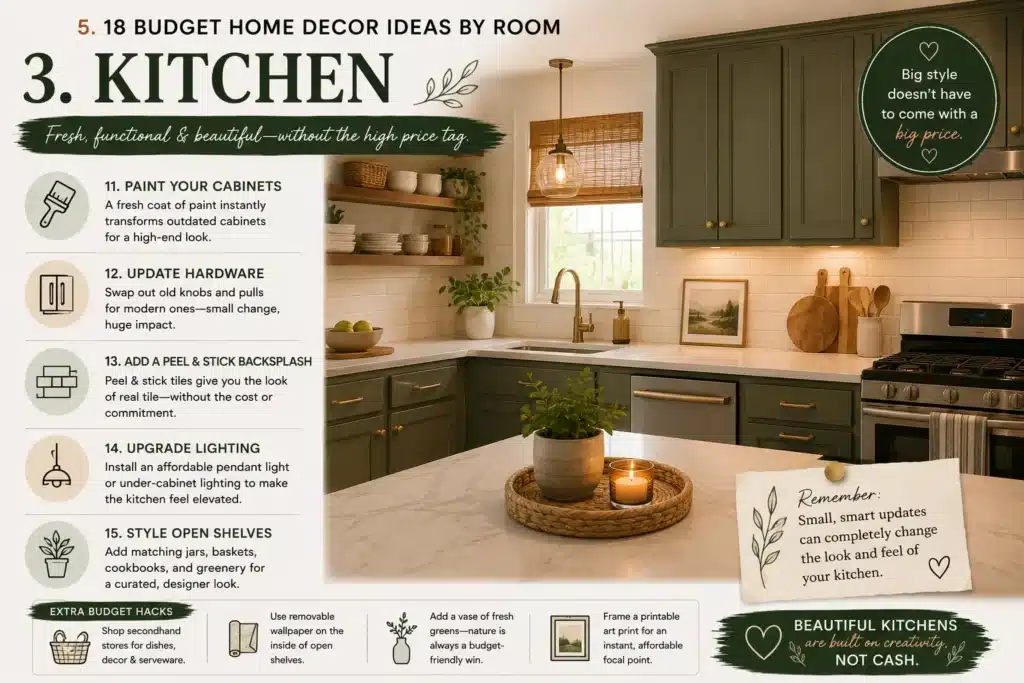
Style open shelving with what’s already owned, grouped by color or height instead of function alone. Grouping a set of white bowls together, rather than scattering white dishes across three different shelves mixed with everything else, turns ordinary kitchenware into a styled display without buying a single new item.
Add one plant near the window, which softens a kitchen’s hard surfaces more than most people expect. A kitchen is one of the only rooms in the house where a plant is also functional — herbs on a windowsill do the same visual softening job as a purely decorative plant, with the added benefit of actually getting used.
4. Bathroom Decor Ideas
Replace towels and a bath mat for an instant color and texture refresh with zero installation. Bathrooms have very little surface area to decorate, which means textiles carry a disproportionate share of the room’s whole look — new towels alone can shift a bathroom’s entire color story in under five minutes.
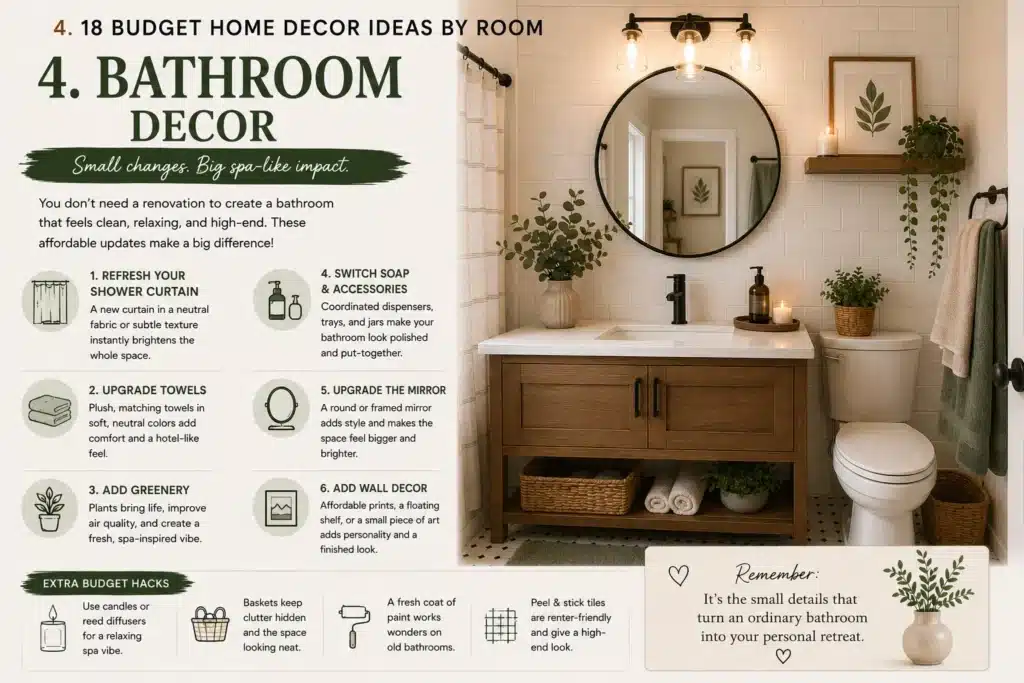
Add a small framed print in a waterproof frame or laminated print for a room that usually gets skipped entirely. Most people never consider art for a bathroom at all, which makes it one of the easiest rooms in the house to feel finished ahead of a guest’s expectations — a single small print does more relative work here than the same print would in an already-decorated living room.
Swap the shower curtain, one of the highest-impact, lowest-cost changes in the whole house. A shower curtain is often the single largest fabric surface in a bathroom, so its color and pattern set the tone for the entire room more than any other individual item.
5. Entryway and Beyond Decor Ideas
Use command-strip hooks for bags and coats, freeing up a console or bench below for styling. An entryway that’s constantly covered in daily-use items never looks decorated no matter what’s underneath; solving the function problem first with hooks is what actually makes the styled surface below possible.
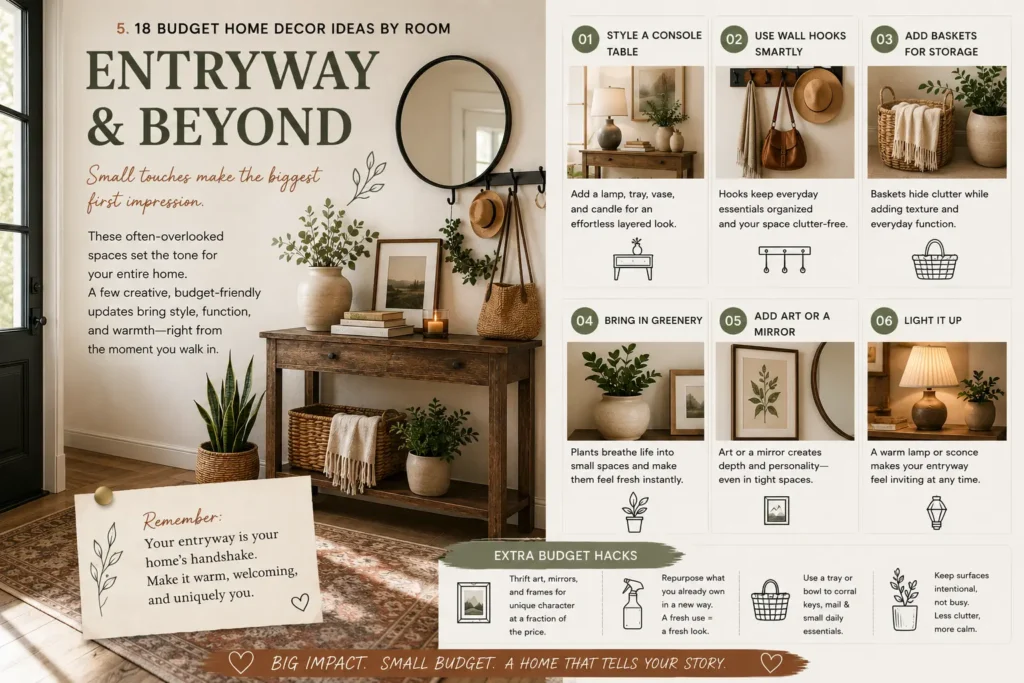
Add one styled surface — a small tray, one object, a plant — anywhere guests pass through, since even a tiny transition space benefits from the same intentional layering as a full room. A hallway console or a single shelf by the door is often the very first thing a guest sees walking in, which makes it one of the highest-visibility, lowest-cost styling opportunities in the entire house.
Every one of these fits inside the $50–$100 tiers from Section 3, and none of them require touching the room’s actual walls or built-ins.
Cheap Home Decor Ideas That Still Look Expensive
Some of the most convincing rooms in this whole guide were built almost entirely from cheap home decor ideas — the trick is knowing which inexpensive home decor ideas actually photograph and feel expensive, and which ones don’t.
Frames and mats do more than the art inside them. A plain black or white frame with a wide mat around a printable or thrifted print reads as gallery-quality, even when the print itself cost almost nothing. Skipping the mat, or using a mismatched frame, is what makes budget art look budget.
Odd numbers beat even ones. Three candles instead of two, five books instead of four. Grouped in odd numbers, cheap accessories read as styled; in even numbers or pairs, they read as mismatched leftovers.
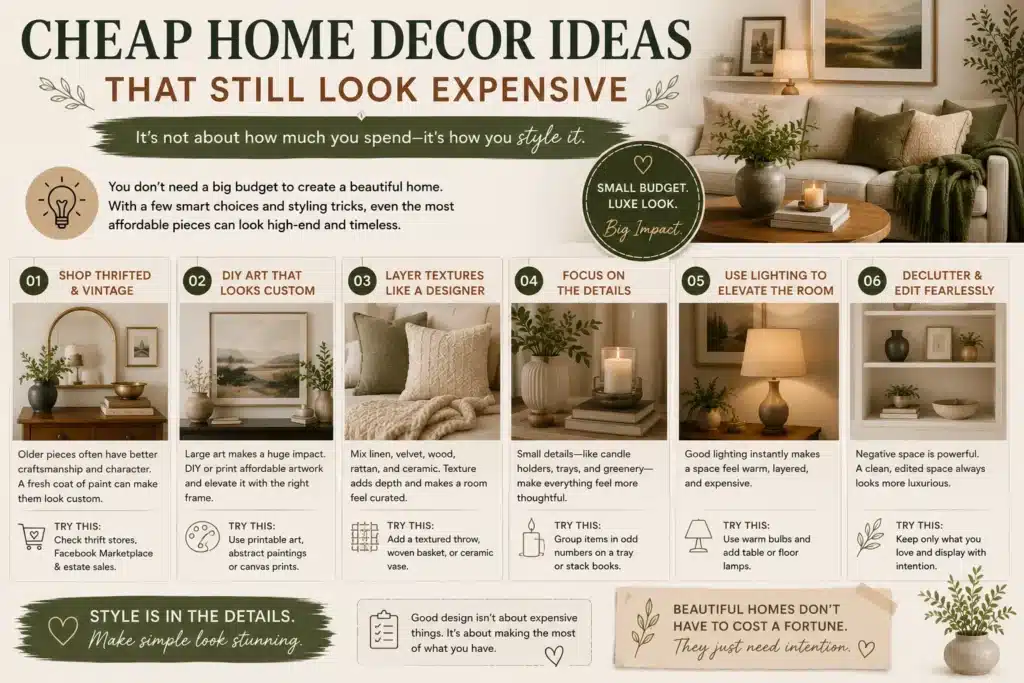
Height variation is free. Stacking books under a lamp, or propping one frame slightly behind another, adds the kind of visual interest that expensive rooms have — at no cost beyond rearranging what’s already there.
Natural materials age better than synthetic ones. A budget wood or rattan piece holds up visually even as it wears; a budget plastic or laminate piece looks worse every month. When a purchase has to be cheap, choosing the natural-material version over the synthetic one is almost always worth it. For the cheapest possible price point, shopping and styling Dollar Tree finds the right way follows this exact same logic — the item matters less than what gets done with it afterward.
Renter-Safe Budget Decorating Ideas With Zero Deposit Risk
Most people gathering decorating on a budget ideas right now are renting, which rules out paint, permanent fixtures, and anything that touches the walls or cabinets. Every idea in this guide is still achievable within those limits.
- ✓
Peel-and-stick over paint for color, pattern, or even a faux-tile backsplash look in a rental kitchen.
- ✓
Command strips over drilling for art, mirrors, and light floating shelves.
- ✓
Furniture over built-ins — a freestanding shelf or rolling cart delivers storage without touching a wall.
- ✓
Plug-in and battery lighting instead of rewiring, for the warm layered light covered in Section 4.
- ✓
Tension rods and clip-on shades for window treatments that install and remove without a single screw.
None of these require a landlord’s sign-off or a deposit at risk, which is exactly why they’re worth doing first when the goal is to decorate on a budget without any renovation risk at all.
Where to Actually Shop for Affordable Home Decor
The venue matters almost as much as the item. A few reliable sources for affordable home decor, sorted by what they’re actually good for:
- ✓
Thrift stores and estate sales — best for solid wood furniture, frames, and one-of-a-kind accent pieces. Worst for anything that needs to match a specific color exactly.
- ✓
Facebook Marketplace and local listings — best for larger splurge-category furniture at a fraction of retail, especially near move-out season in college towns.
- ✓
Big-box budget retailers — best for save-category items like curtains, small storage, and seasonal accessories where consistency matters more than character.
- ✓
Dollar and discount stores — best for small styling props (vases, trays, candle holders) that get elevated with the grouping and height tricks from Section 6, not for anything load-bearing or daily-use.
Spreading purchases across these sources, rather than buying everything from one place, is usually what keeps a room from reading as a single matched set — one of the quiet signals of a room built up over time instead of bought in one trip. Rotating between two or three of these sources is also how the best inexpensive home decor ideas avoid looking like they all came from the same clearance aisle.
Mistakes That Make Budget Home Decor Ideas Look Budget
A handful of avoidable mistakes come up again and again, even with genuinely good taste behind them — the same handful that turn a promising home decor on a budget plan into a room that still feels unfinished.
Buying every item from the save category and nothing from the splurge category. A room built entirely from cheap accents with no anchor piece never quite holds together, no matter how well each individual item was chosen.
Skipping the color layer and jumping straight to accessories. As covered in Section 4, decorative purchases mean very little sitting on top of a palette that was never really decided.
Undersizing the rug to save money. This is one of the most common budget mistakes in the whole category — a too-small rug makes an entire room look smaller and cheaper than an empty floor would.
Buying a full matching accessory set. A bundled set of pillows, art, and accessories from one collection often reads as staged. Mixing pieces from different sources, tied together by the color layer instead of a matching label, reads as more intentional.
Ignoring lighting entirely. Cool white overhead bulbs undercut even a well-chosen palette and quality furniture. It’s one of the cheapest fixes on this whole list and one of the most skipped.
Conclusion
Good budget home decor ideas aren’t really about finding cheap things — they’re about knowing where to spend, where to save, and what order to buy in. The splurge-vs-save rule from Section 2 and the four-layer order from Section 4 matter more than any single item on the list in Section 5.
Start with whichever room gets the most daily use, work through the dollar tiers in Section 3 in order, and let the room build up over a few paychecks rather than one big trip. Do that, and a genuinely limited home decor on a budget project produces a room that looks intentional — not a room that just happens to be full of cheap things.
Frequently Asked Questions (FAQ)
Fix the lighting. A warm bulb swap and one lamp beyond the overhead fixture changes a room’s entire mood for under $30, and it’s the cheapest high-impact move in this whole guide.
It depends on the tier — see Section 3 for a full breakdown. A single accent wall or a full lighting refresh is achievable for around $50; a genuinely finished small room, including one splurge-category piece, is realistically $250 and up.
Anything used daily — a sofa, a bed, a mattress, and the rug in your main living space. These wear out fastest when cheap and are the hardest to compensate for with styling alone.
Yes. Every idea in this guide works within typical rental restrictions — see Section 7 for the full renter-safe rulebook, covering everything from peel-and-stick options to command-strip hangers.
Usually because the spending order was backward — accessories bought before the color and anchor-piece layers were settled. Section 4 covers the order that actually prevents this.