DIY Home Decor Projects: The Skill-Level Guide to Picking (and Finishing) One
If you search “DIY home decor projects” you’ll land on list after list of 25, 30, even 39 ideas — and almost no guidance on which one is right for a Saturday afternoon versus which one quietly eats your whole weekend. That gap is why so many Pinterest-saved projects never get started, and why the ones that do get started sometimes don’t get finished.
This guide skips the giant idea dump. It sorts DIY home decor ideas by what determines whether you’ll finish one — time, tools, and skill — gives you a real toolkit to shop for once instead of piece by piece, and calls out a few trending projects that look better in a video than they hold up in daily use.
before picking any project, match it to what you actually have on hand this weekend — a free hour, a free day, or a free month — rather than to how good it looks online. A project scaled to your real time and tools gets finished. One scaled to your ambition usually doesn’t.
If you’re new to this, the short version is even simpler: the best DIY home decor projects for beginners are the ones with no dry time, no power tools, and a full redo possible in minutes if the first attempt doesn’t land — start there before anything with a learning curve.
1. Why Most “DIY Home Decor Projects” Lists Leave You More Overwhelmed, Not Less
A list of 30 ideas sounds generous, but in practice it just moves the hard decision onto you: which one, with what tools, in how much time. Most people close the tab having saved five ideas and started zero, not because the ideas were bad, but because none of them came with an honest scope attached.
The fix is choosing by constraint first and inspiration second. A project that fits the free hour you have this weekend will get finished. A gorgeous, ambitious one that needs a full Saturday you don’t have will sit half-done on a drop cloth for two weeks — which is a worse outcome for your home than not starting at all. Good DIY home decor ideas are the ones sized to the time slot you’re realistically working with, not the ones with the most saves. That same principle is why the best DIY home decor ideas tend to repeat across very different rooms — small, time-boxed, and reversible if they don’t work out.
2. Pick Your Project by What You Actually Have: Time, Tools, Skill
Before opening a single tutorial, answer three questions honestly. They’ll narrow the field faster than another hour of scrolling.
How much time do you actually have? Be honest about whether this is a stolen hour, a free afternoon, or a project you’re willing to live around for a week (furniture painting, for example, needs real dry time between coats, not just active work time).
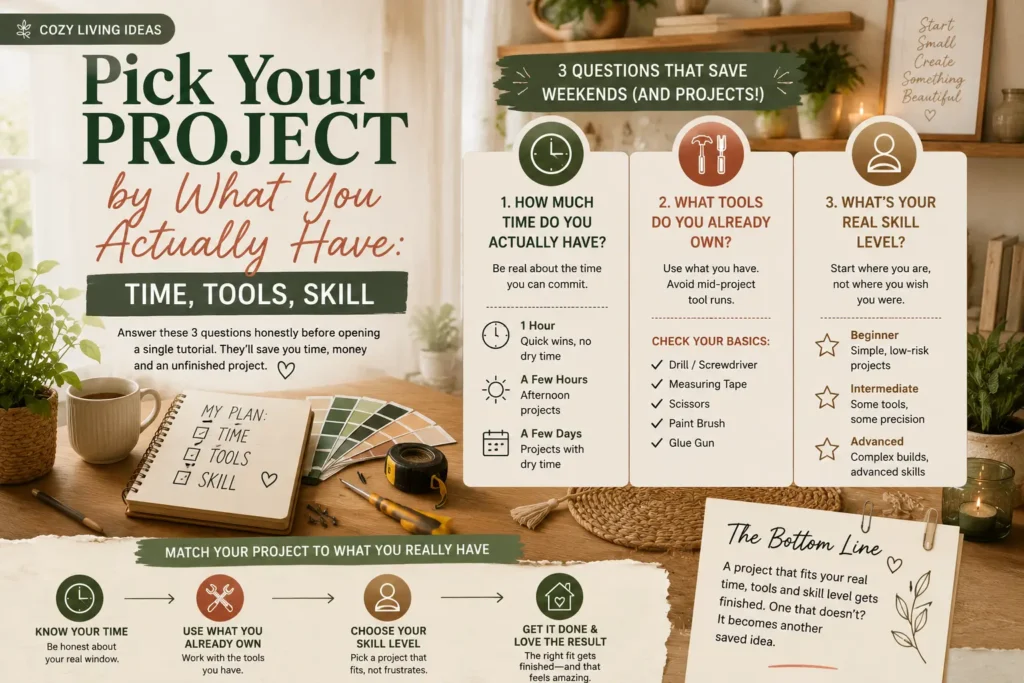
What tools do you already own? A project that requires buying a drill, a miter saw, and clamps you’ll use once isn’t really a quick weekend project — it’s a tool-shopping trip first. Sorting by what’s already in a drawer keeps the first few projects genuinely easy.
What’s your actual skill level, not your aspirational one? Painting and no-sew fabric projects are close to universal. Anything involving cutting wood to precise measurements, working with tile and grout, or hanging something heavy on drywall benefits from having done a simpler version first.
Answering these three honestly is what separates easy DIY home decor projects that get finished from ambitious ones that stall halfway through. It’s a short list of questions, but skipping it is the most common reason easy DIY home decor projects turn into abandoned ones.
3. The Starter Toolkit: What to Own Before You Start Anything
Buying tools project by project gets expensive fast and usually means a mid-project trip to the hardware store. This is the core kit that covers the large majority of small to mid-size decor projects, roughly in order of how often each item gets used — and it’s the single best investment for anyone planning ongoing budget-friendly DIY home decor, since it turns every future project into a materials-only cost.
| Tool or Supply | Typical Cost | Covers |
|---|---|---|
| Cordless drill/driver | $40–80 | Shelves, curtain rods, most hanging and assembly |
| Stud finder | $10–15 | Anything heavier than a picture frame going on drywall |
| Level (torpedo or 24″) | $10–20 | Shelves, art, mirrors — the single most skipped step in bad DIY |
| Painter’s tape (multiple rolls) | $10–15 | Clean paint lines, protecting trim and floors |
| Sandpaper, mixed grits | $10 | Furniture prep, smoothing edges, prepping for paint |
| Hot glue gun + glue sticks | $15–20 | No-sew fabric projects, quick embellishments |
| Command strips/hooks, rated for weight | $15–25 | Renter-safe hanging for lighter items |
| Basic screwdriver set | $10–15 | Furniture assembly, hardware swaps |
| Utility knife + cutting mat | $15–20 | Contact paper, fabric, precise trimming |
| Measuring tape | $8–10 | Every single project on this list, without exception |
Total starter cost lands around $150–200, and it’s a one-time purchase rather than a per-project one. Keep it in a single labeled bin — the time lost hunting for a stud finder mid-project is its own kind of scope creep.
4. 10 DIY Home Decor Projects Worth a Weekend, Sorted by Skill Level
The list below runs from truly easy DIY home decor projects up to weekend-length builds, so you can match one to the time block from Section 2 instead of guessing.
Under an hour, no tools beyond scissors and glue. A styled tray for the coffee table or bathroom counter. A no-sew fabric-wrapped vase. A gallery wall using only command strips and frames you already own — one of the fastest DIY wall decor ideas on this whole list.
One to three hours, basic tools. A stenciled or painted accent on a plain lampshade. A set of floating shelves using pre-cut boards and brackets. A contact-paper refresh on a dated dresser front — one of the most forgiving small DIY home decor projects for a first attempt, since mistakes are easy to redo. Most small DIY home decor projects in this tier share that same quality: low material cost and an easy do-over if the first pass isn’t right.
A full day, including dry time. Repainting a piece of furniture properly (sanding, priming, two coats, and real cure time before use). A decorative plate wall, which takes longer to plan the arrangement on the floor than to hang it, is another of the more forgiving DIY wall decor ideas since a single misplaced plate is an easy fix. A quilted or fabric-stretched canvas for wall art.
A weekend, with some tool comfort. Building a simple open shelving unit from dimensional lumber. A tiled or peel-and-stick backsplash refresh, which needs careful surface prep more than advanced skill.
Whichever you pick first, resist starting with the most ambitious one on the list. A finished simple project beats an abandoned impressive one, and the confidence from finishing carries directly into the next, harder one.
5. Project Ideas by Category: Browse by What You Want to Make
If Section 4 sorted by how much time you have, this section sorts by what you’re actually trying to make. Each category below covers a different part of a room — lighting, greenery, walls, storage, textiles — so you can jump straight to the type of project you’re picturing.
🕯️ DIY Candle Holders & Ambient Lighting
Lighting is the fastest way to change how a room feels in the evening, and a handmade candle holder or two does more for that mood than an overhead fixture ever will. Most versions need no power tools and use materials that are cheap to replace if the first attempt doesn’t work.
Ideas to try:
- ✓
Terracotta pot candle stand — seal and paint a small terracotta pot, then drop in a pillar candle for warm, earthy light.
- ✓
Braided rope votives — wrap glass votive holders in jute or cotton rope for texture, keeping the wrap below the flame line.
- ✓
Salt dough tea light trio — mold a simple no-bake dough into a connected trio of tea light cups.
- ✓
Punched tin lanterns — tap a simple pattern into an old tin can and drop in a battery tea light for a soft, dappled glow.
🌿 DIY Plant Decor & Indoor Greenery Displays
Greenery does a lot of the work in making a room feel finished, and a handmade planter or display stand turns a plain pot into an actual design choice instead of an afterthought. These projects scale easily from a single windowsill to a full plant wall.
Ideas to try:
- ✓
Painted terracotta trio — a graduated set of pots in one tonal color family for a cohesive shelf display.
- ✓
Ladder plant stand — lean a small wooden ladder against a wall and rest pots on each rung for a tiered display.
- ✓
Repurposed colander planter — an old metal colander already has built-in drainage, so line it and plant directly.
- ✓
Hanging propagation wall — a cluster of small glass vessels on hooks for rooting cuttings, doubling as living wall art.
🖼️ DIY Wall Art & Gallery Pieces
Handmade wall art fills a blank wall with something that actually reflects your taste, and most versions don’t require any real painting skill — just a willingness to keep the palette simple and the composition uncluttered.
Ideas to try:
- ✓
Layered paper collage — cut and layer scrapbook or cardstock paper in a single tonal palette for texture without paint.
- ✓
Embroidery hoop fiber art — stretch fabric or a small yarn design inside a hoop for an easy, frameless piece.
- ✓
Botanical print series — scan or photograph a few leaves and print a matching trio for a cohesive gallery moment.
- ✓
Washi tape geometric mural — build a temporary geometric pattern directly on the wall with tape, fully removable for renters.
🪞 DIY Mirrors & Statement Wall Pieces
A mirror pulls double duty as both function and decor, and building a frame or surround around a plain one turns a basic hardware-store mirror into a genuine focal point for a fraction of a designer piece’s cost.
Ideas to try:
- ✓
Scalloped trim mirror — glue small wood cutouts or trim pieces around a plain mirror in a scalloped ring.
- ✓
Vintage frame remount — rehome an ornate secondhand picture frame around a new plain mirror insert.
- ✓
Cork ring mirror — circle a mirror with wine corks for texture, especially fitting in a kitchen or bar nook.
- ✓
Painted arch surround — paint a soft arch shape directly on the wall behind a simple mirror to fake a built-in look.
🗄️ DIY Storage Solutions That Double as Decor
Storage doesn’t have to look like storage. A few small upgrades turn baskets, shelves, and bins into pieces that add to a room’s look instead of just hiding clutter out of sight.
Ideas to try:
- ✓
Fabric-lined wire baskets — line inexpensive wire baskets with fabric remnants for a softer, more finished look.
- ✓
Modular cube shelving — stack painted wooden cubes in an offset pattern for flexible, display-ready storage.
- ✓
Repurposed ladder rack — lean a small ladder in a bathroom or living room to hold folded towels or throws.
- ✓
Labeled glass canister wall — mount a row of glass jars on a board for pantry or craft-room storage that also decorates the wall.
✨ DIY Pillow Covers & Textiles
Textiles are one of the cheapest ways to shift a room’s whole mood, and most pillow and throw projects need nothing more than fabric, scissors, and either a hot glue gun or basic hand stitching.
Ideas to try:
- ✓
Envelope-back no-sew covers — — fold fabric into an envelope closure using fusible tape instead of a sewing machine.
- ✓
Block-printed throw pillows — carve a simple stamp from a sponge or eraser for a hand-printed pattern.
- ✓
Layered fringe trim — hot-glue fringe or pom-pom trim onto plain covers for texture without a full remake.
- ✓
Patchwork scrap cushion — piece together fabric scraps into a single accent cushion that uses up leftover material.
🕰️ Upcycling Old Home Items Into Stylish Decor
Upcycling is where a tight budget and genuinely good design overlap — an outdated or damaged piece gets a second life instead of a trip to the curb, usually for the cost of paint, fabric, or hardware alone. If this category is the one that speaks to you most, our roundup of budget-friendly upcycling projects goes deeper on turning specific salvaged materials into finished pieces.
Ideas to try:
- ✓
Dresser-to-console conversion — remove select drawer fronts and add cord cutouts to repurpose an old dresser as a media console.
- ✓
Window frame photo display — rehang an old window frame with small photos wired into each pane.
- ✓
Reupholstered vanity stool — swap a worn chair seat’s cover for new fabric and foam.
- ✓
Suitcase side table — stack a vintage suitcase on short furniture legs for a functional, storage-friendly side table.
🧵 Handmade Decor Using Fabric, Yarn & Natural Materials
Natural materials — yarn, jute, linen, raffia — bring in texture that painted or glossy pieces can’t, and they tend to be forgiving of imperfection in a way that gives handmade work its charm rather than undercutting it.
Ideas to try:
- ✓
Woven wall hanging — simple over-under weaving with mixed yarn weights on a single wooden dowel.
- ✓
Braided natural-fiber runner — braid strips of jute or raffia into a textured table runner.
- ✓
Dried grass wall bundle — bind a bundle of dried pampas or wheat stems with twine and hang as a minimalist accent.
- ✓
Hand-stitched linen napkins — hem plain linen squares with a simple visible stitch for texture at the table.
Any of these 8t categories can be matched back to the time-and-skill sorting in Section 4 — a punched tin lantern takes well under an hour, while a dresser-to-console conversion belongs firmly in the full-weekend tier.
6. Three Popular DIY Trends That Don’t Actually Hold Up
Not every trending project ages as well as it looks in the video. These three are worth a second thought before committing real time and materials.
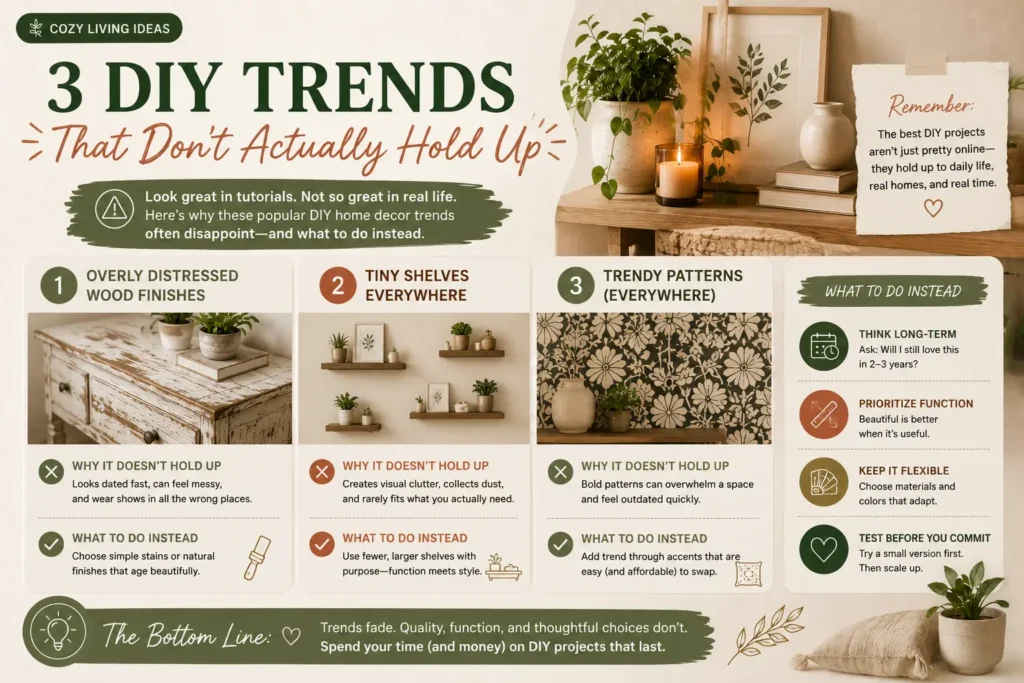
Peel-and-stick wallpaper on textured or humid walls. It’s genuinely one of the best renter-friendly tools available, but it’s also the project most likely to fail quietly over a few weeks — the adhesive struggles on textured walls and softens in humid rooms like bathrooms and kitchens.
If your walls have any texture, a skim coat or a smoothing primer first is the difference between a wall that looks good for years and one that’s peeling at the seams by month two. ROMAN’s breakdown of why peel-and-stick wallpaper fails goes deeper into the humidity and temperature triggers if you’re troubleshooting an install that’s already struggling.
Resin-coated surfaces without proper prep. A glossy resin tabletop or coaster set photographs beautifully, but resin is genuinely unforgiving about surface prep, ventilation, and cure time — rushed batches cloud, yellow, or stay tacky for weeks. Worth doing only with the patience to follow the cure schedule exactly, not as a same-afternoon project.
Hyper-specific seasonal color trends on anything expensive to redo. A bold single-season accent wall color is a fun, cheap way to test a trend. The same color on a $600 refinished dresser is a much more expensive bet on a look that may read as dated in two years. Save the boldest trend colors for the cheapest, fastest-to-redo surfaces.
None of these are reasons to skip a trend entirely — they’re reasons to match the trend to a surface that’s cheap and fast to redo if it doesn’t hold up the way the video promised.
7. Renter-Safe DIY: What’s Reversible and What Isn’t
Renters can do almost everything on this list — the trick is choosing the reversible version of each project rather than the permanent one.
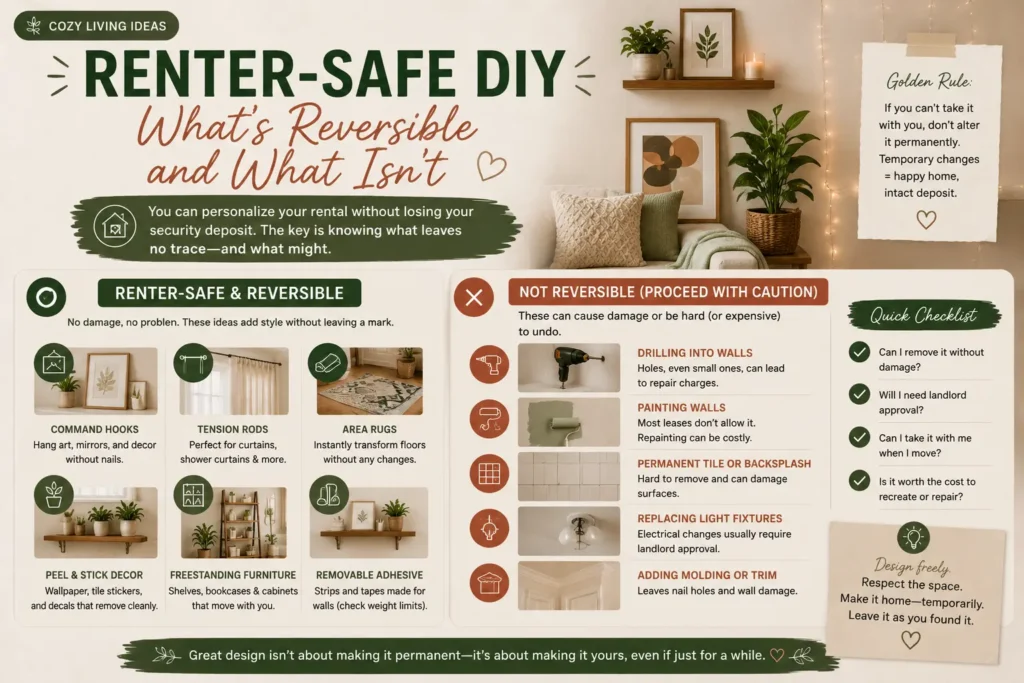
Fully reversible, low risk: command-strip gallery walls, styled trays and vases, no-sew fabric projects, contact paper on furniture you own (not built-ins), freestanding shelving units.
Reversible with care: peel-and-stick wallpaper and tile (on smooth, low-humidity walls, following the surface-prep notes in Section 6), swappable cabinet or drawer hardware (keep the original hardware in a labeled bag for move-out).
Best left alone in a rental: anything requiring paint directly on cabinets or trim without landlord approval, permanent adhesive tile, or holes larger than a small picture-hanging nail.
If your renter-safe DIY plans extend to the bathroom specifically, the renter-safe bathroom decor rules in our Bathroom Inspiration guide cover the aesthetic side of the same reversible-first approach in more depth.
8. Budgeting a Project Without the Mid-Project Surprise
DIY projects reliably cost more than the first estimate, almost always because of one missing line item: the extras. Add 15–20% to any material estimate before starting, specifically to cover the sandpaper, extra paint for a second coat, or the one bracket size that wasn’t in the original kit.
Price the full material list before buying anything, not just the headline item. A “$40 dresser refresh” that only budgets for paint but not primer, sandpaper, and new hardware is really a $70 project wearing a $40 estimate.
For budget-friendly DIY home decor, the lowest true cost usually comes from projects that reuse furniture or materials already owned, since buying a project’s entire material list new erodes the savings DIY is supposed to offer. Anyone genuinely doing DIY home decor on a budget does better shopping their own garage and closets first, and a store’s clearance section second, before ever browsing full-price materials.
9. 7 Mistakes That Turn a Simple Project Into a Weekend-Long One
These seven show up constantly in DIY circles — TUFF Home Inspections’ rundown of common DIY mistakes covers several of the same patterns from a home-inspector’s point of view, which is a useful second perspective if you’re about to take on something bigger than a decor project.
Skipping the level. Free-handing a shelf or gallery wall “by eye” is the single fastest way to redo work that looked fine until the whole wall was hung — a lesson most DIY wall decor ideas teach the hard way at least once. Use the level from Section 3, every time.
Starting without all materials on hand. A mid-project hardware store run doesn’t just cost time — it breaks momentum, and half-finished projects are far more likely to get abandoned once the flow is interrupted.
Skipping surface prep. Painting over dust, grease, or a glossy factory finish without sanding or priming first is why furniture paint chips within weeks. Prep takes longer than the fun part, and it’s not optional.
Underestimating dry and cure time. Paint, primer, resin, and adhesive all have real cure windows. Using a piece before it’s cured undoes hours of otherwise careful work.
Choosing color without testing it in the actual room. A paint chip under store lighting can look completely different by a lamp at 8 p.m. Test a swatch in the room, at the time of day you’ll really see it.
Ignoring weight ratings. Command strips, wall anchors, and brackets are all rated for a maximum weight — checking that number before hanging anything heavier than a lightweight frame prevents the project from ending up on the floor.
Tackling the hardest project first. Building confidence (and skill) on a smaller project makes the next, more ambitious one faster and less error-prone — jumping straight to the most complex build on a first attempt is where most abandoned projects start.
10. From One Project to a Whole Room That Feels Cohesive
A single great project can still leave a room feeling disjointed if it doesn’t share a color or material thread with what’s already there. Before starting, glance at the room’s existing palette and pick a project that either matches it or is deliberately meant to be the one accent that breaks it — not something that lands in between by accident.
This is where a lot of otherwise well-executed DIY room decor ideas fall short: a beautifully painted accent piece that doesn’t relate to anything else in the room reads as random rather than intentional, even when the workmanship is excellent. The strongest DIY room decor ideas are the ones chosen to match or deliberately contrast a room’s existing palette, never the ones picked in isolation from it. If you’re planning several projects for the same room, our guide to cozy living room ideas covers how to build a consistent palette and material story a handmade piece can genuinely slot into.
11. A 5-Minute Pre-Project Checklist
Before starting any project on this list, confirm:
Does this fit the time block I actually have free, not the one I wish I had?
Do I own the tools, or does this require a shopping trip first?
Have I priced the full material list, including the extras, with 15–20% added?
Have I tested color or finish in the actual room and lighting?
Is this reversible, if I’m renting?
A “no” on any of these is worth pausing for — not as a reason to skip the project, but to fix the one gap before materials are already open and half-used. This checklist matters most for anyone still working through DIY home decor projects for beginners, since a skipped step here is what usually turns a first attempt into an abandoned one.
Final Thoughts
The best DIY home decor projects aren’t the most ambitious ones on a 30-item list — they’re the ones sized honestly to the time, tools, and skill you’re bringing to a specific Saturday. Start with the toolkit in Section 3, pick from the skill-sorted list in Section 4, browse Section 5 if you already know the type of project you want, and run the checklist in Section 11 before buying materials. That order is also the fastest path to genuinely budget-friendly DIY home decor, since it front-loads the planning that keeps a project from running over.
Confidence in this hobby compounds. A handful of finished small projects will teach more, and set you up better for an ambitious one, than a single stalled attempt at the hardest thing on the list ever will — which is exactly why DIY home decor projects for beginners should stay small on purpose, and why doing DIY home decor on a budget rewards patience over a single big-ticket purchase.
Frequently Asked Questions (FAQ)
A styled tray, a no-sew fabric-wrapped vase, or a command-strip gallery wall — all under an hour, no power tools, and fully reversible if it doesn’t turn out the way you pictured. These small DIY home decor projects are also the fastest way to build the confidence a bigger build will need later.
Around $150–200 for a kit that covers the large majority of small to mid-size projects, per the list in Section 3. It’s a one-time cost rather than a per-project one, which matters most if you’re doing DIY home decor on a budget over several projects rather than just one.
Yes, on smooth, low-humidity walls — it’s one of the best reversible options available. It struggles on textured walls and in humid rooms like bathrooms, where the adhesive can soften over time, so match the surface to the product before committing.
Time and precision are better indicators than the tutorial’s stated difficulty. If it requires exact measurements, working with tile or grout, or hanging something heavy on drywall, it benefits from having a simpler, similar project under your belt first.
Price the entire material list, not just the headline item, and add 15–20% before starting. Most overages come from missing extras — sandpaper, a second coat of paint, one extra bracket — not from the main material itself. This holds for nearly every category of DIY room decor ideas, from a single accent piece to a full room refresh.