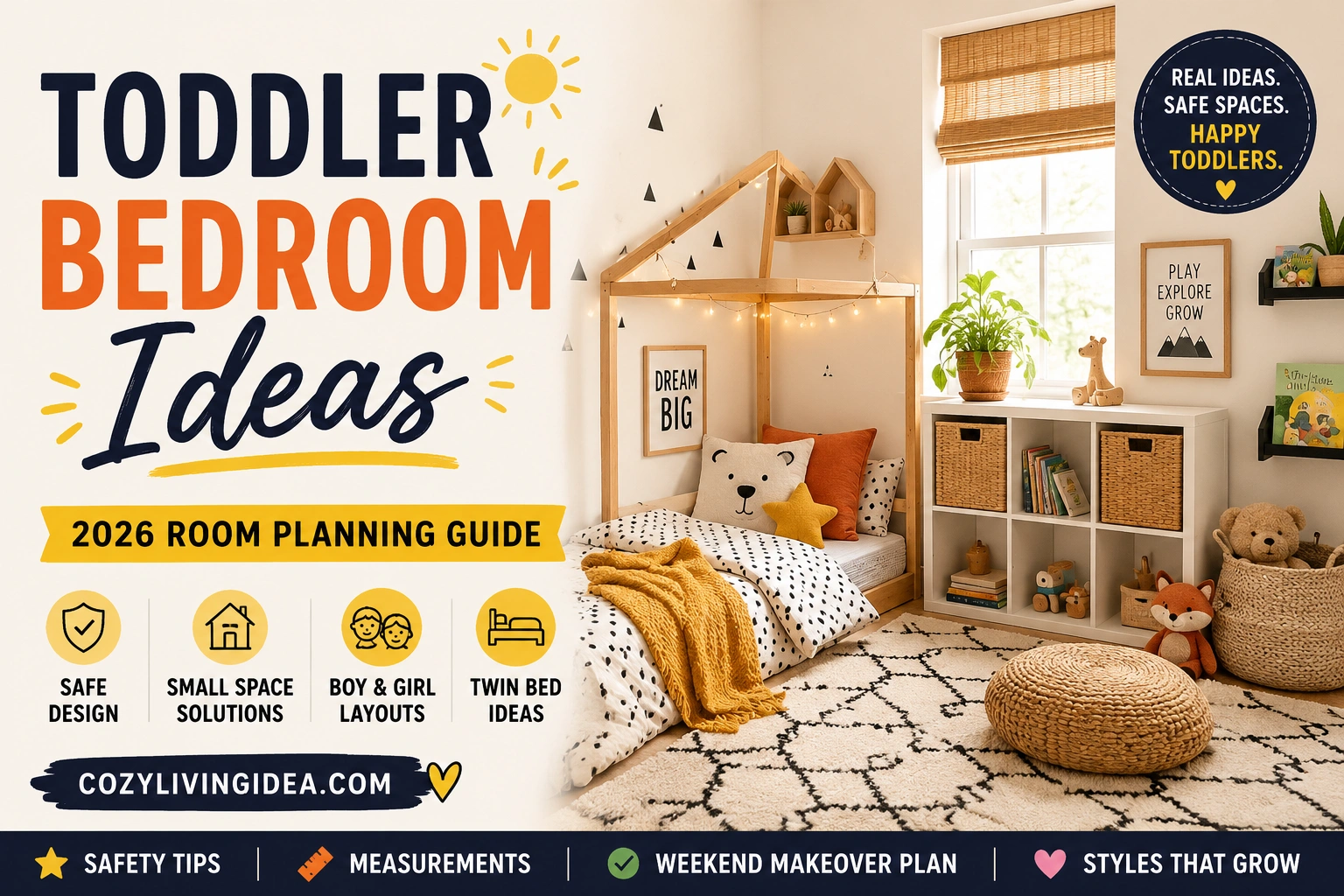
Toddler Bedroom Ideas: 2026 Room Planning Guide (Boy, Girl & Small Spaces)
Turning a nursery into a toddler’s first real room is one of those projects that feels small until you’re standing in the doorway wondering where the crib is supposed to go now. Most toddler bedroom ideas you’ll find online are photo roundups — pretty rooms with no explanation of why anything is placed where it is, or what actually holds up once a 2-year-old starts climbing on it. This guide fills that gap. Every idea here comes with the reasoning behind it: why a layout works, what size furniture actually fits, and where the real safety line sits.
Whether you’re working with a nursery-sized room, a shared twin setup, or a blank slate you can design from scratch, these toddler bedroom ideas are built to be lived in, not just photographed. And if you’re still torn between a few different looks, it’s worth settling on a broader bedroom aesthetic before locking in furniture and color — it makes every toddler-specific decision below faster, since you’re no longer choosing blind.
The best toddler bedroom ideas balance 3 things: safety (anchored furniture, a floor-level or low bed, no climbable pieces near windows), function (storage your toddler can actually reach), and a calm color palette that won’t feel overstimulating by age 3. Start with the bed and the furniture anchoring, then build the theme and color scheme around what’s left.
Where to Start With Toddler Bedroom Ideas (Safety First)
Every list of toddler bedroom ideas should start here, because it’s the one section most inspiration blogs skip entirely. Toddlers climb. They pull open drawers and use them as steps. They lean on dressers to reach the top shelf.
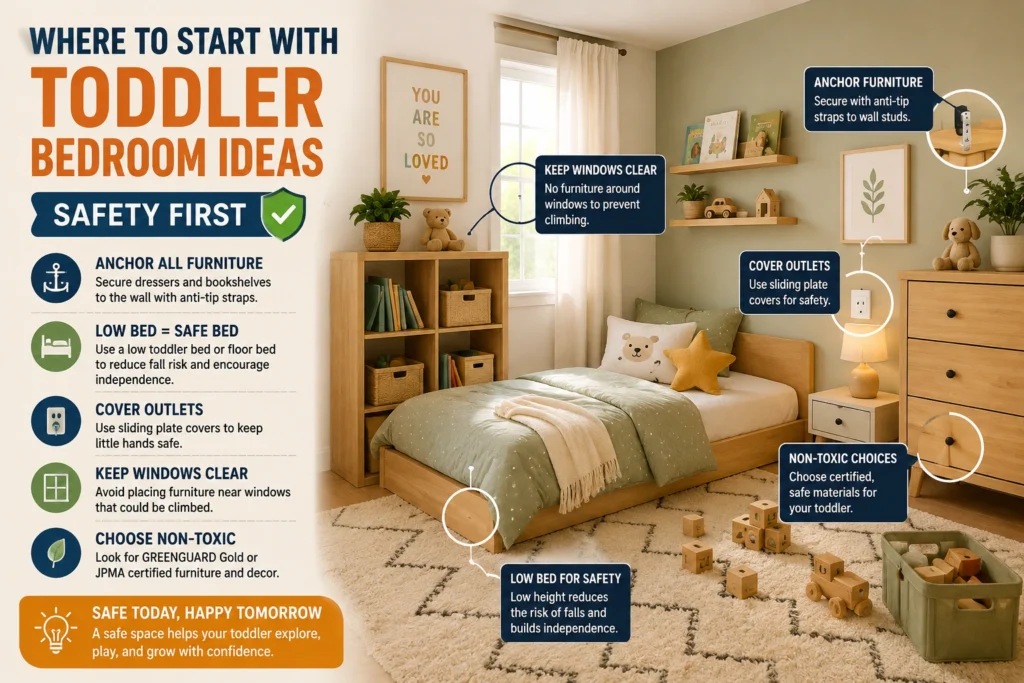
Furniture tip-overs are one of the most preventable injury risks in this age group, and the fix is simple: anchor every dresser, bookshelf, and tall piece to a wall stud with an anti-tip strap, not just adhesive tape. The CPSC’s Anchor It! campaign has free, step-by-step instructions for doing this properly in under 20 minutes per piece, and it’s worth the 5 minutes it takes to read before you touch a single wall bracket.
A few non-negotiable to build into any toddler bedroom idea before the decorating starts:
- ✓
Anchor tall furniture to the wall. Use L-brackets or furniture straps screwed into a stud, not drywall alone. Do this even if the piece “looks stable.”
- ✓
Keep the crib-to-bed transition low. A toddler bed or floor bed (mattress directly on a low frame or the floor) reduces fall height and lets your child get in and out independently, which cuts down on middle-of-the-night climbing accidents.
- ✓
Cover every outlet within reach. Sliding plate covers are sturdier than plug-in caps, which toddlers can pry out.
- ✓
Skip window-adjacent furniture. Anything a toddler could climb to reach a window — a dresser, a toy shelf — should sit against a different wall.
- ✓
Choose non-toxic finishes. Look for GREENGUARD Gold or JPMA certification on any new furniture piece, especially anything the child will chew or lean against.
Once the safety foundation is set, every other decision — color, theme, layout — has room to be fun without being risky. That’s the real starting point behind good toddler bedroom ideas, and it’s why the rooms that photograph well but skip this step tend to get redone within a year anyway.
Small Toddler Bedroom Ideas That Actually Work
Small toddler bedroom ideas get harder the moment you add a dresser, a toy shelf, and a reading corner into a room that was already tight as a nursery. The fix isn’t fewer things — it’s using vertical space and multi-purpose furniture so the floor stays open for play. A lot of the same logic shows up in layout tricks for tight apartment bedrooms — the room is bigger, but the vertical-storage-over-floor-clutter principle carries over directly.
Go vertical before you go wide. Floating shelves above dresser height hold books and display items without eating floor space. A wall-mounted bookshelf angled so covers face out (a “front-facing” library ledge) also makes it easier for a toddler to choose their own book, which is a small independence win that fits naturally into small toddler bedroom ideas built around a reading nook.
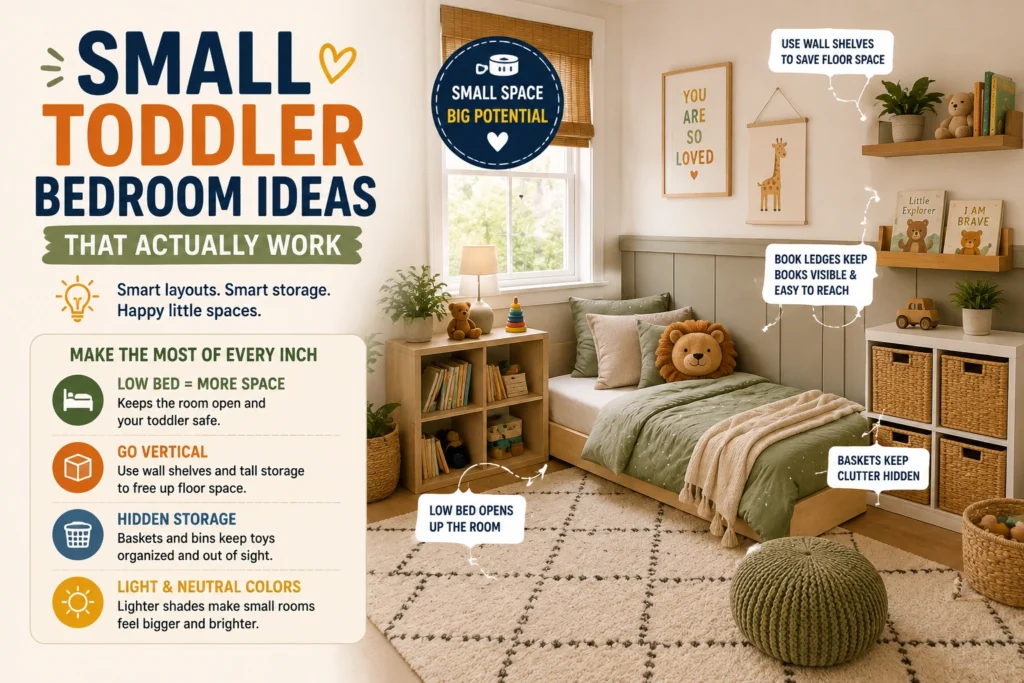
Let the bed pull double duty. A bed with built-in under-bed drawers replaces a separate dresser in rooms under 90 square feet. If the frame doesn’t have drawers, slim rolling bins that slide underneath work just as well and cost less.
Zone instead of separate. In a small room, a rug alone can define a play area at the foot of the bed, freeing you from needing a hard boundary like a shelf or half-wall. This is one of the most repeated small toddler bedroom ideas in real (non-staged) rooms, because it costs nothing beyond the rug you probably already have.
Mount, don’t stack. A wall-mounted reading lamp with a low-glare bulb frees up nightstand space entirely — useful when the room is too small for a nightstand in the first place.
Measure your tallest piece of furniture against the door swing before buying. In rooms under 80 square feet, a few inches of clearance on a door swing can be the difference between a room that feels open and one that feels like storage.
Toddler Bedroom Ideas for Small Rooms Under 80 Square Feet
Toddler bedroom ideas for small rooms need a different starting math than a standard 10×12 layout. In a room this size — think a converted nursery or a secondary bedroom in an older home — every piece of furniture has to earn its footprint twice: once for function, once for the empty floor space a toddler needs for actual play.
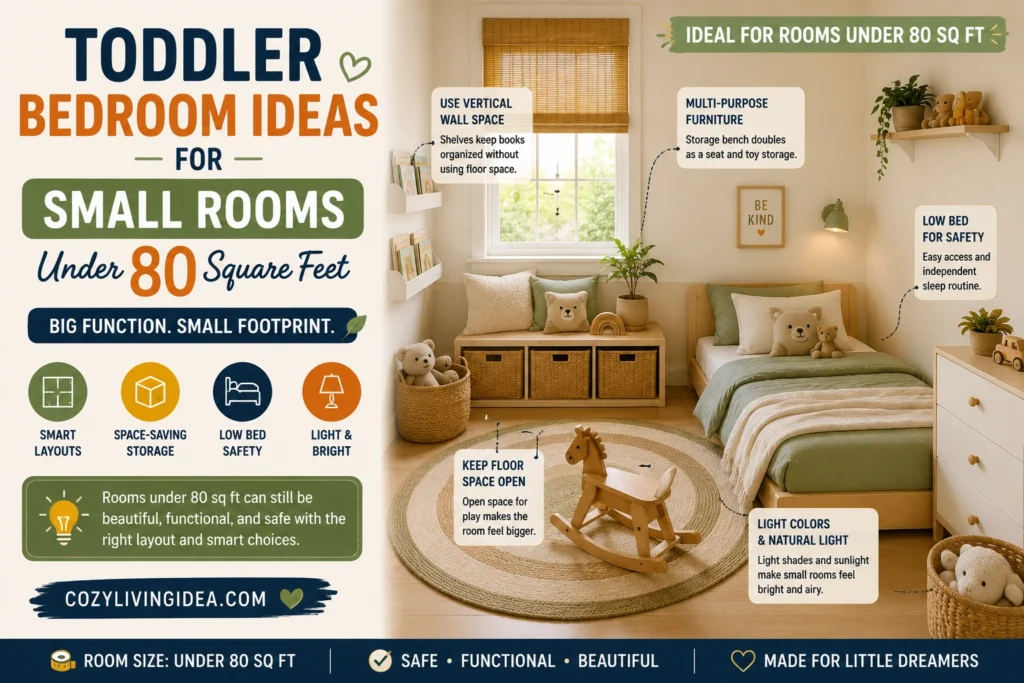
A workable formula for toddler bedroom ideas for small rooms: bed against the longest wall, 1 low dresser (30 inches or shorter, both for reach and tip-over risk) opposite it, and a single open floor zone of at least 4×4 feet left in the center or a corner. That 4×4 foot buffer matters more than any decor choice — it’s the space your toddler will actually use most, whether that’s blocks, a reading mat, or just running in circles before nap time.
If the closet is deep enough, converting it into a combined clothing-and-toy-storage zone with a low bar (toddler clothes rarely need more than 36 inches of hanging height) frees up an entire wall for a reading corner or art display instead of a standalone dresser.
Twin Toddler Bedroom Ideas: Getting the Bed Sizing Right
Twin toddler bedroom ideas come up most often around ages 3 to 4, when a child outgrows a toddler bed but a full crib-to-twin jump feels early. A standard twin mattress measures 38 by 75 inches — noticeably longer than a toddler bed (about 52 inches), which means twin toddler bedroom ideas need to account for roughly 2 extra feet of floor length the toddler-bed layout didn’t require.
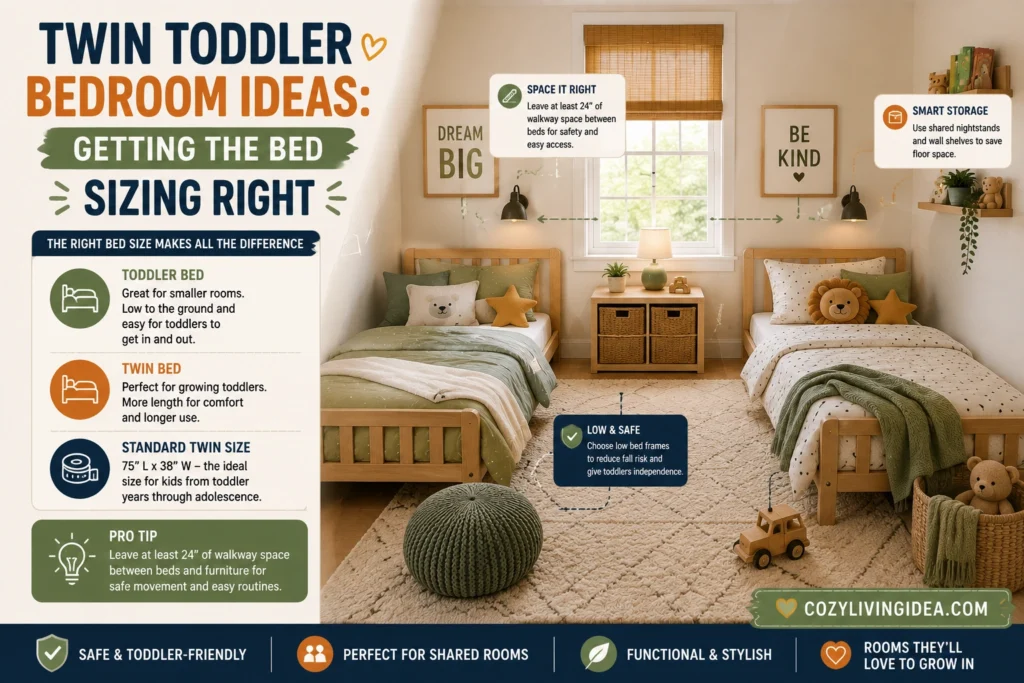
The safest way to introduce a twin bed to a toddler-aged child is low to the ground, either on a floor frame or with the mattress directly on a foundation with no elevated frame at all. Guardrails on at least 1 side (ideally both, if the bed isn’t against a wall) are worth adding until your child is reliably staying in bed through the night — this is one of the most commonly skipped safety steps in twin toddler bedroom ideas that otherwise look picture-perfect.
For siblings sharing a room, 2 twin beds parallel along opposite walls, with a shared low shelf or table between them, keeps the center of the room open and gives each child a defined “side” — something that matters more than parents expect once a toddler starts asserting ownership over space.
If you’re buying a twin bed a toddler will use for years, choose a frame with a headboard and footboard that can accept a guardrail kit later, rather than needing an entirely new frame when your child is ready to lose the rail.
Toddler Bedroom Ideas Boy: Themes That Grow With Him
Toddler bedroom ideas boy searches tend to return heavy, all-in themes — full truck murals, wall-to-wall dinosaur bedding, a room that looks like a toy store. Those photograph well but rarely survive past age 5 without a full redo. The stronger approach is a neutral base with a swappable theme layer, and most of the theme lives above the bed rather than across the whole room — a handful of well-chosen framed prints and wall art does more work than a full mural, and it’s the first thing that’s cheap and easy to swap when interests change.
Base first, theme second. Paint or wallpaper stays neutral (a soft sage, warm greige, or muted blue), and the theme — dinosaurs, trucks, space, animals — lives in bedding, wall decals, and a few framed prints. When the theme changes, you’re swapping textiles, not repainting.
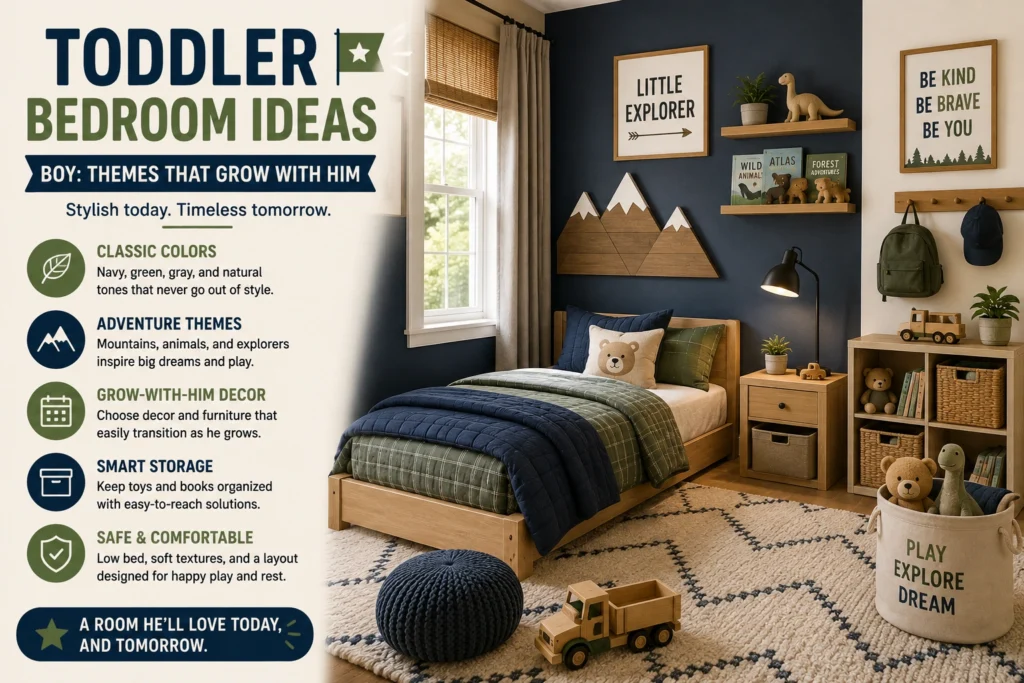
Pick a theme with growth room. Dinosaurs age into fossils and nature study. Space themes age into science and astronomy. Trucks and construction age into building and engineering play. Choosing a theme that has a “next stage” avoids a full teardown in 2 years.
Add 1 tactile play element. A soft climbing wedge, a small tent, or a floor cushion reading nook gives a toddler boy’s room a physical activity the flat-photo versions of toddler bedroom ideas boy content rarely mention, but that actually gets used daily.
Keep the palette to 3 colors. 1 neutral wall color, 1 accent (often a mid-tone blue, green, or warm red), and white or wood tones for furniture. More than 3 colors in a small room reads as busy rather than playful.
Toddler Bedroom Ideas Girl: Soft, Playful, and Practical
Toddler bedroom ideas girl searches skew heavily toward pastel palettes and whimsical detail — canopy beds, floral wallpaper, fairy-light garlands — and those elements do work well for this age group because soft textures and gentle color genuinely support a calmer bedtime routine for many toddlers. The gap in most toddler bedroom ideas girl content is that the whimsy comes at the cost of function: canopies that block light needed for daytime naps, delicate decor within toddler reach, or storage that looks pretty but doesn’t actually hold anything.
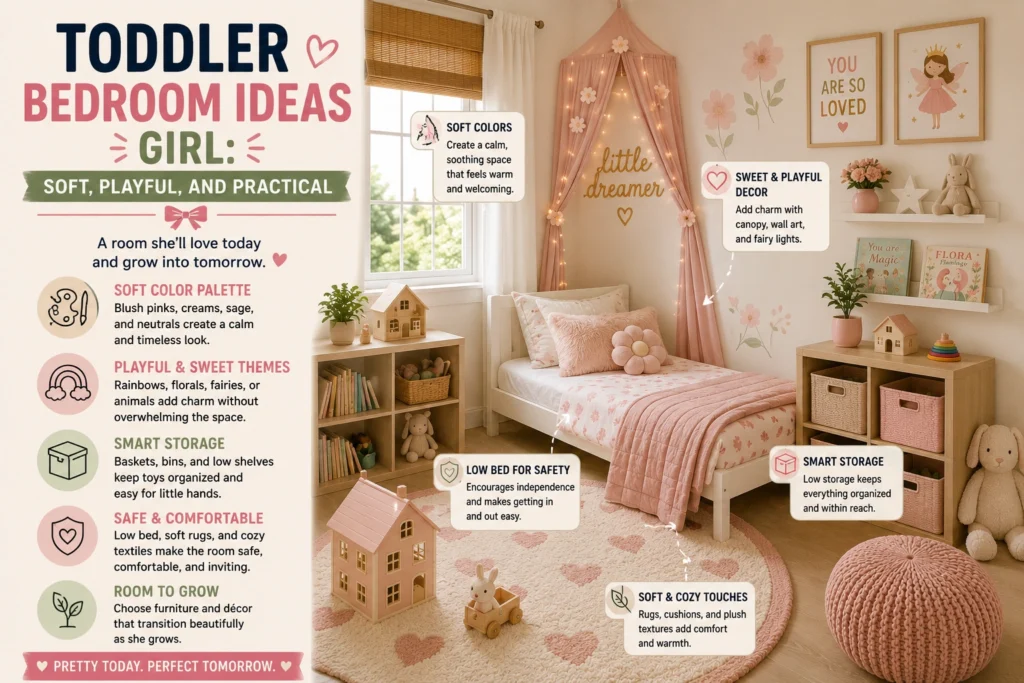
Build the reading corner as the anchor. A low bookshelf, a floor cushion or small chair, and a soft rug create the “storybook corner” toddler bedroom ideas girl searches are usually after — and it’s genuinely functional, since bedtime reading routines benefit from a dedicated, cozy spot.
Use pattern in layers, not everywhere. 1 patterned element (wallpaper, a large rug, or bedding) paired with solid-color walls or solid bedding keeps a girl’s toddler room from feeling visually overwhelming, which matters for a child this age who’s still developing sensory regulation.
Choose secure, low display. Floating shelves for stuffed animals or dolls should sit at a height a toddler can reach without climbing — around 24 to 30 inches — so the “display” doesn’t turn into a climbing hazard.
Pink Toddler Bedroom Ideas Without the Sugar Rush
Pink toddler bedroom ideas are some of the most searched in this category, and also some of the easiest to overdo. A full bubblegum-pink room can feel overstimulating by year 2, while a single well-chosen pink — blush, dusty rose, or terracotta-pink — paired with warm white and natural wood tones gives you the softness of pink toddler bedroom ideas without the visual noise.
A dependable formula: 1 wall in a muted pink (blush or dusty rose reads calmer than bubblegum), white or warm wood furniture, and a single pattern — florals, polka dots, or a subtle print — kept to bedding or 1 accent pillow rather than repeated across curtains, rug, and wallpaper at once. This restraint is what separates pink toddler bedroom ideas that still look fresh at age 5 from ones that feel dated within a year.
Simple Toddler Bedroom Ideas for Busy Parents
Simple toddler bedroom ideas exist for a reason — not every family has the time, budget, or desire for a themed, multi-layered room, and a pared-back space is often easier to keep tidy and easier for a toddler to actually navigate. Simple doesn’t mean bare; it means fewer decisions repeated well.
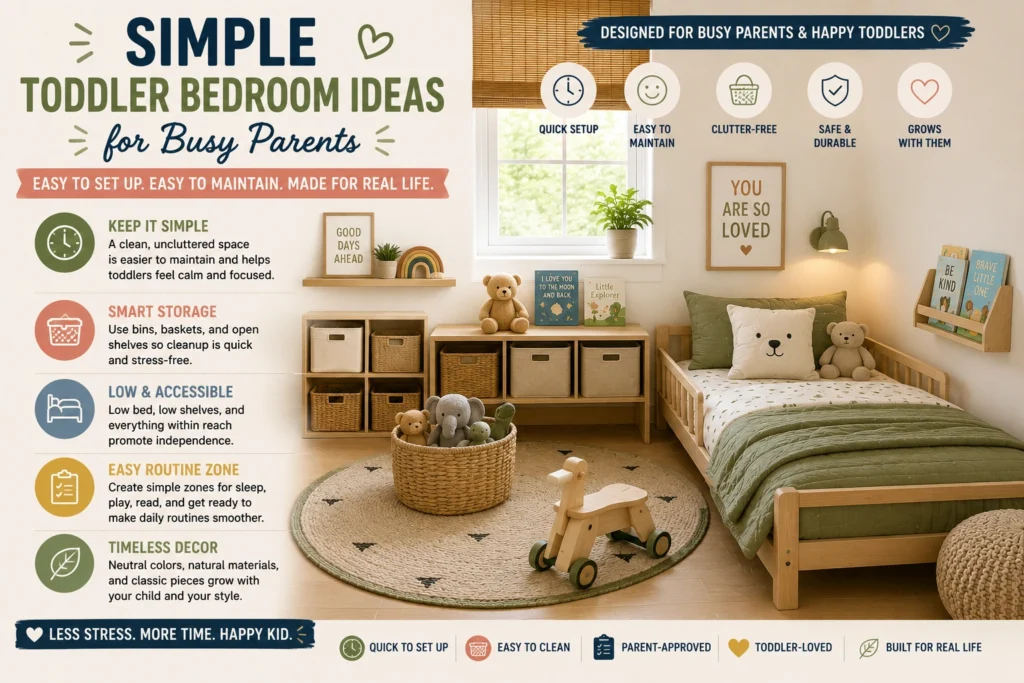
1 color, 1 accent, done. A single wall color with white trim and 1 accent color in textiles (a rug, curtains, or bedding) is the fastest of all simple toddler bedroom ideas to execute and the easiest to keep looking finished as the room changes.
3 furniture pieces, no more. Bed, 1 storage piece (dresser or shelf), 1 small seat. Anything beyond that in a toddler’s room usually ends up as clutter rather than function.
Let art carry the personality. 2 or 3 framed prints — even inexpensive ones — add warmth to a simple toddler bedroom without requiring a full theme, and they’re the easiest element to swap out as your child’s interests change.
Skip anything that needs maintenance. Delicate garlands, fairy lights that need untangling, or fabric canopies that collect dust all add upkeep a simple toddler bedroom design is specifically trying to avoid.
Color Palettes for 2026 Toddler Bedrooms
The color direction in toddler rooms this year has shifted away from primary-bright palettes toward calmer, nature-inspired tones — sage green, warm terracotta, muted clay, and soft beige are showing up across both boy and girl toddler bedroom ideas because they work as a neutral base that ages well and doesn’t need to be repainted every couple of years.
A practical palette structure for any toddler bedroom idea:
| Layer | Color Choice | Why It Works |
|---|---|---|
| Walls | Soft neutral (sage, greige, warm white) | Ages with the child, doesn’t compete with decor |
| Accent wall or textile | 1 mid-tone (terracotta, dusty blue, blush) | Adds personality without overwhelming a small room |
| Furniture | White, natural wood, or light gray | Neutral base keeps furniture usable through style changes |
| Pop of color | Bedding, rug, or wall art | Easiest and cheapest element to change later |
If you’re not sure a color will hold up, test it in bedding or a rug before committing to a wall. Textiles are the cheapest way to trial a palette in real toddler bedroom ideas before painting anything.
Storage That Keeps Up With a Toddler
Storage is where most toddler bedroom ideas fall apart in practice, because what looks organized in a photo rarely survives daily toddler use. The fix is designing storage around how toddlers actually put things away — which is to say, quickly and without much precision.
- ✓
Low, open bins beat lidded boxes. A toddler is far more likely to toss a toy into an open bin than to lift a lid, put the item in, and close it again.
- ✓
Group by type, not by system. Baskets labeled “blocks,” “books,” “stuffed animals” work better than a color-coded or alphabetized system a toddler can’t read yet.
- ✓
Rotate rather than store everything out. Keeping a portion of toys in a closet or under-bed bin and rotating them every few weeks keeps the room feeling fresh without needing more furniture.
- ✓
Hang what you can. A mesh hammock in a corner for stuffed animals, or wall hooks for dress-up items, clears floor space that toy boxes would otherwise take up.
Common Mistakes in Toddler Bedroom Design
Buying furniture before measuring the room. This is the single most common issue behind toddler bedroom ideas that look great in a showroom and then don’t fit — or block a door swing — once they’re home.
Skipping furniture anchoring because the room “isn’t finished yet.” Anchoring should happen the day furniture is placed, not after the room is fully decorated. Toddlers climb on unfinished rooms too.
Over-theming a small room. A full theme across walls, bedding, curtains, and rug in a small space reads as cluttered rather than cohesive — the neutral-base-plus-theme-layer approach above solves this.
Choosing decor over durability. Delicate finishes, glass frames within reach, or furniture with sharp corners create ongoing risk in a room a toddler uses daily and unsupervised for parts of the day.
Ignoring the door swing and traffic path. A beautifully arranged room that blocks the door from opening fully, or forces a toddler to walk through a tight gap to reach the bed, will get rearranged within weeks regardless of how it looks now.
Frequently Asked Questions (FAQ)
Most families transition from nursery to toddler bedroom between 18 months and 2.5 years, often triggered by a sibling’s arrival or a child climbing out of the crib. There’s no fixed age — climbing behavior is the more reliable signal than a birthday.
Rooms as small as 70 to 80 square feet can work well with a bed, 1 storage piece, and a defined open floor zone. Below that, prioritizing vertical storage and a floor bed over a framed bed becomes especially important.
Not if it’s set up low to the ground with guardrails. A twin bed placed directly on a low frame or the floor, rather than a raised frame, keeps fall height similar to a toddler bed while giving several extra years of use.
Lean on the neutral-base palette (sage, warm white, terracotta) described above, and let personality show through
Furniture anchoring. It’s inexpensive, takes under 15 minutes per piece, and is consistently the step skipped by parents focused on the visual side of toddler bedroom ideas rather than the structural one.