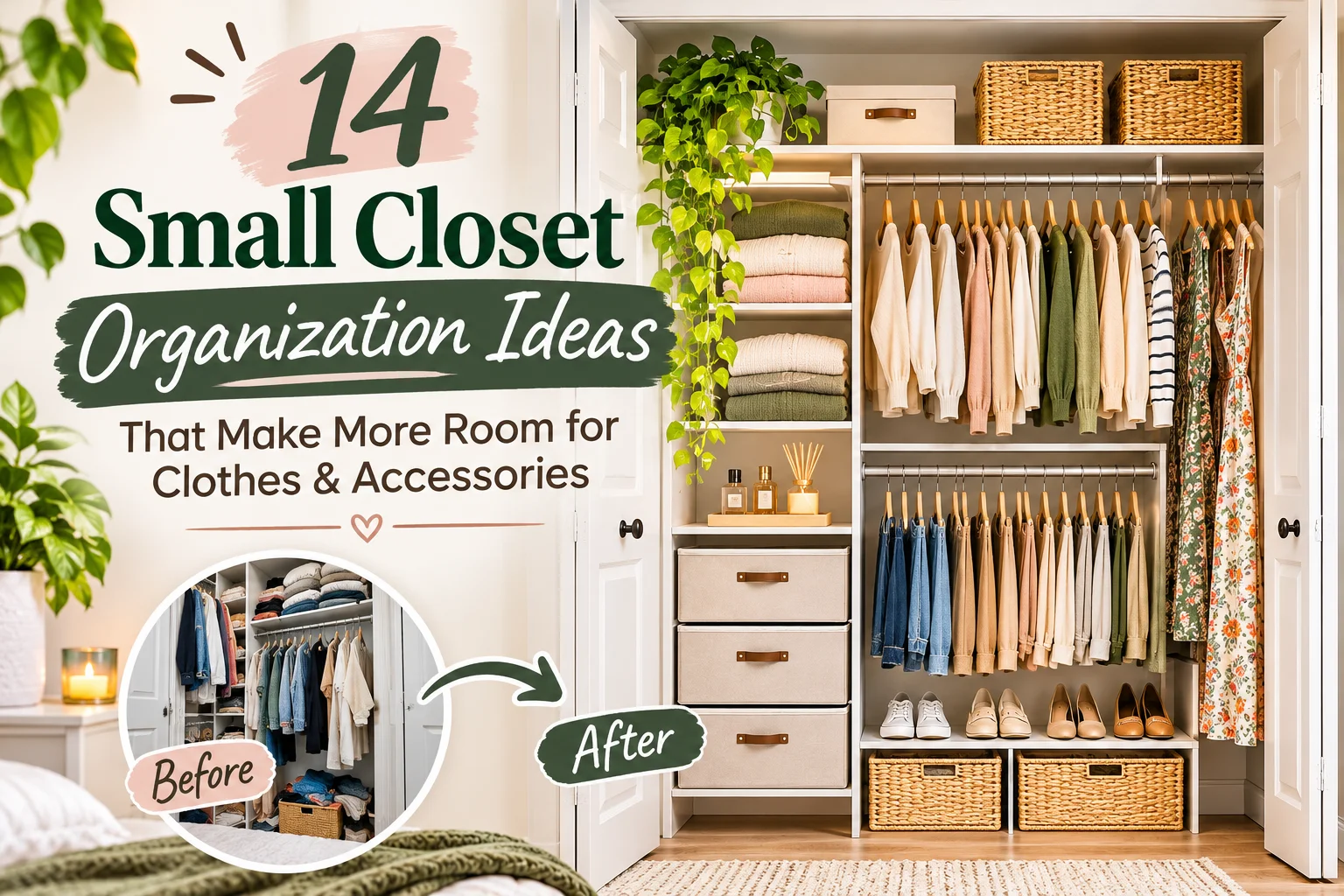
14 Small Closet Organization Ideas That Make More Room
Open a small closet on a bad morning and you can see the problems in two seconds. Hangers jammed so tight that the shirt you want won’t come free. A shelf stack that tips over when you pull from the middle. Three pairs of shoes in the doorway, belts on the bedpost, and a watch you last saw on Tuesday.
Most small closet organization ideas fix this by adding stuff: bins, racks, and then a second round of bins. That helps up to a point. After that you own a small closet plus a pile of organizers.
This guide goes the other way. It splits the closet into zones: hanging, folded, shoes, small accessories, and a top-shelf zone for things you rarely touch. The 14 ideas below show how to fit those zones into the closet you already have. They run from tiny closet organization ideas for a three-foot-wide reach-in to fixes for a rental where you can’t drill into the wall. Some cost nothing at all.
To organize a small closet, sort your clothes into everyday, occasional, and seasonal groups, then give each group its own zone. The fastest way to maximize small closet space is to add a second hanging level under shorter clothes, move rarely used items to the top shelf, use the door and floor for accessories and shoes, and measure before you buy any organizer. The things you wear most should be the easiest to reach.
Small Closet Organization Ideas That Make Better Use of Every Inch
Nobody needs all 14. Read through them and pick the ones that match what is actually wrong with your closet.
1. Create Two Hanging Levels for Shorter Clothes

A single rod wastes the air under your shirts. Rods usually sit at around 65 inches, so anything shorter than a dress leaves a gap you could park a laundry basket in.
A double-hang closet uses two rods to make room for shorter clothes. A common starting layout places the lower rod around 40–42 inches from the floor and the upper rod around 80–82 inches, with a shelf above if ceiling height allows. These are planning guidelines, not fixed measurements. Before installing either rod, measure your longest shirts and jackets, check the available height, and make sure you can comfortably reach the upper clothes.
Before you buy a rod, measure your longest shirt. A 34-inch shirt clears a 42-inch lower rod, and a tunic may not. Then count your long pieces, because they need their own space (idea 2). In a narrow closet, a common split is double hang on one side and a single long rod on the other.
If you rent, a hanging add-on rod that hooks over the existing rod gives you a second level with no drilling. Check the weight rating on the packaging, and keep heavy coats on the main rod.
Put painter’s tape on the wall at 42 and 84 inches before you buy anything. You’ll see right away whether your clothes clear it.
2. Give Long Clothes Their Own Hanging Space
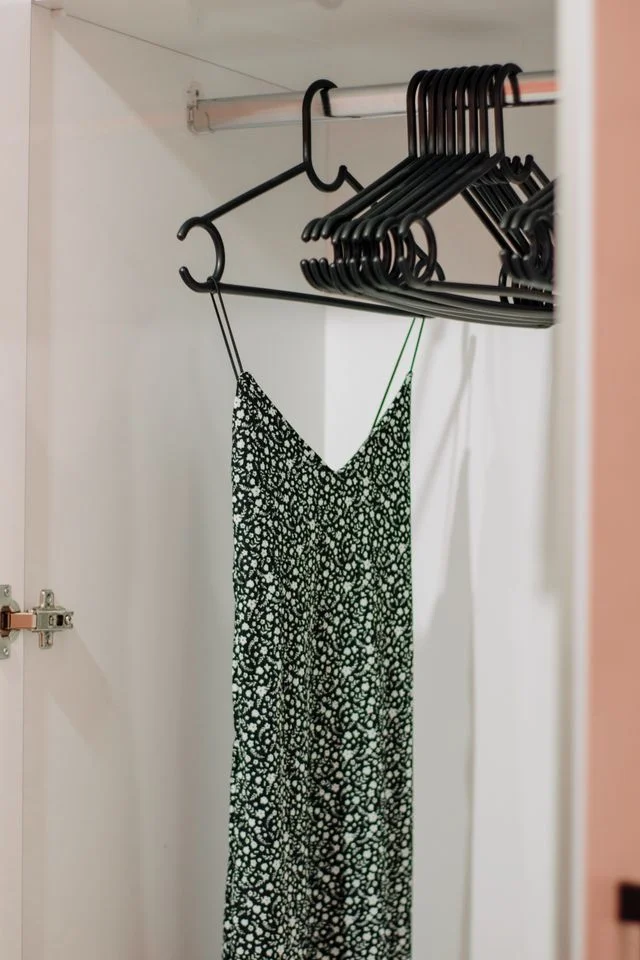
Dresses and long coats are the reason double hang fails in a mixed closet. They drag across everything beside them, and you end up leaving gaps to keep them from bunching. Give them one section and the gaps stay in one place.
Here is how to size it:
- ✓
Lay your dresses and long coats on the bed with the hangers side by side.
- ✓
Measure the width they take up.
- ✓
Give them that much rod, at one end of the closet, not the middle. The double-hang area then stays one clean block.
The floor under long clothes can hold shoes, a low basket, or a small rack, as long as the hems clear the top of it. If a hem touches the storage, shorten the storage or leave the floor empty. A dress that brushes a basket every morning wears out at the hem.
3. Use Slim Hangers to Free Up Hanging Room
Bulky plastic and wooden hangers take more rod width than the clothes need. Matching slim hangers are the cheapest way to gain room, and the rod looks calmer too.
You don’t have to replace every hanger. Start with T-shirts, button-up shirts, and trousers, since you own the most of those. Keep proper shaped hangers for blazers and structured coats so the shoulders hold, and padded ones for silk and delicate tops. Fold knitwear instead of hanging it, because hanging stretches the shoulders over time. Toss the wire hangers from the dry cleaner. They bend and leave points in the shoulders.
4. Turn the Upper Shelf Into a Seasonal Storage Zone
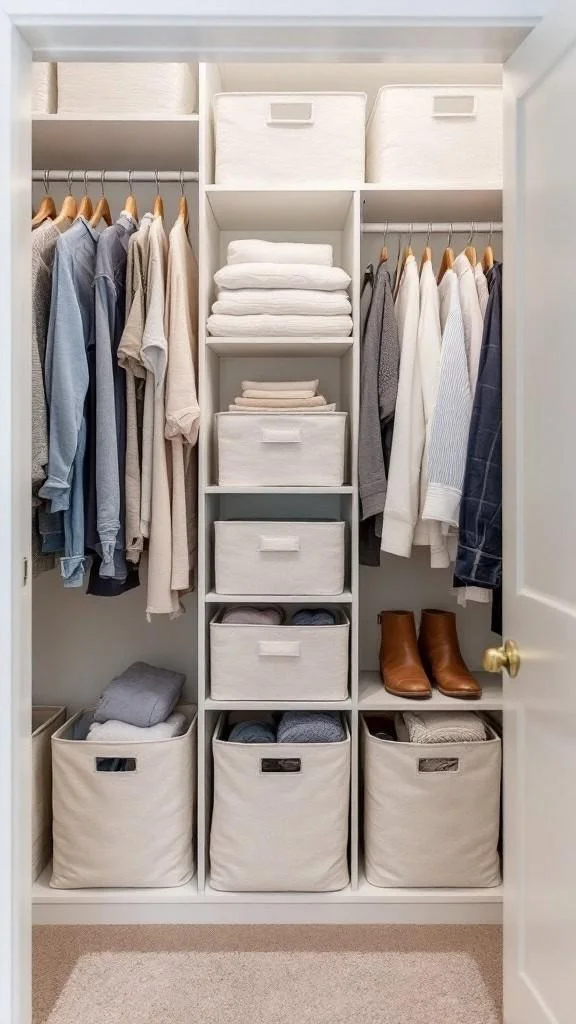
The shelf above the rod usually sits at about 84 inches, which is too high to reach without a step stool. That makes it a poor spot for daily clothes and a good one for things you use a few times a year: spare bedding, a suitcase, special-occasion bags, hats, and gift wrap.
Group them in boxes of the same size, with the label facing out. Lidded boxes keep dust off, and fabric bins with handles slide forward more easily. Keep each box light enough to lift down with one hand while the other hand holds the stool.
Shelf depth matters here. A shelf that is at least 12 to 16 inches deep takes most standard bins. On a shallower shelf, pick bins that match the depth, so nothing overhangs the edge and gets knocked off when the door closes.
5. Arrange Folded Clothes So You Can See Everything
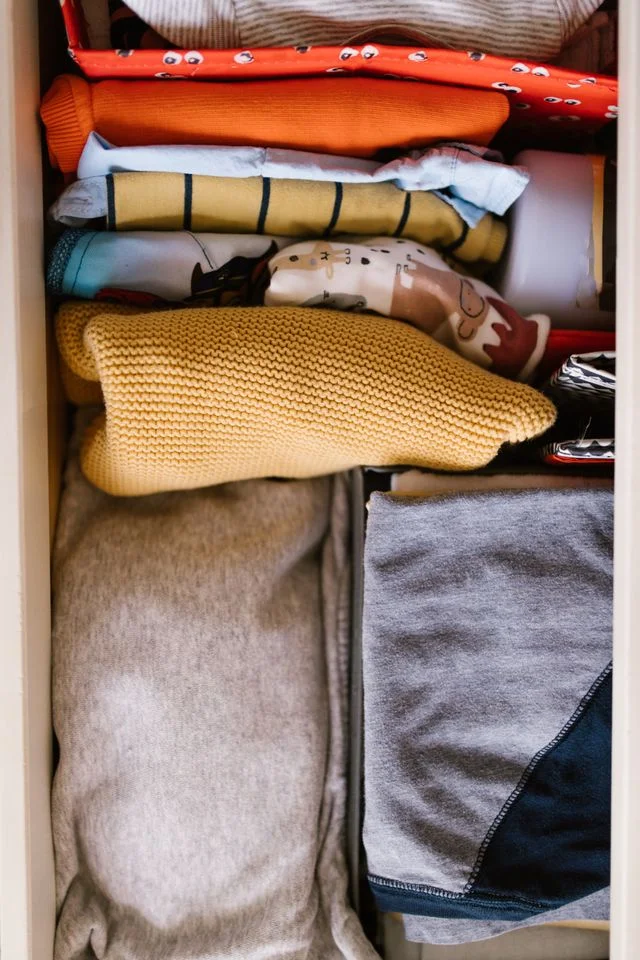
A stack of folded sweaters has one visible sweater. The rest are guesses.
Fold T-shirts, leggings, and jeans into small rectangles and stand them on their edge in rows, the way files sit in a drawer. From above you can see every piece, and you can pull one out without touching the others. On open shelves, about 12 inches between shelves is a common spacing. As a rule of thumb, that height fits a stack of four or five items before the top one brushes the shelf above.
Dividers or a few boxes cut a shelf into sections, so a collapsed stack stays in its own lane. Choose bins that fit the shelf’s depth exactly. A bin that is too deep hides what is at the back, and those are the clothes you stop wearing.
6. Make Use of the Space Beneath Hanging Clothes
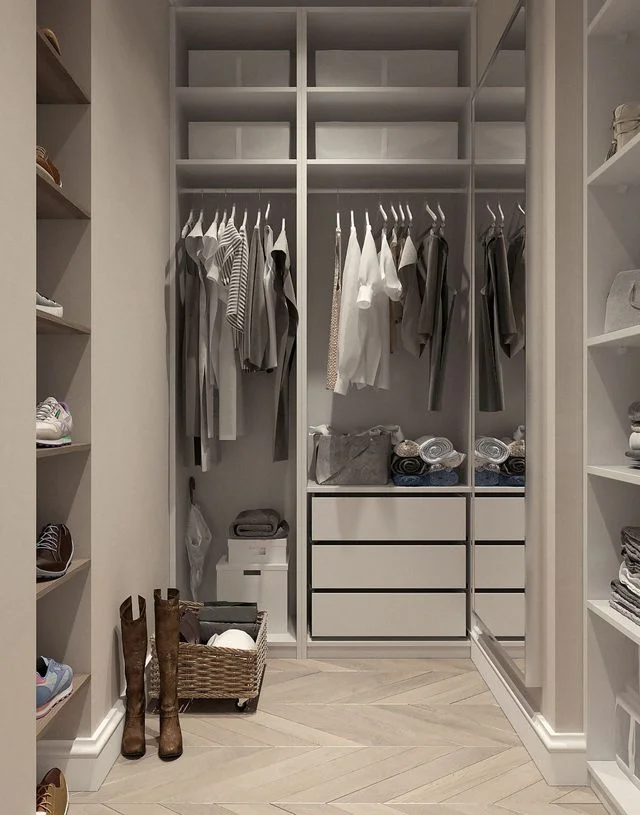
If all your hanging clothes are short and you kept a single rod, the space under them is wasted. A low drawer unit, a set of baskets, or a shoe rack can fill it.
This idea and idea 1 fight over the same space, so pick one for each section of the rod:
- ✓
Double hang turns that space into more hanging clothes. It suits a wardrobe of mostly shirts, blouses, and trousers.
- ✓
A low unit turns it into folded clothes and shoes. It suits a wardrobe heavy on knitwear, jeans, and gym clothes.
Measure from the floor to the hem of your longest hanging piece and subtract a few inches. That is the tallest unit you can use. Choose one with open fronts or easy handles that you can reach with the clothes hanging above it. A drawer that won’t open all the way is just a shelf you can’t use.
7. Organize Shoes According to How Often You Wear Them

Most closets store all shoes the same way, which is why your daily pair ends up under the ones you wore once. Sort by use instead. Everyday pairs get the easy spot, either the floor at the front or the lowest shelf. Occasional pairs go on a higher shelf or in a box under the bed. Seasonal pairs, like winter boots, go with the rest of the off-season items.
The right setup depends on your floor. These small closet shoe organization ideas cover the common cases:
- ✓
Narrow floor: A slim two-tier rack or an angled shelf holds more pairs in less width. Keep it one pair deep so nothing hides behind something else.
- ✓
Deeper closet: A shoe shelf around 12–14 inches deep works for many everyday pairs, but measure your largest shoes before choosing a rack. Adjustable shelves are useful because flats and low sneakers need less height than heels, high-top sneakers, or boots. Keep your most frequently worn pairs on the lowest accessible shelf.
- ✓
Boots: They flop over alone. A boot shaper, or a rolled sheet of cardboard in each boot, keeps the shaft upright.
- ✓
Shoes that lose their shape: Leather loafers and heels do better in a box or on a shelf with a little room around them than squeezed between other pairs.
If your everyday shoes tend to collect near the front door instead, these small entryway ideas include compact storage options that keep shoes accessible without crowding the entrance.
8. Store Handbags Upright Instead of Stacking Them

Stacked bags crush the ones at the bottom. Bags standing on a shelf keep their shape, and you can see each one at a glance.
Stuff soft bags with tissue paper or a small towel and stand them in a row with the opening facing you. For floppy styles, a bookend or shelf divider on each side stops them from slumping onto the next bag. Keep everyday bags at the front or on the lowest shelf, and special-occasion bags at the back or higher up.
Leave a little gap between bags, roughly a hand’s width. A packed row looks neat for a day, then one bag comes out and the whole row leans over.
9. Create One Dedicated Zone for Small Accessories

Small accessories spread because nothing gives them a home. Belts end up on the bed, scarves in a drawer, and watches on the dresser. Choose one zone and move all of it there. Where it goes depends on the closet:
- ✓
Inside the door: Belts, scarves, and hats hang well here.
- ✓
A short stretch of wall: A rail with a few hooks takes belts, a daily bag, and a tote.
- ✓
A drawer or tray: Jewelry and watches scratch and tangle when they hang, so they do better flat.
If you have a drawer, put jewelry and watches in it and hang the rest on the door. If you have no drawer, a shallow tray on a shelf is enough. The goal is simple: when you want a belt, you know where it is.
Count your accessories before you shop. Twelve belts need a rail. Three belts need one hook.
10. Use the Closet Door Without Making It Look Cluttered

The inside of the door is free storage, but only if the door still closes. Before you buy anything, check three things: the gap between the door and the nearest shelf or rod, how far the door swings open, and whether the hinge side has room for hooks. Even a slim organizer adds an inch or more, and a door that hits a shelf edge will chip paint and jam.
Stick to light items you reach for often, like scarves, belts, a few hats, or a pocket organizer for small things. Keep it to one column or one row. Once a door has three kinds of storage on it, it looks busy every time you open the closet.
Sliding and bifold doors work differently. Over-door hooks won’t fit over them, and anything on the inner face can catch on the track. In a small sliding door closet, use the side wall or a shelf for accessories, and use the door itself only if the track clears.
11. Make Awkward Corners and Narrow Gaps Useful

Every small closet has a spot nobody uses: a narrow gap beside the shelves, a corner behind the door swing, or a few inches beside the rod. Some of these are worth using, and some are traps.
Worth using:
- ✓
A gap just wide enough for a slim rolling cart, which holds ties, belts, or small bags and pulls out when you need it.
- ✓
A few hooks on a side wall, for tomorrow’s outfit or a tote.
- ✓
In a small corner closet, a compact shelf above the rod for light things like folded scarves.
Leave empty or nearly empty:
- ✓
A deep corner you can’t reach without moving three other things. It collects items you forget you own.
- ✓
The space behind the door swing, which is the same problem.
If you can’t get to a spot with the door open and the closet in daily use, keep one item there that you rarely need, such as a suitcase, or leave it empty.
12. Keep Everyday Outfits Within Easy Reach

Most people wear the same 10 to 15 pieces most weeks. Those should not live at the back of the rod or on the top shelf. Pull them into one section at the front, between knee and shoulder height, where you can grab and rehang in seconds.
Group by how you dress: workwear in one block, weekend clothes in another, gym clothes in a basket or on a low shelf. When you open the door, the first thing you see is what you actually wear. That cuts the time spent flipping through hangers, and it works in a closet you can’t change at all. You can test it in one evening.
13. Rotate Seasonal Clothes to Reduce Crowding

A small closet doesn’t need to hold every season’s wardrobe at once. When the weather changes, move clothes you won’t use for the coming season into clean, dry storage. In climates with clear summer and winter wardrobes, twice-yearly rotation may be enough. In places with more frequent temperature changes, review your clothes more often.
Wash or dry-clean each piece. Body oils and small stains that don’t show now can set and discolor over a few months.
Fold the clothes into breathable containers such as fabric bins or cotton storage bags. Sealing damp clothes in plastic traps moisture and can cause mildew.
Under the bed, a spare-room shelf, or a suitcase all work.
Label each box with its contents and the season, so you don’t open four boxes to find one scarf.
Swap at the change of season, and donate anything you didn’t wear.
14. Choose Adjustable Storage for a Closet That Needs to Change
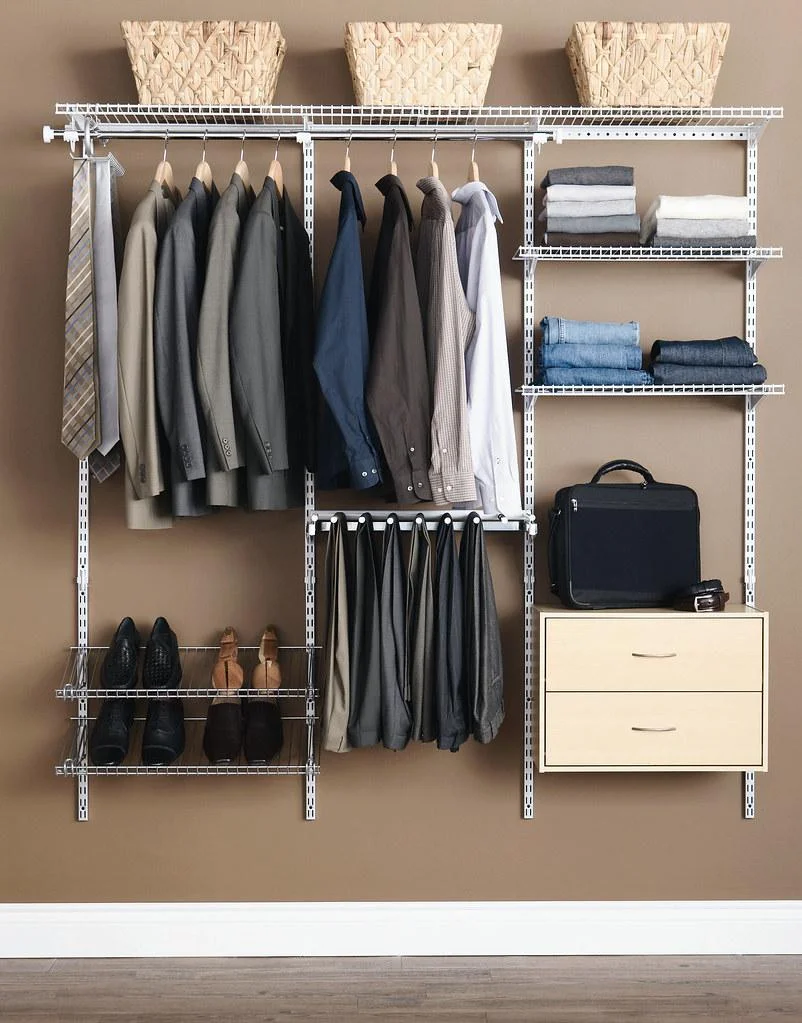
Your wardrobe changes. You buy more jeans, give away a coat, or start a job that needs more dresses. A fixed organizer built around last year’s clothes can become this year’s problem.
Adjustable storage lets you move parts instead of replacing them: shelves that slide along a track, rods you can raise or lower, and modular units where you add or remove pieces. IKEA’s PAX system is one example of modular wardrobe storage. You can choose compatible frames, shelves, rails, and drawers to suit your wardrobe, while ready-made combinations are also available. Check the available dimensions, assembly requirements, and wall-anchoring instructions before choosing a configuration.
Wire shelving, common in small walk-ins and rentals, already adjusts along its track. Lay a thin board or a liner over it so small items and folded clothes don’t tip through the gaps.
Before you buy anything adjustable, measure the closet’s width, depth, and height, and note where the door opens. A flexible system only helps if it fits first.
Safety note: Adjustable doesn’t always mean freestanding or renter-safe. Tall wardrobes, drawer units, and shelving systems may need to be securely anchored to the wall. Check the manufacturer’s installation instructions, required clearances, and weight limits before buying. If drilling isn’t allowed in your rental, choose a storage solution specifically designed to be used safely without wall mounting.
Small Closet Layout Ideas: How to Organize Different Types of Small Closets
The 14 ideas work alone, but most closets need several together. These closet organization ideas for small spaces combine differently in five common layouts.
Organizing a Small Reach-In Closet in a Bedroom
A standard reach-in is about 24 inches deep, which is enough for hangers to clear the back wall. Start by splitting the width into two. Put double hang on one side if your clothes are short, and use the other side for shelves or a drawer unit. If you own long clothes, give them a rod section next to the shelves.
Shoes go on the floor under the long section, the upper shelf holds occasional items, and the door holds accessories if the clearance allows. For a small bedroom closet, this one split handles clothes, shoes, and accessories without any new furniture.
When your bedroom has little room for extra furniture, our small-space living ideas explain how to plan storage and furniture placement without overcrowding the room.
Making a Shallow Closet More Functional
A closet under about 22 inches deep can’t hold standard hangers facing the door. The usual fix is a rod on the side wall, so the hangers face the opening. That has a catch: the rod can only be as long as the closet is deep, so it holds just a handful of hangers. Plan on hooks and folded storage for the rest.
Keep storage depth in line with the closet. Skip bulky bins, use slim hangers, and put daily items at the front. In a shallow closet, one deep container can block the whole row behind it.
Small Walk-In Closet Organization Ideas That Use Every Wall
A walk-in only beats a reach-in if you hang clothes on at least two walls. Hanging needs about 24 inches of depth, and most guides call 36 inches the comfortable minimum for the aisle. A few accept 24 to 30 inches in a very tight space. Your width decides the layout:
- ✓
About 5 feet wide: One wall carries the hanging (24 inches) and the aisle takes the rest (36 inches). Use the end wall for hooks and shelves, and the floor under the rod for shoes.
- ✓
About 6 to 7 feet wide: You can hang on both long walls with an aisle of roughly 24 to 36 inches between them. The closer you get to 36, the easier it is to turn around and open a drawer.
- ✓
L-shaped: Hang on the two long walls and use the corner for a stack of shelves, since a rod can’t use a corner well.
In a tiny walk-in, treat it as a reach-in you can step into. Skip the shelves along the aisle, and use the back wall for a rod and one shelf above.
Shelves for shoes and small items should be about 12 inches deep, and shelves for general storage 14 to 16 inches. Anything deeper just shrinks the aisle. A small master closet often has to hold two people, so see the shared closet section below.
Wire shelves are common here, and they cause two problems. Small items tip through them, and soft folded knits can pick up ridge marks. A thin board or a shelf liner solves both. If you want budget DIY small walk-in closet organization ideas, a tension rod for a second hanging level, a few hooks, and an over-the-door shoe pocket cover most needs.
Organizing a Small Closet Shared by Two People
These small closet organization ideas for couples start with one rule: don’t split the closet by an even half. Split it by need. If one person owns more dresses and long coats, that person gets the long-hang section. If the other owns mostly shirts and trousers, give them double hang.
As a starting point, allow about three feet of hanging rod per person when the space permits, then adjust based on your actual clothing. Someone with mostly folded clothes may need considerably less, while a wardrobe of coats, dresses, and jackets may require more. Count your hangers before deciding how to divide the rod.
What to Do When Your Bedroom Has No Built-In Closet
A bedroom with no closet needs furniture that does the closet’s job. A freestanding wardrobe hides everything behind doors. A garment rack gives hanging space for less money, but it looks busy. A dresser holds folded clothes.
If you’re working with a rental bedroom, these apartment bedroom decor ideas also cover practical furniture choices and renter-friendly ways to make the room feel more finished.
A good combination is a rack for daily clothes and a wardrobe or dresser for the rest. Put the rack on the longest uninterrupted wall and keep it clear of the door swing and the window. When you shop for a wardrobe, check the depth first.
Many are around 23 inches deep, like IKEA’s PAX frames, which is just enough for standard hangers. An open closet in a bedroom works best when it holds only what you wear regularly. Keep the rest in drawers or lidded boxes under the bed.
How to Organize a Small Closet From Scratch
Most people buy organizers first and measure later. That is how you end up with a basket that is two inches too wide. This order avoids it.
Take everything out, including the shoes. You can’t judge a closet while it is full, and you will find things you forgot you owned. Anything you haven’t worn in a year, or that no longer fits, goes in a donate bag now.
Make three piles on the bed. Everyday clothes go back first and get the best spots. The other two go higher or farther back.
Shirts, blouses, dresses, and trousers hang well. Knitwear, T-shirts, jeans, and gym clothes fold well. Hanging more than you need uses rod space on pieces that would be fine in a drawer.
Write the numbers on your phone. HGTV’s closet measuring tips show what to measure and where.
Look at the empty closet and the piles. Maybe the shoes have no spot, or the shelf is too high to use, or there is empty air under the shirts. Write each problem down.
Match each problem to one fix and one measurement. If you can’t name the problem a product solves, don’t buy it yet.
Put daily clothes and shoes at eye and hand level, occasional items higher, and seasonal items highest or out of the closet.
Small Closet Organization Ideas on a Budget (DIY and Rental-Friendly)
You can improve a small closet at three spending levels. Start with the free changes. Many closets need nothing else.
- ✓
No-cost improvements. Remove clothes you don’t wear, group similar pieces, and move everyday clothes to the front. For DIY small closet organization ideas, cut cardboard from a shipping box into shelf dividers, or use shoe boxes as drawer sorters. It takes an afternoon, and it shows you what you actually need before you spend anything.
- ✓
Low-cost improvements. Add a few slim hangers, a set of hooks, a couple of small baskets, or simple shelf dividers, but only where they fix a problem you found in step 5 above. A few well-placed hooks do more than a cart of baskets.
- ✓
Larger improvements. A second hanging rod, adjustable shelving, or a compact drawer unit makes sense when the layout is the problem and rearranging hasn’t helped. Measure first, and pick pieces that can move with you.
If you rent, keep the changes removable. A hanging add-on rod, tension rods, adhesive hooks rated for the weight you plan to hang, and freestanding units give you small closet organization ideas for a rental that never touch the walls. Check your lease before you drill anything, and take a photo of the closet before you start.
Buying more organizers does not automatically create more space. A closet has a fixed volume, and every bin takes some of it. The best budget fix is often fewer things in the closet, not more containers around them.
Live with the new layout for two weeks before you buy anything. Whatever still bothers you after that is worth spending money on.
How to Keep a Small Closet Organized
The easiest closet system is one you can maintain without reorganizing everything each month.
Once a week, spend five minutes returning shoes, bags, and clothes to their assigned spots. Rehang clean clothing, put folded items back in their drawers or bins, and clear anything that has collected on the floor.
Once a month, check for overcrowded shelves, hangers that no longer slide freely, and accessories you haven’t put away properly. If one zone keeps becoming messy, change the storage arrangement rather than buying another organizer.
Review seasonal clothing whenever the weather or your daily routine changes. Keep the things you use most in the easiest spots, and move occasional items out of the way.
How to Make a Small Closet Look Neater and Less Cluttered
A tidy closet and a calm-looking closet are not always the same thing. If your saved small closet inspo is all white walk-ins with glass shelves, borrow the parts that scale down. This is the part of a small closet makeover that most guides skip, and it is where the small closet aesthetic comes from.
Matching hangers where they show. A rod of mixed hangers looks noisy even when the clothes are sorted. You don’t have to replace them all. Start with the front section of the rod, which you see first.
Open shelves with room to breathe. A shelf packed edge to edge looks heavy and is hard to use. Leave a few inches empty on each one. That gap also stops you from stuffing in one more thing.
Baskets and boxes that suit the bedroom. Choose two or three materials, such as woven baskets, fabric bins, or plain white boxes, and use them throughout. If the bedroom has warm wood and linen, natural fibers will look right. If it is white and gray, plain boxes will blend in.
Fewer colors, labels, and mismatched containers. Five container styles in one closet look like a yard sale. Pick one label style and use it everywhere, or skip labels where the contents are obvious.
A little empty space. A closet filled to the last inch looks stressful and is slow to use. Free space on the rod and a spare shelf spot make the closet look calmer, and they give you room to add things without a full reshuffle.
Light where you need it. A dark closet looks smaller and hides what you own. A battery-powered stick-on light or a motion-sensor strip works in a rental, needs no wiring, and makes a visible difference.
For a more coordinated look beyond the closet, these minimalist home decor ideas show how to use natural textures, practical storage, and a little empty space to make a room feel calmer.
Small Closet Trends for 2026
Two trends from this year’s design coverage fit small closets well.
Storage that adapts. Coverage of KBIS 2026 points to modular parts, replaceable inserts, and adjustable frames, so closets can change as a household does. Woodworking Network’s KBIS report describes this shift, and it matches idea 14 above. In a small closet, it means buying a few adjustable pieces rather than fixed units sized for today’s wardrobe.
Natural materials. House Digest names biophilic design as a 2026 direction that reaches into closet organization. On a budget, that looks like woven baskets, wood hangers where they show, and natural fabric bins in place of clear plastic. It also works with the matching-materials advice in the section above.
Common Small Closet Organization Mistakes to Avoid
These mistakes can undo an otherwise good setup.
Buying organizers before measuring. A bin half an inch too wide won’t fit the shelf, and returns are a hassle. Measure first, buy second.
Using deep containers that hide or trap clothing. Everything under the top layer of a deep bin disappears. If you can’t see it, you won’t wear it. Use shallow bins or stand items on their edge.
Filling every shelf and rod to capacity. A full closet has no room for the next purchase, so the next purchase becomes a pile on the chair. Leave a little slack.
Storing frequently used clothes in hard-to-reach places. If you need a stool for your jeans, they will end up on the floor. Daily clothes belong at the middle height. The top shelf is for things you use a few times a year.
Keeping seasonal items in the most accessible areas. Winter coats in July take the best spot in the closet. Move them out when the season ends.
Adding too many organizers. Once a closet has six different systems, it takes work to understand them. One or two that solve real problems beat a dozen that each solve a little.
Small Coat, Hall, Linen, and Pantry Closets: Quick Fixes
Most of this guide is about bedroom clothing closets, but many people search for small closet organization ideas for other closets too. The same approach works: sort by how often you use things, measure first, and keep daily items at the front.
Small coat and hall closets. These fill fast because everyone in the house uses them. Give each person one hook or one section of the rod, and put out-of-season coats and boots on the top shelf. In a narrow hall closet or hallway closet, a slim over-door organizer holds gloves, hats, and scarves without taking any floor space.
Small linen closets and bathroom closets. A small linen closet works best when you sort by room: bath towels together, bedding together, and each sheet set folded inside its own pillowcase so the set stays together. Put daily items at hand level and spares on the top shelf. In a small bathroom closet, shallow baskets stop small items from sliding to the back.
Small pantry closets. Use shelf risers or tiered racks so you can see cans and jars from the front, and group food by type. Everyday cooking items go at eye level, and bulk items go on the floor or the top shelf.
Final Thoughts
A good small closet is not the one that holds the most. It is the one where clothes, shoes, and accessories each have a sensible place, and the things you wear every day are easy to reach.
You don’t need to do all 14 ideas. Start with the part of your closet that frustrates you most, whether that is the crowded rod, the pile on the shelf, or the floor of shoes. Fix that, live with it for a week, and then decide what to do next. These small closet organization ideas work because each one solves a specific problem, so pick the problem first.